Tuesday, July 13, 2010

Castles of Rome

I don't know it just seems to me that that rather literal translation of Castelli Romani just doesn't say it! In fact I'm not sure there is a translation that would do the region justice.

Right on our door step - this Sunday's jaunt to Ariccia took 45 minutes, okay according to TomTom (the GPS system) it should have only taken 33 but then good old Tom doesn't always take into consideration that a whole lot of Romans are leaving the heat of the city on a Sunday morning. But the point is that within an hour's drive of the apartment there are wonderful towns to head to for a look-around, a meal - often a local specialty, a nice regional wine and a pleasant stroll.

The area is built on the remnants of a volcano which means the ground is fertile and it's been an agricultural area since people first settled in the area. Two of the craters form lakes - Albano and Nemi - which are a source of recreation for modern Romans as well as natural reservoirs for the surrounding communities.

The great Roman families of the Renaissance built summer palaces on the volcanic slopes of the area to escape the summer heat, stench and malaria of the swampy crowded city and enjoy the cool breezes of the hillsides. And of course the farms and forests around them provided produce, poultry, meat and game for their tables.

Ariccia was the summer stronghold of the Chigi papacy and the Palazzo - renovated to designs by Gian Lorenzo Bernini for Alexander VII - was the summer home of the Chigi famly until they turned it over to the city in 1988. The Piazza and Chiesa di Santa Maria Assunta in front of the Palazzo was also designed by the great Neapolitan born creator of much of what we see in Rome today.
Palazzo and Chiesa face each other across what once was a piazza and is now the main road into town. The fountains are capped with the familiar Chigi family crest. Bernini's church was modeled on the Pantheon. He had been instructed by Alexander to make it a "Pantheon Marian". The colonnades on either side, which once housed Papal offices, are now a bar and trattoria.


Behind the main altar is a fresco of the event that gives the church its name: the Assumption of the Virgin as painted by Jacques Cortois a Burgundian artist. The main decoration is the stucco work by Bernini's faithful disciple Antonio Raggi that adorns the dome. He also created the striking Evangelists stucco work for Bernini at San Tomaso di Villanova in Castel Gandolfo. And just in case there is any doubt who paid for the building of the church - there's that familiar Chigi crest again.

Church has always been theatre but in this case a church on Ariccia's Corso Garibaldi has been turned into a theatre. Town centre was almost empty on Sunday afternoon - but I discovered all the action was the other side of the Piazza - mind you it was kind of nice to have the place almost to ourselves. In the hot summer sun that bougainvillea was almost blinding in its intensity.

And it seems that each town in Castelli has its own specialties - food or wines. Frascati and Velettri are known for their wines; Nemi as I mentioned a few weeks ago is the strawberry capital of the region; and Ariccia is the home of porchetta. In the Piazza alone there are three take-aways serving only this local specialty. A boneless pork loin is rolled, stuff with herbs and slow roasted over a wood fire. Then it is sliced and served - most often cold - with various simple additions. Porcine heaven!
Corso Garibaldi ends at a belvedere overlooking the fertile farm lands of the region and it was there that we settled in for lunch at Spazio Art'è, an enoteca that was featured, so the owners proudly showed us, in a recent edition of La Cucina Italiana. The service was friendly and when I mentioned I had to be gluten-free they sprang into action showing what I could and couldn't have. So my anti-pasti was a sauted mixture of zucchini, arugula and ciccoria (chickory); followed by - what else? - Porchetta. The large plate of roast pork, enough that I took some home for dinner the next night, was served with prunes, pine nuts and a drizzle of balsamic reduction. Dolci was a tangy lemon semi-fredo which was a refreshing end to a very satisfying lunch. The meal was washed down with a very nice white "Vertus" from the region.

Though it would be nice to go back and see a bit more of the Palazzo - we took an hour long guided tour of the main rooms of the Piano Nobile, many of which were used by Lucchino Visconti in The Leopard. There were a few other areas that we had left unexplored and look definitely worth the visit. And another plate of porchetta wouldn't be so bad either.

13 luglio - San Dario
Enhanced by Zemanta

Monday, July 12, 2010

Lunedi Lunacy

My friend Cathy - who sort of acts as a talent scout for this sort of thing - sent this one to me. It worth slogging through the first minute of typical French television verbosity to get to the act.


They remind me of an act I recall from the old Ed Sullivan show - the Nitwits. Unfortunately the only clips of them I found were not great quality but you might want to take a look at:

Hollywood Palace - Petulia Clark

or

Hollywood Palace - Jack Benny

Though the act may be considered in many ways politically incorrect today, it was the sort of thing that made us laugh back then. Pagagnini follows the tradition to prove once more that everything old is new again!

12 luglio - San Giovanni Gualberto Visdomini

Sunday, July 11, 2010

A Loving Father

Though the Palazzo Chigi in Ariccia is filled with many wonders, I think the most wonderful is this simple painting by Gian Lorenzo Bernini. And the subject is not all that common - the normal devotional painting is Madonna with Child but here the infant Christ is held by his Earthly father San Giuseppe (Saint Joseph).


It was executed in 1623 for the chapel of the Palazzo and is one of Bernini's rare paintings. And it is the only known work actually signed by the artist. All religious significance aside I find it an incredible vision of paternal love.

11 lulgio - San Benedetto da Norcia


Enhanced by Zemanta

Saturday, July 10, 2010

40 Years in 3 Minutes

I've never been a big Billy Joel fan and though I remember his "We Didn't Start the Fire" I must admit I've never paid much attention to the lyrics.

Well it appears a very talented chap from University of Chicago with a lot of spare time, Google and curiosity was able to create a video that gives visual sense to that string of names and events in Joel's song.


Apparently Joel meant it as an homage to 40 years of news events since his birth in 1949. It has been said that some teachers use it in schools as a teaching aid for history.

Take a look it really is fascinating:

We Didn't Start the Fire


And according to someone out there if you are 65 or over and lived in North America you should remember 90% of the events - I think I clocked in at about 95% so that must make me around 70!

Many thanks to Elaine for sending me the link.

10 luglio - San Silvano

Thursday, July 08, 2010

Trans Atlantic Caricature


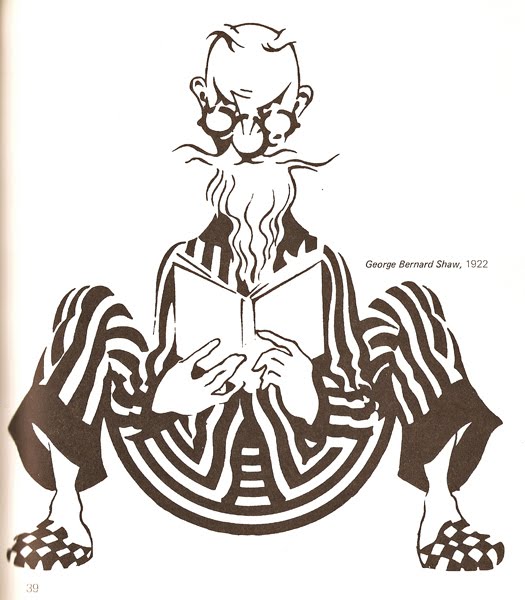
When I was writing about Al Hirschfeld last week I remembered a slender little book I had picked up many years ago on one of my - what was in those days - frequent trips to London. Einar Nerman - or simply as he was know Nerman - was a Swedish artist who in 1921 moved to London at the suggestion of playwright/composer/actor/producer Ivor Novello. For the next 19 years he chronicled the theatrical and social scene in London mostly working for The Tatler, a weekly society and gossip magazine and Eve - a weekly look at things classical in the music world.


I think this has to be my favorite drawing of one of my favorite playwrights. Nerman catches George Bernard Shaw at his most curmudgeonly and cocking a snood at the world as he poses in his pajamas and comfortable slippers.

Many of the West End stars of those days were well-known on both sides of the Atlantic. Stars such as John Gielgud caught here as Hamlet - you can almost see those Gielgudian nostrils quivering as he delivers "To be or not to be?" Others were well-loved but only known in the UK like Maisie Gay, a revue comedienne who retired to the Wiltshires due to ill health and ran a pub until her death in 1945.

"Continental" artistes made the trip across the Channel to do their turns at variety houses or give "seasons" in French or Italian plays at West End theatres. Maurice Chevalier was a great London favourite and Nerman catches that Gallic charm in full force. And he captures Yvette Guilbert in all her stillness with those long black gloves dominating the drawing as they did when she sang on stage.

Cléo de Mérode was a great beauty of the Belle Epoque and a fine ballet dancer whose career was sadly overshadowed by a reported affair with King Leopold II of Belgium. Her appearance in the Tatler probably had more to do with the later than the former. Also amongst his "society" subjects were The Windsors - I'm sure that Mrs Simpson was less than pleased with Nerman's view of her and her ex-King.

During World War II Nerman and his family moved to the US and he found work with the Journal-American, one of the many New York newspapers of the day. His Hollywood portraits included a rough and tumble - but oddly feline - Clark Gable and an incandescent fellow-Swede Ingrid Bergman.

Nerman was equally at home drawing portraits of classical music performers as here where he treats two fellow Swedes to his slightly satirical pen. Jussi Bjoerling is still considered by many (myself included) to be the greatest tenor of the late 20th century. Unfortunately Bjoerling was often paired with divas who were a head taller than him and even his platform heels can't bring him up to Grace Moore's chin. Fun loving in real life Birgit Nilsson was an intense interpreter of Wagner and Strauss - Nerman was 82 when he penned this drawing of the great soprano as Strauss's Electra.


There is such a wealth of wonderful portraiture in this now out-of-print little book and over the next while I may publish one of two more things of this neglected but, to my mind at least, brilliant caricaturists.

08 luglio - Santa Priscilla

Enhanced by Zemanta


Wednesday, July 07, 2010

Mercoledi Musicale

I was looking for something on YouTube the other day and as so often happens came across another clip that led me to all sorts of distractions.

Though she suggested that the title be passed on to some Welsh Popera singer there will only be one "Forces Sweetheart" - Dame Vera Lynn.


Still an active 93 Dame Vera was one of the people instrumental in having the Beast of Battle Memorial created. And she also topped the chart recently with a reissue of her greatest hits - an album that reached gold three weeks after it was released in 2009.

Here she is in an interview on September 3, 2009 - and she has a little surprise at the end.


7 lulgio - Santi Claudio, Illaria, Giasone e Mauro
Enhanced by Zemanta

Monday, July 05, 2010

Help - We'll Listen

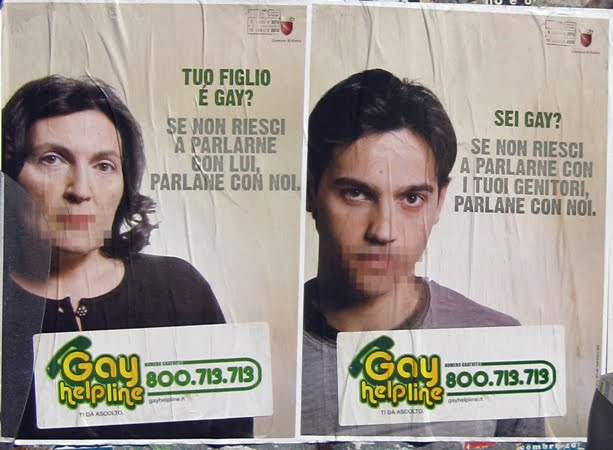
I was both surprised and pleased to see these posters on the wall of a school that's on my route to work. Though regular school is out there are summer classes going on. Its all part of a new campaign by the GayHelpLine here in Italy.

This set of posters addresses communication between parents and gay children. The HelpLine makes the point that it is there for either parents who know their children are gay but can't talk to them about it or the gay person who can't talk to their parents. If you can't talk to them then talk to us.

The campaign also has a video component - though I am seriously wondering what venues it will be seen on.


Still an effective piece of - particularly as it includes the father which the poster campaign doesn't. But I am happy to see that it aims at peer groups as well as the family.


And if it helps one gay man or woman then it has done its job.

05 luglio - Sant'Antonio Maria Zaccaria

Lunedi Lunacy

Sure it plays to stereotype but its still one of the funniest pieces of television around. And lets admit it for Italian content the routine is as old as Plautus.


The woman matching feet with Lucy was Theresa Tirelli (D'Amico) who was actually born in what is now known as Croatia. She was an opera singer, actress and hosted her own radio show in Los Angeles. She died in 1989 at the age of 81.

05 luglio - Sant'Antonio Maria Zaccaria

Sunday, July 04, 2010

Happy 4th

To all my American family and friends:

HAPPY INDEPENDENCE DAY!


04 lulgio - Sant'Elisabetta del Portogallo
Enhanced by Zemanta

Rome Pride 2010

This weekend - as in many cities and towns - it was Gay Pride weekend. Over the past few years - and despite some unsettling incidents - the festivities have become more open and are certainly well publicized.

The slogan for this year's Pride has been: ogni bacio una rivoluzione - each kiss a revolution.


And being Italy the political parties jump on the bandwagon peppering the town with posters. This one from the CGIL (Italian General Confederation of Labour) has been appearing around town the past week or so:

Its very inclusive: Hetero, Gay, Lesbian, Trans-gender and I am assuming the * means some of the below, all of the below or I'm undecided.

And the three words central to it all:

Freedom
Rights
Secularism

The later, not surprisingly coming from a Far-Left organization, being a not so subtle reference to freedom from the influence of the Church (Meaning of course Big Ben and the Boys in the City across the River). An interesting concept here of all places.

Happy Pride to all my friends celebrating everywhere this weekend.

04 luglio

Enhanced by Zemanta

Saturday, July 03, 2010

Language - Random Thoughts Plus a Few Photos

A few random thoughts on language and several shots of the interior of the lovely Bernini Chiesa di San Tommaso di Villanova at Castel Gandolfo taken a few weeks ago on a Sunday spent in the Castelli Romani region just outside of Rome.

The church of San Tommaso di Villanova shares Piazza Liberta with the facade of the Papal Palace. It was commissioned by Pope Alexander VII (Chigi) and built by Gian-lorenzo Bernini. Typical of Bernini it is filled with light and the stucco work by his disciple Antonio Raggi adds to an atmosphere of elegance I find often lacking in so many Baroque churches.

I've just finished one of my monthly marathon sessions of translating for the tri-lingual (French-English-Italian) Ballet magazine - Ballet2000. I'm not sure what the magazine circulation is but I know that every month I get reviews and media reports from around the world in Italian and French and turn them into, what I hope, is acceptable English. Like many of the people involved with the magazine, the publisher Alfio , his assistant Cristiano and my friend Simonette - I really must have words with her, she tricked me into this - I do it mostly for love. And for the education - I am learning much about Italian, French, English and the language of dance.

As I was struggling with a particular turn of phrase in Italian yesterday the vagaries of language were reinforced. I tried a literal translation - it didn't work; I contacted my friend Marco who played around with it but again no success. If I recall his exact words where: If you can make this into English it is a miracle. After awhile I went for the idea - and it took a fair bit of digging to find it - more than the words themselves and found I was able to convey the message even though the way of doing it was not the same. The riches of one language do not always translate freely into another but there is always a way.

The church is a cruciform with a soaring dome at the centre. I find here the stucco work that so often can become overbearing has just the right touch and the creams, whites and yellows give it a simple richness.

Conversation on the Internet:
Marco: I am going to the beach with a friend (girl) tomorrow

Me: Why do you always tell me the sex of the person you are doing things with?

Marco: Because your stupid language does not have a word for a friend who is a girl or a friend who is a boy.
He's right of course - there really is no way in English of indicating gender for words like friend and if I say "girl friend" or "boy friend" it has an entirely different meaning.

Stupid Language!


The Raggi stuccos depict the four Evangelists with their respective emblems which in the Renaissance had a layer of meanings. St. Matthew is symbolized by a winged man or angel signifying the human nature of Christ. St Mark is accompanied by a winged lion, a figure of courage and monarchy. The lion* had many meanings in the iconography of the Christianity of the period.

In innumerable conversations:

Marco (again): Will, I will tell you a thing.

I always knew he meant "something" but never corrected it because frankly it has a charm which I like and I find I am using it in conversation now to. Of course its a direct translation from the Italian: una cosa. Or the French: un chose. Again one of those interesting vagaries of language.


St Luke is shown with a bull or ox - a sacrificial beast to represent the sacrifice of Christ. While the fourth Evangelist, John, is shown with an eagle. It was thought that eagles, creatures of the air, could stare straight into the sun. At the base of each relief is the coat of arms of Alexander VII and the Chigi family. The six mountains topped by a star can be seen throughout Rome and the old Papal states - Alexander was a Pope who built - and built to be remembered.

I make no bones about the fact that I have been going to a therapist for the past six months - for all sorts of reasons that need not be gone into here - and one thing keeps popping up in our sessions : language. My ability (as poor as it is) with my own, my inability to speak other languages - reading and writing are no real problem otherwise why would I do translating???? but speaking I bumble through - my concern (bordering on the obsessive) over choosing the right word even in our sessions. One of these days we may get to the root of why everything about me seems to centre around language.

*Amongst the believes at the time was that lions slept with their eyes open - ever vigilant. And it was also thought that they died at birth only to be returned to life three days later. Those believes along with the attributes of majesty and power made the lion a perfect symbol of the Christ.

03 lulgio - San Tommaso Didimo

Enhanced by Zemanta

Thursday, July 01, 2010

Bonne fête Canada! Happy Birthday Canada!

Nicky and Nora are really not all the impressed about the fact that they will one day be Canadians - I guess they've heard a bit too much about that immigration process. Nicky has stated he will not marry a Canadian just so he can enter as a Family Class applicant!

Joking aside today my country turns 143 years old - young by European standards (though Italy is only 149 years old this year - next year is the big 150!) but its a country that reached maturity quickly. I am proud to be a Canadian despite the problems and concerns I read about daily. Despite the fact that it is not the country I once knew it is still my country and I love it with all my heart and soul no matter where I may be.

Last night was spent with our friends at the Canadian Club of Rome - a group of Canadians, Italians and friends of Canadians who "live, love and laugh in Rome". Tonight its a BBQ with more Canadian friends. Sadly there is nothing "official" happening as budget cuts have meant that there just isn't money for such frivolous things as celebrating our national day! Though I find it odd that countries receiving financial aid from Canada seem to be able to have big, elaborate National Days. I must get someone to explain that to me one day.

So tonight's celebration will be small, homespun and nothing elaborate - but maybe that is the way to celebrate our nationhood. With friends, good food, a beer or glass of wine and conversation. And who knows maybe a few fireworks.

As we blow out the birthday candles I am going to make a few wishes for my country. And then with all the breath I can manage make sure I blow out all the candles so those wishes come true.

For Canada I wish:
  • continued prosperity and peace
  • a safe and soon return of our troops from their "peace keeping" mission in Afghanistan
  • that if this "peace keeping" mission must continue then that there be no more bodies loaded onto airplanes in Kandahar - dead soldiers who are then ignored by a government to cowardly to admit that those deaths are senseless
  • for a government of politicians who are more interested in the common good of our country and less in their pensions, personal greed and desire to be reelected
Sadly though in my heart I make those wishes I have become cynical enough in the past few years to know in my head that they are only that - wishes!

But maybe today is a time for putting aside cynical thoughts and thinking of all the wonderful of positive things about being a Canadian. Simply celebrating with friends and saying Happy Canada Day!


01 luglio - Canada Day