Showing posts with label Einar Nerman. Show all posts

Monday, November 28, 2011

Lunedi Lunacy


Late last year and the earlier part of this year I posted a series of caricatures by the Swedish artist Einmar Nerman lining famous performers from New York, Hollywood and the West End. Many of them were well-known on both continents from their appearances on stage and screen but just many were artists who's fame rested solely in their work in England and Europe. Many of them were the stars of the hundreds of revues that filled West End theatres between the wars - shows produced by C.B. Cochrane or André Charlot with wonderful title like "London Calling", "Rats", "On With the Dance", "Queen High", "Bow Bells" or "Wake Up and Dream". Many of them features full scale production numbers with beautiful chorus girls and elaborate effects while others were small scaled and built on the abilities of multi-talented artists like Cicely Courtneidge and her husband Jack Hulbert.

Cicely was one those performers who was born in a trunk - her father Robert was a producer of theatricals from musical comedies to revivals of Shakespeare and in 1901 the 8 year old Cicely made her debut in 1901 as Peaseblossom in her father's production of A Midsummer Night's Dream in Manchester. By 16 she was playing leading roles in her father's musicals though there was some indication that her "star" status was dependent on paternal nepotism. When financial difficulties put an end to her father's days as a producer the young Cicily turned to playing the "Halls" realizing she could not be an "ingenue" forever.  And that experience with the raucous often unforgiving Music Hall audiences honed her craft as a comedienne, singers and dancer.  Her professional partnership with Jack Hulbert began in 1913 and led to a series of hit West End revues, many written by and produced by Hulbert. 

It was in one of their revues, Clowns in Clover, that she first ordered "A Dozen Double Damask Dinner Napkins" and


She first appeared on stage with Hulbert in 1913 and they married - despite her father's warning of dire things to come if she married an actor - in 1916. They were to appear on stage together until 1976 and that "undesirable" marriage was to last until Hulbert's death in 1978. Though known chiefly for her stage work Cicely appeared in several successful movies in the 1930s and 40s as a comedienne.   In this clip from Soldiers of the King, a 1933 musical,  she fills in for the missing member of an Adagio act in a - you'll never guess what??? - West End revue.  I may be missing something but I can't see where any stunt double takes over for her - the acrobatics seem to be solely Courtnedige at her comedic best.


Though she was to make marvellous cameo appearances in movies until she retired in 1977  her most memorable performance was as the elderly Lesbian actress in The L-Shaped Room in 1962.  She continued preforming  on stage and in 1971 during the run of Move Over, Mrs Markham celebrated her 70th year as a performer.  She toured this quintessential British farce throughout England and as far afield as Toronto's O'Keefe Centre.  It was the only time I saw her on stage and to be quite honest little about the play sticks in my memory.  However what happened afterwards is one of those small moments I cherish.  I went backstage afterwards clutching a copy of Robert Baral's Revue which I had bought a few weeks before.  He devoted several pages to London revues and included a picture of Cecily Courtneidge  and Jack Hulbert amongst the illustrations.  Dame Cecily - an honour she received in 1972 -  seemed a bit nonplused by this kid from the suburbs standing in the doorway of her dressing room - I'm sure there had been very few autograph seekers during the run -  but graciously invited me in.  She introduced me to an elegant gentleman who was seated in the corner but I didn't quite catch his name.  She signed my book and showed him the photo and they both chuckled.  He asked if I wanted his autograph too?  Stupidly I said no, as to be honest I've always been awkward at being an autograph hound and after mumbling my thanks I  beat an embarrassed retreat.  It was only later that I realized it was Hulbert and I missed my chance to get the two of them to sign the photo.  And am not at all sure to this day that I may not have offended his professional pride just a bit.

As a way to make up for it, here's a wonderful clip of the two of them together throughout their professional and private lives with Jack singing a song that could have been their theme:  Where There's You  There's Me.


I will always regret only getting Cecily Courtneidge's autograph when I had Jack Hulbert sitting - unrecognized - right in front of me.  Oh the foolishness of youth!

28 novembre/November - San Giacomo della Marca


Friday, January 07, 2011

West End Nerman - Part I

I am continuing my on-again off-again series on the brillant caricatures by the talented Swedish artist Einar Nerman from a delightful little book now long out of print. A left click on the above link will take you to the earlier postings.

Since the Restoration (1660) theatres have existed in London's West End – the first was the Theatre Royal, Drury Lane built in 1663 followed by the Theatre Royal, Haymarket and the Theatre Royal, Covent Garden. They were all what were termed patented companies: under the control of the Lord Chamberlain they were the only theatres that were allowed to perform spoken plays. Slowly other theatres began to appear in the area which got around the patent laws by performing musical plays or melodramas. With the passing of the Theatres Act in 1843 the strangle hold enjoyed by the Theatres Royal was relaxed and a theatre building boom began that saw The Vaudeville, Criterion, Savoy and Comedy theatres all opened by 1881. The boom reached it zenith by the beginning of World War I and today there are 38 theatres in the boundaries of what is known as Theatreland.

Between the two Great Wars West End theatre was awash with new plays, musical revues, operettas, revivals, musicals and stars – British and International. During the 20s-30s when Nerman was recording the theatre scene in and around London it was not unusual to have two or three openings a week. Unfortunately many of those big names are today largely forgotten or remembered only for appearances later in their lives in movies or on television but in the day a name such as Marie Tempest or Mrs Pat Campbell on the marquee meant full houses and long runs.


Continental stars frequently made the trip across the channel to appear in "seasons" in the West End. There could not have been two more different actresses than Sarah Bernhardt and Eleonora Duse. The Devine Sarah was all art and artifice, the Sublime Duse more subdued and natural. Both had their place in the theatre and often in the same roles. Camps were divided and for many years the two were considered Rivals. George Bernard Shaw seeing them perform in the same play within a matter of days compared the two and not in the Devine one's favour.


The two great British actresses of the period were as dissimilar as their continental sisters. Sybil Thorndike was a crusader both on and off the stage. Intensely interested in politics and the plight of the worker she and her husband of 60 years Sir Lewis Casson took Medea and Grand Guignol to the West End and the coal mining valleys of Wales. I recently saw of video of her speaking of the first performances of Saint Joan and even in her 70s that voice recalling those first lines was ringing and passionate and distinctively Thorndike. Perhaps even more distinctive were the plummy tones of Edith Evans, the milliner's assistant from London who became one of the great classical actress of the period. But she also sparkled in light comedy and, though not a great beauty, glamorous parts. When Sybil Thorndike and Edith Evans were appearing together in N. C. Hunter's Waters Of The Moon, the producer decided that Evans, playing a flamboyant socialite, should be re-dressed by the couturier Balmain when the play reached its 500th performance. A delighted Evans remarked: 'Oh yes, and Sybil must have a new cardigan.'


American actors made the trans-Atlantic crossing frequently during the period and many became great favourites with London theatre goers. A member of America's leading theatrical family John Barrymore was known as The Great Profile. Unfortunately his legendary misadventures often over-shadowed his equally legendary performances on stage and screen. The same was true of Tallulah Bankhead. Her oft-repeated quips and witticisms were more well known than her remarkable performances in plays like The Little Foxes. Over the years she became a caricature of herself - it was once said that she gave the best female impersonation of Tallulah Bankhead around.
The exchange of talent wasn't all one way. Quite a few well known West End performers made their way to New York and many went on to Hollywood. Cathleen Nesbitt first appeared in New York with the Irish Players in a performance of Synge's The Playboy of the Western World. The enraged audience of Irish-American Catholics, angered by the less than flattering portrait of their homeland, pelted the cast with vegetables. She went on to appear on stage and in films on both sides of the Atlantic in a career that spanned over 80 years. In North America she is best remembered as a cast member of The Farmer's Daughter. A great classical actress Constance Collier was a member of Beerbohm Tree's company and appeared on both sides of the Atlantic under his management. She also formed a partnership with the young and promising Ivor Novello. Several memorable movie appearances led to her becoming a coach in Hollywood for many of the emerging new stars as the talkies came into vogue. Never really at home on a sound stage and disdainful of movie actors Mrs Patrick Campbell was very much a creature of the stage. She was the first Eliza Dolittle and her correspondence with George Bernard Shaw reveals a platonic relationship of great wit, affection and depth. In her mature years she often fell on hard times and her acerbic wit alienated her from would be benefactors on more than one occasion. It was either John Gielgud or Noel Coward who once referred to her as "... an aged British battleship sinking rapidly and firing every available gun on her rescuers”

07 gennaio - San Canuto Lavard
Enhanced by Zemanta

Wednesday, October 20, 2010

Mercoledi Musciale

While thumbing through the little book of Nerman sketches I was surprised to come across a drawing of Zarah Leander, the Swedish actress-singer. Her life and career have been the subject of much controversy because of her work in Germany during World War II. But that is not what surprised me - it was her association with that most gemütlich of operettas The Merry Widow. I have a hard time imagining her voice which verged on being baritone singing Vilija!!!!

My first memory of hearing her would have been on one of Otto Lowy's early radio programmes singing Cole Porter's Wunderbar from Kiss Me Kate. It become a bit of a signature piece for her after the war and I remember my mother wondering who that man was singing.


She continued to perform - as did many of those incredible European women who became household names in the years between, during and after World War II - as late as 1975 appearing as Madame Armfeldt in a production of Sondheim's A Little Night Music and reprising the role in the 1978 Stockholm production. It was during that run that she suffered a stroke and was forced to retire from the stage at the age of 71. Here she is singing, the most known number from that musical or any other of Sondheim's works for that matter.


Perhaps its is her age, perhaps her circumstances that give this version an added poignancy. She had come a long way from the light hearted widow that Nerman captured back in 1931.

20 ottobre - LGBTQ Spirit Day


Enhanced by Zemanta

Friday, September 17, 2010

Nerman in Hollywood

This is another posting in the irregular series I've been doing highlighting the work of Swedish artist Einar Nerman.

After his ten year stay in England, Einar Nerman and his family returned to Sweden and probably would have resettled there but for the threat of war. His wife decided that she and the children should join friends who were going to America. Nerman was give the choice to go with them and reluctantly agreed. What was going to be a few months once again turned into a ten year stay.

On arriving in New York he went searching for a newspaper or magazine to publish his work. In those days New York had morning, afternoon and evening newspapers chief amongst which was the Hearst published Journal-American. When Nerman went to see the editor he discovered they had been printing his London drawings without his permission or payment. Rather than sue he took a job with the newspaper and for one of his first assignments was sent to Hollywood to draw the current screen favorites.

Sonja Henie was three time Olympic champion and star of a series of popular 20th Century Fox movie musicals. Nerman has captured that ever present Henie smile as she glided across the rink and it may just be me but has he also captured a bit of her reported devilishness in that trailing shadow?

The Hollywood Raj was the name penned by Sheridan Morley to describe the large number of performers from the British Isles who made Beverly Hills their home in the hay day of the studio system. Nominally headed by C. Aubrey Smith they included some of Hollywood's most famous leading players and some of its finest character actors. Many had travelled over to appear on Broadway, made their way to the West Coast and found the sunshine of California more appealing than the cold fogs of London. Nerman had caught some of them on paper during their London days and others he lined during his Hollywood days.

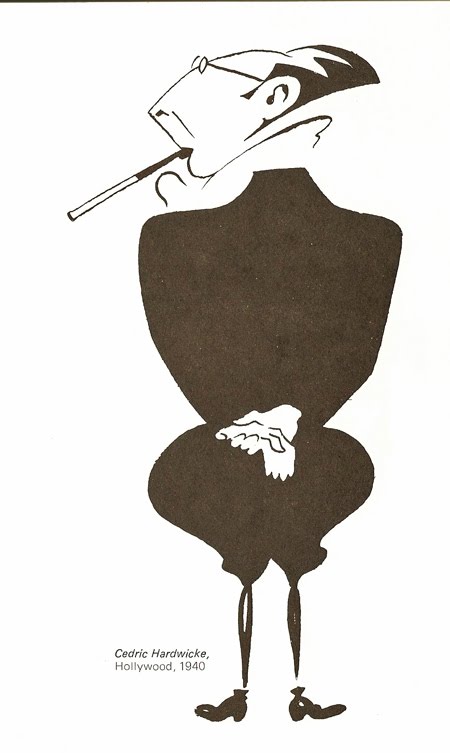
Unfortunately Sir Cedric Hardwicke is probably now best known as King Seti in C. B. Demille's The Ten Commandments. However his career spanned film, theatre, radio and television with performances that won him awards and accolades on both sides of the Atlantic. His Follo in the 1934 Hunchback of Notre Dame is a truly chilling portrait of evil. In day-to-day life he was, like many of his colleagues, a gentle, well-spoken and highly educated man.
Before he became known as Sherlock Holmes, Basil Rathbone was the adversary of many of Hollywood's swashbuckling heros. The irony was that he was one of the finest swordsmen in the world and as he often jokingly remarked: I could have killed Errol Flynn anytime I wanted to.

Nerman captured many actors from the British community while they were still appearing on the London stage - many of them as they enjoyed their first flush of success.

Charles Laughton was a leading actor in some of the most astonishing performances ever committed to celluloid - The Mutiny on the Bounty, The Hunchback of Notre Dame, Witness for the Prosecution. Though Edmund Gwenn was a supporting player his Kris Kringle in Miracle on 34th Street is still the definitive and most loved Santa Claus on film.
Claude Rains is probably best remembered as Captain Louis Renault in Casablanca and King John in Robin Hood. Gladys Cooper was a great beauty in her day and known as a fine player of Maugham and Pinero, as she aged she became the grande dame in many movies (Rebecca,
My Fair Lady
) and continued performing on stage and screen until well into her 80s. She also starred in The Rogues, one of the most sophisticated, superbly written and acted - and short lived - series ever shown on American TV.
Many members of the British Colony had been introduced to film goers in the early films of English director Alfred Hitchcock. When he moved to the United States many were to appear in his films and on his popular TV series. Though the most famous caricature of the director was the one he created himself for the beginning of his TV show, Nerman's is a fine representation of the rotund master of implied horror.

In the preface to the book these drawings are taken from composer-Playwright Sandy Wilson quotes Nerman as saying: It is very easy to be nasty, but kindness nowadays means so much. And that is one thing that is notable in Nerman's work - his drawings are seldom unkind to their subject. But that did not stop him from taking the odd sly dig at his sitter if it meant he could capture something of their character with his pen.

We've all heard stories about Joan Crawford - real and apocryphal - about her toughness and her spiky temper. Nerman's lines for this drawing have a sharpness that reflect the character of his sitter.
I may be reading a bit too much into this but in this caricature of Spencer Tracy, I think Nerman rather slyly caught some of the squareness of the man - that solidness that made him beloved of women and men.
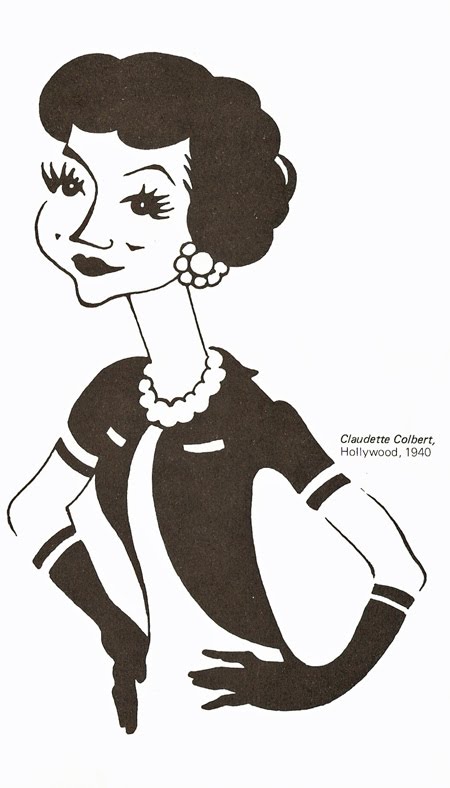
Claudette Colbert was one of the highest paid screen stars of the 30s and 40s. She had a flair for comedy and sophisticated scripts but under it all was a will of iron. She made incredible demands of the studios and got most of them. Even Nerman met one of those demands - she insisted on always being photographed from her left side. And I think he also captured a little bit of the steel behind the satin.

One of Nerman's favourite subjects - and close friends - was the reclusive Swedish star Greta Garbo. He seldom spoke of their friendship but she is the Hollywood star who he drew most often.
His drawings of the legendary actress were particularly popular in his homeland and the bottom one was used on a Swedish stamp in 2005 to commemorate the centenary of her birth.

Other postings on Nerman and his work can be found at:
Trans-Atlantic Caricatures
Classical Nerman
Dance, Dance, Dance Little Lady

17 settembre - San Roberto Bellarmino
Enhanced by Zemanta

Thursday, August 26, 2010

Dance, Dance, Dance Little Lady

Though I am no longer working - my choice by the way - I am still having a bit of trouble finding time to get the posts on Pesaro and the trip to Umbria completed but they will come - no honestly they will. In the meantime I'm struggling through the monthly task of translating items for Ballet2000. One can only hope that working with the flowery and complicated proses of dance criticism will teach me to temper my own writing when it comes to reviews.

In the meantime, as a break from making a 95 word Italian sentence with three subordinate clauses but not a principal clause in sight into readable English, I thought I'd post some dance related caricatures from the wonderful world of Einar Nerman.

In the classical dance world of the first half of the 20th century there was no hope of success unless you had a Russian or French name. Thus Alicia Marks from Finsbury Park became Alicia Markova and Patrick Healey-Kay from Slinfold, Sussex became Anton Dolin. No matter what their names theirs was an incredible partnership that galvanized the dance world between the Wars and guided it as teachers, choreographers and company founders and directors after they retired from the stage.


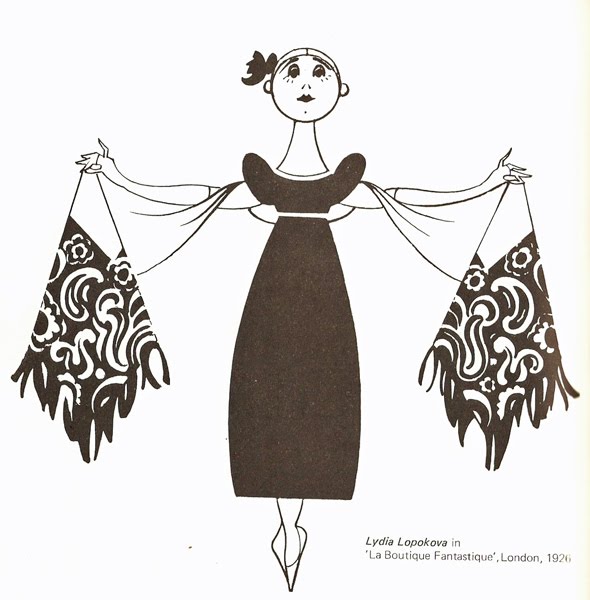
There is a bit of a Rossini connection in this one. La Boutique Fantastique* (sic) was a ballet created by Léonide Massine for Serge Diaghilev's Ballets Russes in 1919 and is set to a suite of music adapted by Ottorino Respighi from piano pieces by Rossini. It is the familiar story of toys in a shop that come to life after hours. The Can-Can Doll was one of Lydia Lopokova's signature roles.
Much as been written about Serge Diaghilev (in fact a new book was just reviewed in the New York Times), a man who's only talent was the ability to recognize and nurture the talent of others. It difficult to imagine what the world of dance, music and the visual arts would have become if he had not encouraged so many dancers, artists, choreographers, writers and composers to exercise their creativity. Here he's shown with dancer Anna Pavlova, designer Leon Bakst and composer Igor Stravinsky.

This drawing always makes me smile - Nerman captures both the fluidity and the foolishness of the great Isadora Duncan. Just as he captures her with his lines so that remarkable writer Janet Flanner captured her in words in her profile for The New Yorker written in 1927 just after Isadora's death.
In the summer of 1926, like a ghost from the grave, Isadora Duncan began dancing again in Nice. Two decades before, her art, animated by her extraordinary public personality, came as close to founding an aesthetic renaissance as American morality would allow, and the provinces especially had a narrow escape. But in postwar European years her body, whose Attic splendor once brought Greece to Kansas and Kalamazoo, was approaching its half-century mark. Her spirit was still green as a bay tree, but her flesh was worn, perhaps by the weight of laurels. She was the last of the trilogy of great female personalities our century cherished. Two of them, Duse and Bernhardt, had already gone to their elaborate national tombs. Only Isadora Duncan, the youngest, the American, remained wandering the foreign earth.

The Introduction to Isadora from Paris Was Yesterday
Janet Flanner
Harcourt Brace Jovanovich


The Austerlitz kids from Nebraska did pretty damned good for themselves. Fred and his older sister Adele formed a partnership at the age most children were starting grade school. It led them to New York, London and the entertainment capitals of the world and along the way they changed their last name to Astaire. Shows, skits and songs were written for them and after their split up in 1932 they both went on to successful careers: Adele as the wife of first a British Lord and then a CIA director. As for Fred I'll once again quote from the New Yorker:
From “The Gay Divorcee” (1934), two visions of the sublime. First: Fred Astaire getting ready to go out. He’s in a dressing gown, which he removes, slinging it behind his back to his butler. Singing all the while, he chooses one tie, rejects it, chooses another, moves to a mantelpiece at the side of the room, and halts. And then, in a single long take, he dances around a couch and right into his jacket, which is held by the butler, inserts a boutonnière, leaps over the couch, dances around it again, does three heel-clicking leaps, mounts a chair at the door, receives his bowler and umbrella—flipped by the butler—and goes out. Second: Astaire singing “Night and Day,” Cole Porter’s greatest song, and then leading Ginger Rogers, who has been resisting him, into a long dance of seduction, with heart-stopping episodes of aggression, temporary acquiescence, fierce pleading, and, finally, submission, all of it dramatized with dance, as dance.
David Denby
Film Forum - The New Yorker
August 30, 2010
To read more by David Denby click here.

The Music Hall of the 1920s-30s had a fascination with the pan-sexual. Perhaps it reached its zenith with Barbette - a Texas trapeze artist who performed in drag - but was certainly seen in many acts of the time. The Rocky Twins were two young and beautiful Norwegian dancers whose European careers took off when they appeared in Paris just after their 18th birthday. They were adored by the French audiences and were popular throughout Europe. They were so alike that it was often said that you could never tell which one you were talking to or which one you had slept with.

*The ballet is actually titled La Boutique fantasque and was mislabeled in the compilation of Nerman's drawings published by HARRAP.

More of Nerman's delightful caricatures are posted here and here.

26 agosto - Sant'Alessandro di Bergamo
Enhanced by Zemanta

Friday, July 16, 2010

Classical Nerman

I thought I'd post a few more of the wonderful Nerman caricatures from that little book I was mentioning last week.

Einar Nerman's contract with Eve magazine required a monthly page of caricatures of singers, conductors and notable musicians who played the Royal Albert Hall and other concert venues in the London of the 20Ss and 30s. His talented pen found plenty of scope in the full-bosomed prima donnas and eccentric conductors who mounted the podiums.


By the time Nerman inked these drawings of these two musical Dames, they were both approaching the end of long careers. Nellie Melba was a reigning prima donna of the opera stage from the 1880s until her retirement in 1928. Much loved by the public she was less appreciated by her colleagues. The Melba stories are numerous as the dishes named after her and most suggest that the Australian soprano did not "work and play well with others", but damned she could sing! Clara Butt was much loved by the British public though her stock within the musical world was not always as high. Sir Thomas Beecham, well known for his sarcastic wit, once quipped that she could stand on the Cliffs of Dover and be heard on the shores of France. Rather snidely Nerman has her cradling Kennerley Rumford, her stage and life-partner, to her amble bosom.

Frieda Hempel and Amelita Galli-Curci shared much of the same repertory though the petit Italian soprano never ventured into the realms of Wagner the way her saftig colleague did. Though Hempel had a successful career in Europe it is thought that her North American career was overshadowed by Galli-Curci. Both turned to recitals in the late 20s and that was Hempel chief venue until her retirement. Galli-Curci's singing days were cut short by surgery which left her vocally damaged and she retired to a life of teaching.


By the time Nerman drew this caricature of Enrico Caruso, the great tenor had been dead for 20 years. I'm not sure where Nerman got his inspiration but he captured the well-known roguishness of his subject. Its interesting to see that current tenor heart throb Jonas Kaufmann wasn't the first one to go for that rugged five o'clock shadow look. Of course while Nerman was in New York Danish tenor Lauritz Melchior ruled the roost in all thing Wagnerian at the Met. He was never known for his convincing acting but when you sang like he did - on a night when he felt like it - acting really didn't matter. I agree with Sandy Wilson who says of this drawing that Nerman "has, I could swear, capture sound on paper."


These two great conductors of the 20th Century were as different as night and day. Arturo Toscanini was the martinet, the terror of the podium; Sir Thomas Beecham was the avuncular uncle. Both were magnificent in their own way. My own preference has always leaned towards Beecham, I've always found Toscanni's readings to be cold - to my ears his Falstaff robs that masterpiece of all its humour and joy. However with Beecham you always feel the joy of a true "amateur": he was chiefly self-taught as a conductor, championed various neglected works and seemed to be in the habit of founding orchestras when he couldn't find any to hire him as their conductor. His recordings of La Boheme and Carmen are still - to my mind - the touchstones for those two war horses.


Its probably just me being an old "fogie" - no it is definitely me being an old fogie - but I can't imagine a caricaturist having as much fun with today's crop of singers or conductors.

16 luglio - La Beata Vergine Maria del Monte Carmello
Enhanced by Zemanta

Thursday, July 08, 2010

Trans Atlantic Caricature


When I was writing about Al Hirschfeld last week I remembered a slender little book I had picked up many years ago on one of my - what was in those days - frequent trips to London. Einar Nerman - or simply as he was know Nerman - was a Swedish artist who in 1921 moved to London at the suggestion of playwright/composer/actor/producer Ivor Novello. For the next 19 years he chronicled the theatrical and social scene in London mostly working for The Tatler, a weekly society and gossip magazine and Eve - a weekly look at things classical in the music world.


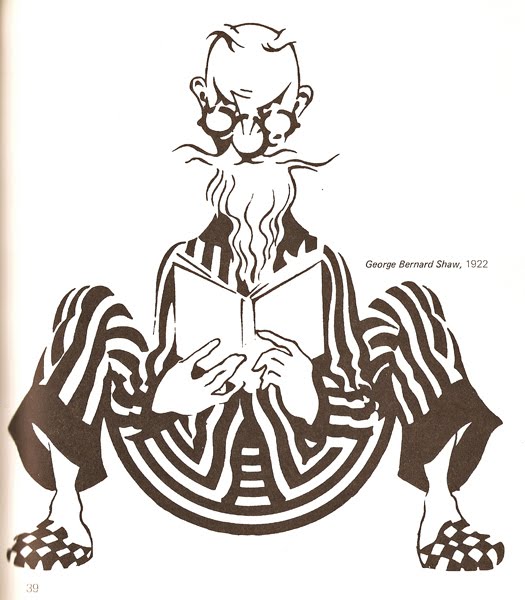
I think this has to be my favorite drawing of one of my favorite playwrights. Nerman catches George Bernard Shaw at his most curmudgeonly and cocking a snood at the world as he poses in his pajamas and comfortable slippers.

Many of the West End stars of those days were well-known on both sides of the Atlantic. Stars such as John Gielgud caught here as Hamlet - you can almost see those Gielgudian nostrils quivering as he delivers "To be or not to be?" Others were well-loved but only known in the UK like Maisie Gay, a revue comedienne who retired to the Wiltshires due to ill health and ran a pub until her death in 1945.

"Continental" artistes made the trip across the Channel to do their turns at variety houses or give "seasons" in French or Italian plays at West End theatres. Maurice Chevalier was a great London favourite and Nerman catches that Gallic charm in full force. And he captures Yvette Guilbert in all her stillness with those long black gloves dominating the drawing as they did when she sang on stage.

Cléo de Mérode was a great beauty of the Belle Epoque and a fine ballet dancer whose career was sadly overshadowed by a reported affair with King Leopold II of Belgium. Her appearance in the Tatler probably had more to do with the later than the former. Also amongst his "society" subjects were The Windsors - I'm sure that Mrs Simpson was less than pleased with Nerman's view of her and her ex-King.

During World War II Nerman and his family moved to the US and he found work with the Journal-American, one of the many New York newspapers of the day. His Hollywood portraits included a rough and tumble - but oddly feline - Clark Gable and an incandescent fellow-Swede Ingrid Bergman.

Nerman was equally at home drawing portraits of classical music performers as here where he treats two fellow Swedes to his slightly satirical pen. Jussi Bjoerling is still considered by many (myself included) to be the greatest tenor of the late 20th century. Unfortunately Bjoerling was often paired with divas who were a head taller than him and even his platform heels can't bring him up to Grace Moore's chin. Fun loving in real life Birgit Nilsson was an intense interpreter of Wagner and Strauss - Nerman was 82 when he penned this drawing of the great soprano as Strauss's Electra.


There is such a wealth of wonderful portraiture in this now out-of-print little book and over the next while I may publish one of two more things of this neglected but, to my mind at least, brilliant caricaturists.

08 luglio - Santa Priscilla

Enhanced by Zemanta