
Thursday, September 09, 2010


Wednesday, September 08, 2010
Mercoledi Musciale
The other day on Facebook, Jeff from World O'Jeff, who use to take us on those great Sunday drives mentioned that he was watching A Hole in the Head (1959) with Frank Sinatra. Being a bit of movie nerd I shot back: Edward G. Robinson, Thelma Ritter, Carolyn Jones, Eddie Hodges and "High Hopes". Jeff was disappointed I had forgotten the mint green Cadillac convertible with the two-toned interior. And I must admit that bit of trivia I had forgotten.
But I did remember all the words to "High Hopes". How could I forget them - Sammy Cahn and Jimmy Van Heusen's song was on the hit parade for months and I heard it almost every morning on CFRB before I went to school.
In the movie Sinatra as down on his luck hotel owner Tony Manetta sings it with his ever optimistic son Alley (Eddie Hodges). Hodges had shot to fame on Broadway in The Music Man and was to have a career on stage, screen and disc until he retired from show business in his late teens.
Though they sang part of the number together on screen, Sinatra's hit record was recorded with a children's chorus. It was on the charts for weeks and was the number 15 most popular song that year - and won the Oscar for best original song in a movie.
And Jeff I'm sorry I forgot the Cadillac!
08 settembre - Natività della Beata Vergine

But I did remember all the words to "High Hopes". How could I forget them - Sammy Cahn and Jimmy Van Heusen's song was on the hit parade for months and I heard it almost every morning on CFRB before I went to school.
In the movie Sinatra as down on his luck hotel owner Tony Manetta sings it with his ever optimistic son Alley (Eddie Hodges). Hodges had shot to fame on Broadway in The Music Man and was to have a career on stage, screen and disc until he retired from show business in his late teens.
Though they sang part of the number together on screen, Sinatra's hit record was recorded with a children's chorus. It was on the charts for weeks and was the number 15 most popular song that year - and won the Oscar for best original song in a movie.
And Jeff I'm sorry I forgot the Cadillac!
08 settembre - Natività della Beata Vergine
Tuesday, September 07, 2010
Amacord - Waiting for the Rex
One of my favorite scenes in Amarcord is one of those incredible sequences that only Fellini could do without it seeming coy and fake - though the whole thing is obviously shot on a sound stage it has an innocent truth to it that makes it wonderfully believable.
The SS Rex - the largest ship in the Italian Liner fleet - is scheduled to pass near the town on its way to New York. The entire town has set out in every boat available and it turns into a festa. As the hours pass darkness has set in and Gradisca, the town beauty, becomes sentimental about what she wants in life - what every good woman wants - a loving husband and children. By midnight everyone, even the blind accordionist, has fallen asleep but the liner's foghorn awakens them. To calls of greeting and wishes of success what must be the biggest ship in creation plows its way through the little flotilla.
Pure cinema magic!
07 settembre - Santa Regina

The SS Rex - the largest ship in the Italian Liner fleet - is scheduled to pass near the town on its way to New York. The entire town has set out in every boat available and it turns into a festa. As the hours pass darkness has set in and Gradisca, the town beauty, becomes sentimental about what she wants in life - what every good woman wants - a loving husband and children. By midnight everyone, even the blind accordionist, has fallen asleep but the liner's foghorn awakens them. To calls of greeting and wishes of success what must be the biggest ship in creation plows its way through the little flotilla.
Pure cinema magic!
07 settembre - Santa Regina
I Remember
 One of my favorite Italian movies is Federico Fellini's 1973 Amarcord (A m'arcord - I Remember). It is a film I can watch over and over again and find a constant delight - a funny reminiscence of the director's youth in Fascist Rimini touched with the sadness of growing up. As he - and we - remember things they are always bigger than they really were - the snow banks from an unusual snow fall hide people from sight, the luxury liner REX has 20 decks, a visiting Sultan has 50 wives - memory is also kind to those we love and less kind to those we don't. Fellini is not above taking satirical swipes at both himself and his countrymen for allowing themselves to be entrapped in what he called "perpetual adolescence". Though perhaps it is that entrapment that give both this film and this country their charm and hold over me.
The Rimini (renamed Borgo in the film) Fellini captured was mostly on the sound stages of Cinecittà so anyone going to the coastal town looking for the square, the church or Titta's home will be disappointed. Though the Grand Hotel does exist and stands white and imposing on the beach front in Rimini, Fellini's Grand was in Anzio a few miles from Roma.
But that didn't stop us from making a pilgrimage, Borsolinos in hand, down the long tree lined Viale Principe Amedeo to the Parco Federico Fellini and the manicured grounds of the Grand Hotel.

Lunch in the enormous - and almost empty - dining room and a walk around the hotel confirmed that this was indeed a "Grand" hotel in the old style. And though the grand staircase in the lobby and seafront veranda may have been only the chiaroscuro of Fellini's memory it had the atmosphere that he captured so well.
Just off the lobby - as in all Grand Hotels - there were the telephone booths, all set for you to make that important overseas call .....


I am often fond of rather pompously reminding people who complain about historical accuracy in films that "after all its only a movie!" I should have remembered that when planning to have my photo taken sitting on the veranda in a Felliniesque pose sipping an Aperol spritz, my bald spot shaded by my straw hat. It didn't happen; somehow though this was the Grand with all its 1920s atmosphere, it wasn't THE Grand. Or at least not the one that Fellini, and I, remembered.
07 settembre - Santa Regina

Monday, September 06, 2010
Restored and Refreshed - Part II
While searching for information on the Monstra dell'Acqua Felice I was a little confused - granted not an unknown state but in this case understandable. I had been told that it was called Fontana di Moses (The Fountain of Moses) and found a good deal of information on the Internet under that appellation. But another source kept referring to it as the Mostra and even more history, facts and fables showed up on a search. And, as these things tend to do, one search led to another. And sources became a bit confused - there didn't seem to be any agreement on something as basic as who sculpted the statue of Moses in the central arch. I've tried to make sense of it but whatever its story, the important thing is that another glorious bit of the history of Roma has been restored and refreshed.

A "Fontana" becomes a "Monstra" not just because of its size and its elaborate structure but because it is the public monument to the construction of an aqueduct - and a celebration of the person who commissioned it. Sextus V had the new aqueduct - the first in Modern Rome - built following the lines of the old Alexandrina, Claudia and Marcia aqueducts into the city. He may have enjoyed tearing down pagan Roman to the glory of Christianity but he was no fool. He recognized - or rather his engineer Giovanni Fontana did - a good thing, pagan or not, when he saw it. Those aqueducts still supply the city and its fountains with water today.

So why "Felice" rather than Moses? Well the good Pontiff's name, pre-Triregnum, was Felice Peretti di Montalto and he never quite let go of it even after assuming the Throne of St Peter in 1585. And of course there is also the meaning of the word "felice" = happy. The new aqueduct brought water to an area that had been waterless for almost 900 years and with the water came new buildings, people and life back into the Quirinale Hill. This wasn't quite a selfless gesture as it also brought water to his own Villa Montalto as well as the 27 public fountains in the Rione.

The main body of the monument was built along the lines of a Roman triumphal arch with three arches atypically of identical height; Sextus may have not liked those pagan ruins but wasn't above borrowing from them if it would enhance his glory and send a message. And the Mostra was meant to send a very strong message. The reference is - as is befitting a commission from a Pope consumed with the Counter-reformation - Biblical and the niches hold three episodes from the Exodus of the Jews from Egypt. It is a reminder to the populace that the Church (Catholic) was seeing to their wants and looking after their well being while those filthy Protestants neglected their earthly needs.
I can't seem to find agreement on the events depicted other than the centre panel. Of that there can be no question: Moses strikes the rock that brings forth the water promised by God for the parched people of Israel. The allegory couldn't be any plainer - Sextus, the elect of God, brings water to the parched people of Rome. Conveniently Moses's disobedience of God's instructions and God's punishment for those transgressions seems to have been forgotten.
The central niche stood empty until Prospero Bresciani's Moses was placed there in 1588 and it immediately came under the most severe criticism. The fourteen foot high sculpture - one of the largest pieces of the period - is visibly out of proportion. The head is too small for rest of the body, the torso too small for the legs and the whole thing appears squat and almost pear shaped. Even the positions of the arms - the ambiguously extended right arm once held a rod - appear awkward. It is hard to believe that only several decades before Michelangelo had created his great Moses.
The left panel I have seen referred to as Aaron and the Children of Israel gathering manna or Aaron and the Children of Israel gathering water - in any case Aaron is definitely there and they are definitely gathering something. The right panel shows either Joshua selecting warriors for the battle of Rephidim against the Amalekites or Joshua Leading His Army Across the Jordan. Again Joshua - or at least a General - is there as are soldiers and they are preparing for something. Make you choice!
 The inscription makes sure that all and sundry know who commanded that the aqueduct be built, the origins of the water ( the springs at Pantano Borghese) and the length of the aqueduct (24 km or 15 miles). The later part of the inscription (FELICEMQ.ue DE NOMINE ANTE PONT.ificatus DIXIT) explains that the Ponfiff called it Felice (Happy) because it was quenching the thirst of the populace.
The Mostra came in for criticism shortly after its completion. Even at a time when facades had the appearance of stage sets it has a flattened aspect and lacks a certain gravitas. The attic is disproportionate to its base but that was necessary if the inscription Sextus commanded was to be visible to all. And perhaps some of that criticism reflected more the feeling of the time towards a less than popular Pope - he had restored law and order and financial solvency to the Papal States with a heavy hand - as well as unfair comparisons to other Mostre in Roma and elsewhere.
But as well as its ceremonial duties the Mostra served the Rione as an important source of water. The populace collected their water from the four large basins fed by the replicas of Egyptian lions while outside the marble balustrade - which acted as an barrier - there was a separate basin for animals. Two large marble basins were set aside for laundry and a private wash house was built beside the fountain for the use of the local women.
As I mentioned in my first posting the approach from my neighbourhood gives little indication of what lies just around the corner. The photos above show the back of the Mostra - a boutique B&B called The Moses Fountain Apartments and a section of the St Regis Hotel - coming up Via XX Settembre. Even at the corner in front of Santa Maria della Vittoria there is little hint of what is to come. It isn't until that corner is turned that all is revealed.

But then it was never meant to be viewed from that approach - which was after all only a country road leading to Porta Pia - but rather from the Piazza San Bernardo. Though today's view is obstructed by poles, signs and traffic with Santa Maria della Vittoria in as a balance it is still - all quibbles about proportion and artistic validity aside - an impressive sight.
06 settembre - Beato Angelo da Foligno

The Mostra dell'Acqua Felice as I first remember it in August of 2007 - just roll your cursor over it to see what greeted me on my early morning sojourn this past weekend.
A "Fontana" becomes a "Monstra" not just because of its size and its elaborate structure but because it is the public monument to the construction of an aqueduct - and a celebration of the person who commissioned it. Sextus V had the new aqueduct - the first in Modern Rome - built following the lines of the old Alexandrina, Claudia and Marcia aqueducts into the city. He may have enjoyed tearing down pagan Roman to the glory of Christianity but he was no fool. He recognized - or rather his engineer Giovanni Fontana did - a good thing, pagan or not, when he saw it. Those aqueducts still supply the city and its fountains with water today.

The source of the water is some 24 kms from the Mostre and originates with a spring at Pantano Borghese in the Castelli region. The above ground part is visible at the Parco dell'Acqueduct (above) running beside and at times on top of the Acqua Claudia.
So why "Felice" rather than Moses? Well the good Pontiff's name, pre-Triregnum, was Felice Peretti di Montalto and he never quite let go of it even after assuming the Throne of St Peter in 1585. And of course there is also the meaning of the word "felice" = happy. The new aqueduct brought water to an area that had been waterless for almost 900 years and with the water came new buildings, people and life back into the Quirinale Hill. This wasn't quite a selfless gesture as it also brought water to his own Villa Montalto as well as the 27 public fountains in the Rione.

The main body of the monument was built along the lines of a Roman triumphal arch with three arches atypically of identical height; Sextus may have not liked those pagan ruins but wasn't above borrowing from them if it would enhance his glory and send a message. And the Mostra was meant to send a very strong message. The reference is - as is befitting a commission from a Pope consumed with the Counter-reformation - Biblical and the niches hold three episodes from the Exodus of the Jews from Egypt. It is a reminder to the populace that the Church (Catholic) was seeing to their wants and looking after their well being while those filthy Protestants neglected their earthly needs.
I can't seem to find agreement on the events depicted other than the centre panel. Of that there can be no question: Moses strikes the rock that brings forth the water promised by God for the parched people of Israel. The allegory couldn't be any plainer - Sextus, the elect of God, brings water to the parched people of Rome. Conveniently Moses's disobedience of God's instructions and God's punishment for those transgressions seems to have been forgotten.


Like the work of his great predecessor Michelangelo, Bresciani's Moses has a pair of horns. This was based on the description of Moses' face as "cornuta" (horned) in the Latin Vulgate translation of Exodus 34:29-35. The Greek Septuagint and Hebrew Masoretic use words meaning "radiant", suggesting an effect like a halo. But those horns gave Western artists of the period a convenient attribute by which Moses could easily be recognized in crowded pictures.
The central niche stood empty until Prospero Bresciani's Moses was placed there in 1588 and it immediately came under the most severe criticism. The fourteen foot high sculpture - one of the largest pieces of the period - is visibly out of proportion. The head is too small for rest of the body, the torso too small for the legs and the whole thing appears squat and almost pear shaped. Even the positions of the arms - the ambiguously extended right arm once held a rod - appear awkward. It is hard to believe that only several decades before Michelangelo had created his great Moses.


A left click on the image will enlarge the sculptures in the niches - my own guess is that the right is Aaron and the Jews collecting the water from the spring and the right is the preparation for battle after men and animals have been refreshed.
The left panel I have seen referred to as Aaron and the Children of Israel gathering manna or Aaron and the Children of Israel gathering water - in any case Aaron is definitely there and they are definitely gathering something. The right panel shows either Joshua selecting warriors for the battle of Rephidim against the Amalekites or Joshua Leading His Army Across the Jordan. Again Joshua - or at least a General - is there as are soldiers and they are preparing for something. Make you choice!
 The inscription makes sure that all and sundry know who commanded that the aqueduct be built, the origins of the water ( the springs at Pantano Borghese) and the length of the aqueduct (24 km or 15 miles). The later part of the inscription (FELICEMQ.ue DE NOMINE ANTE PONT.ificatus DIXIT) explains that the Ponfiff called it Felice (Happy) because it was quenching the thirst of the populace.
The Mostra came in for criticism shortly after its completion. Even at a time when facades had the appearance of stage sets it has a flattened aspect and lacks a certain gravitas. The attic is disproportionate to its base but that was necessary if the inscription Sextus commanded was to be visible to all. And perhaps some of that criticism reflected more the feeling of the time towards a less than popular Pope - he had restored law and order and financial solvency to the Papal States with a heavy hand - as well as unfair comparisons to other Mostre in Roma and elsewhere.


These rather endearing, if slightly effete, lions spit water into the basins that were meant for public use. A notice (in Latin??) tells us that these are copies of statues that can now be seen in the Egyptian Museum in the Vatican.
But as well as its ceremonial duties the Mostra served the Rione as an important source of water. The populace collected their water from the four large basins fed by the replicas of Egyptian lions while outside the marble balustrade - which acted as an barrier - there was a separate basin for animals. Two large marble basins were set aside for laundry and a private wash house was built beside the fountain for the use of the local women.


But then it was never meant to be viewed from that approach - which was after all only a country road leading to Porta Pia - but rather from the Piazza San Bernardo. Though today's view is obstructed by poles, signs and traffic with Santa Maria della Vittoria in as a balance it is still - all quibbles about proportion and artistic validity aside - an impressive sight.
06 settembre - Beato Angelo da Foligno
Lunedi Lunacy
Jörgen (Torkel Petersson) will be our Monday morning guest chef. He's the star of the Swedish film Farsan and he's become convinced that his wife thinks he isn't manly enough. So he "embarks on a quest to become more assertive and studly in order to save his marriage."
06 settembre - San Zaccaria (profeta)
Sunday, September 05, 2010
Restored and Refreshed! - Part I
Three years ago now on one of my first Sundays here in Roma - it was perishing hot and so many things were closed because it was ferragosto - I remember heading down to Centro for a look around. In those days home was on Via Asmara about 3 kms from the city walls and a number 60 bus went almost in a straight line down to the Centro Storico. Within the walls where Via 20 Settembre meets Largo Santa Susanna the bus made a right hand turn. There built into the wall on the left was an enormous fountain - enormous but dirty and dry. The calcium in the water here had obviously clogged the system - god only knows what it does to ours - and the exhaust spewed out from the constant traffic jam at that intersection had added several inches of grim onto the sculptured figures and dulled the detail. It was magnificent if somewhat grandiose but sad and neglected.
At that point I commented that it was a shame such a monumental piece of work had been let fall into that state and railed a bit about a government that wouldn't do anything about it.
Fast forward a year later and low and behold:
 And so it has been for the past year and a half - until last week. Without fanfare or publicity the scaffolding was removed and the restored and refreshed Mostra dell'Acqua Felice was revealed.
 Guiseppe Visi's engraving shows the Piazza as it was in the mid-1700s. On the left the Church of Santa Susanna, at the centre the Church of Santa Maria della Vittoria and to the right the Mostra dell'Acqua Felice. The convent joining the two churches was demolished in the 1920s to make way for road connecting Piazza Barberini with Termini, the central railway station.
The Mostra (better known as the Fontana di Moses) was built in 1587 by the appropriately named Domenico Fontana as a monument to mark the spot where the new acquaduct - Acqua Felice - built by Sextus V entered the city to provide the Quirinale with a supply of water. The above engraving by Guiseppe Vasi is taken from a wonderful website that follows the engraver's tour of Rome and allows us as creator Roberto Piperno says: To Follow In the Footsteps of a XVII Century traveler.
I often thing that early morning is the best time to see Rome - little traffic and few people - so yesterday morning I headed out early to take some photos of the restored Fountain. I'll be sharing them and a few more notes about it later today or early tomorrow.
05 settembre - Madre Teresa di Calcutta
At that point I commented that it was a shame such a monumental piece of work had been let fall into that state and railed a bit about a government that wouldn't do anything about it.
Fast forward a year later and low and behold:
 And so it has been for the past year and a half - until last week. Without fanfare or publicity the scaffolding was removed and the restored and refreshed Mostra dell'Acqua Felice was revealed.
 Guiseppe Visi's engraving shows the Piazza as it was in the mid-1700s. On the left the Church of Santa Susanna, at the centre the Church of Santa Maria della Vittoria and to the right the Mostra dell'Acqua Felice. The convent joining the two churches was demolished in the 1920s to make way for road connecting Piazza Barberini with Termini, the central railway station.
The Mostra (better known as the Fontana di Moses) was built in 1587 by the appropriately named Domenico Fontana as a monument to mark the spot where the new acquaduct - Acqua Felice - built by Sextus V entered the city to provide the Quirinale with a supply of water. The above engraving by Guiseppe Vasi is taken from a wonderful website that follows the engraver's tour of Rome and allows us as creator Roberto Piperno says: To Follow In the Footsteps of a XVII Century traveler.
I often thing that early morning is the best time to see Rome - little traffic and few people - so yesterday morning I headed out early to take some photos of the restored Fountain. I'll be sharing them and a few more notes about it later today or early tomorrow.
05 settembre - Madre Teresa di Calcutta
Saturday, September 04, 2010
Sevice with uno Sorriso
You may recall that last year around this time I went shopping for new glasses with my friend Marco. He shamed me into doing away with the professor look and with Laurent's final approval I started sporting a pair of light weight trendy Adidas frames.
Well while on vacation I went to take them off to thoughtfully suck on the temple arm after having read something profound - okay it was a menu in a restaurant, but they can be profound - and one of the nose pads arms, nose pad attached, remained resting in place. Now one does not expect that bits and pieces of a pair of very, very, very expensive Adidas glasses will detached themselves of their own free will. Particularly not when they are made of the same metal as is reported to be used on intergalactic space probes and have been futher tempered in the fires of the damned.
Given that I no longer could find the receipt and the level of customer service I have experienced on most occasions here in Roma - we won't rehash the IMAC story - I expected the worst. I knew they couldn't be repaired and what were the chances of having them replaced? Give it a try said my ever optimistic spouse. Give it a try said my friend Marco in a tone of patriotic defensiveness. Give it a try said my friend Laurie with a bit of a smirk.
So yestreday morning I walked into the Optica looking for Andrea, the good looking young man who had first served me, knowing he would be, at the least, nice to look at if not sympathetic to my sorry tale. No luck - a total stranger was sitting in front of the D&G display with that "I am a sales person in an exclusive store sitting in front of a display of glasses you could never afford." look on his face. So I took a deep breath and launched into my standard apology for my bad Italian with my very English accent and explained - with many descriptive gestures - what had happened.
Okay said the Gentleman - no really he said okay. He looked at the de-nose-paded frames, weighed them in his hand and then said: I'm sorry... Oh boy I thought here it comes - I had 16 days to return a product I wasn't satisfied with! Where is my bill? What did I do to break them? ... but it will take about five days to get a replacement.
What? My jaw dropped! Is that too long? he asked. I was gobsmacked but managed to stammer an incredulous no. I had another pair of glasses - my old professor ones - with me so it wasn't going to be a problem. He smiled, took my name, cell number and copied down the serial number on the frame. And with a very friendly wave said: I'll call you the minute they are ready. Arrivederci
I reeled out of the store into the bright sunlight of Viale Regina Margherita - okay part of that was trying to get accustomed to the focus on the old glasses. Had this been a dream? There had been no fight! No argument! No looking superior! No curt cutting off in mid-whine! In less than two minutes my problem had been solved. Take a note of the date - September 3, 2010 at 1045, I was in Roma and I had received Service, capital S, with a SMILE.
04 settembre - Santa Rosalia

Well while on vacation I went to take them off to thoughtfully suck on the temple arm after having read something profound - okay it was a menu in a restaurant, but they can be profound - and one of the nose pads arms, nose pad attached, remained resting in place. Now one does not expect that bits and pieces of a pair of very, very, very expensive Adidas glasses will detached themselves of their own free will. Particularly not when they are made of the same metal as is reported to be used on intergalactic space probes and have been futher tempered in the fires of the damned.
Given that I no longer could find the receipt and the level of customer service I have experienced on most occasions here in Roma - we won't rehash the IMAC story - I expected the worst. I knew they couldn't be repaired and what were the chances of having them replaced? Give it a try said my ever optimistic spouse. Give it a try said my friend Marco in a tone of patriotic defensiveness. Give it a try said my friend Laurie with a bit of a smirk.
So yestreday morning I walked into the Optica looking for Andrea, the good looking young man who had first served me, knowing he would be, at the least, nice to look at if not sympathetic to my sorry tale. No luck - a total stranger was sitting in front of the D&G display with that "I am a sales person in an exclusive store sitting in front of a display of glasses you could never afford." look on his face. So I took a deep breath and launched into my standard apology for my bad Italian with my very English accent and explained - with many descriptive gestures - what had happened.
Okay said the Gentleman - no really he said okay. He looked at the de-nose-paded frames, weighed them in his hand and then said: I'm sorry... Oh boy I thought here it comes - I had 16 days to return a product I wasn't satisfied with! Where is my bill? What did I do to break them? ... but it will take about five days to get a replacement.
What? My jaw dropped! Is that too long? he asked. I was gobsmacked but managed to stammer an incredulous no. I had another pair of glasses - my old professor ones - with me so it wasn't going to be a problem. He smiled, took my name, cell number and copied down the serial number on the frame. And with a very friendly wave said: I'll call you the minute they are ready. Arrivederci
I reeled out of the store into the bright sunlight of Viale Regina Margherita - okay part of that was trying to get accustomed to the focus on the old glasses. Had this been a dream? There had been no fight! No argument! No looking superior! No curt cutting off in mid-whine! In less than two minutes my problem had been solved. Take a note of the date - September 3, 2010 at 1045, I was in Roma and I had received Service, capital S, with a SMILE.
04 settembre - Santa Rosalia
Thursday, September 02, 2010
Mercoledi Musciale - A Day Late
According to the Catholic calendar last Sunday was the celebration (?) of the Decapitation of John Baptist. Its a subject that has fascinated artists for centuries: painters, sculptures, composers and writers. The recounting of the execution of John at the hands of Herod Antipas has been expanded over time from a few paragraphs in the Gospels to a full blown epic with all the things that make a story good - intrigue, sex, family feuds, incest and political scandal. Strangely the telling of the events is more detailed in the writings of the Jewish historian Josephus who looks at it without the gloss of the Evangelists. 
One of the more famous - though seldom seen - plays on the subject was written by Oscar Wilde. His Salome was written first in French and then translated into English. Needless to say it shocked the British censors with its language and subject - though written in 1891 it was not allowed on the stage in England until 1931.
While Richard Strauss's take on it caused little stir in Dresden when it premiered in 1905 New York was to be another story. Its first performance on January 22, 1907 at the Metropolitan Opera was well received and word of mouth about the scandalous nature of the piece meant that it was sold out. However J. Pierpont Morgan and the other righteous Episcopalian stockholders in the Met, had seen a dress rehearsal at 1100 of a Sunday morning and where suitably shocked. It was withdrawn - reluctantly given the damage to receipts - after only 5 performances. It was to be another 27 years before it would be presented in New York again.
Watching these videos of the last scene from the 1974 Götz Friedrich film with Teresa Stratas one can understand some of what shocked the still Victorian sensibilities of the good Burgers of Manhattan.
This is perhaps the definitive performance of the role - one that Stratas, by her own admission, could never have sung with such subtlety and nuance on stage. The size of the orchestra and the density of the music alone demands a bigger voice in the theatre than this great singer possessed. Conductor Karl Böhm - a colleague of and leading conductor of Strauss - maintained that this was the sort of voice the composer had always wanted for the role. I don't think any other performer has come as close to tracing the degeneration of the character from willful spoiled teenager to depraved maddened woman so intensely. The combination of Stratas's performance, Friedrich's direction and Böhm on the podium makes for an intense, frightening and fascinating experience.
I know its a long haul - 3 videos totaling some 20 minutes or more. For my non-operatic friends who might find it a struggle I might suggest the middle one section is perhaps the most fascinating for the language, music and Stratas' intense portrait of the Wilde-Strauss princess.
Salome, the step-daughter of Herod, has become fascinated by John the Baptist (Jokanaan) and becomes obsessed with kissing his mouth. The Holy Man is repulsed by the depravity of both this woman-child, her incestuous mother and the court of the King. Herod, who lusts after his step-daughter, in a moment of folly offers her anything if she will dance for him. Her only wish - the Head of Johanahan on a silver platter. Then he will be hers and she will be able to kiss his mouth.
I was fortunate that I saw Teresa Stratas at many stages in her career. I was in the audience in 1958 when she made her professional debut at the age of 20 in the Canadian Opera Company production of La Boheme. I was 12 years old at the time and my friend Bruce and I sat in the vertigo inducing 2nd balcony of the Royal Alexandra Theatre on the final evening of that run. I remember crying as Mimi died and Bruce was embarrassed until he realized that half the people around us where doing the same thing.
I was to see her again in Butterfly, Cosi fan tutte, Nozze di Figaro (twice - once as Cherubino in Salzburg than again as Suzanna in Paris) and for the last time live in 1992 in Pelléas et Mélisande in Chicago. And of course I heard and saw her on so many broadcasts during her long career at the Met. Fascinating as a singer, totally committed as an actress and complex as a person she was one of the great operatic performers of the second half of the 20th century.
02 settembre - Sant'Antonino di Apamea


This wonderful wood sculpture in oak (there I go with wood again)was carved around 1430 in Southern Germany. Its part of the rich collection at the wonderful Bode Museum in Berlin.
One of the more famous - though seldom seen - plays on the subject was written by Oscar Wilde. His Salome was written first in French and then translated into English. Needless to say it shocked the British censors with its language and subject - though written in 1891 it was not allowed on the stage in England until 1931.
While Richard Strauss's take on it caused little stir in Dresden when it premiered in 1905 New York was to be another story. Its first performance on January 22, 1907 at the Metropolitan Opera was well received and word of mouth about the scandalous nature of the piece meant that it was sold out. However J. Pierpont Morgan and the other righteous Episcopalian stockholders in the Met, had seen a dress rehearsal at 1100 of a Sunday morning and where suitably shocked. It was withdrawn - reluctantly given the damage to receipts - after only 5 performances. It was to be another 27 years before it would be presented in New York again.
Watching these videos of the last scene from the 1974 Götz Friedrich film with Teresa Stratas one can understand some of what shocked the still Victorian sensibilities of the good Burgers of Manhattan.
This is perhaps the definitive performance of the role - one that Stratas, by her own admission, could never have sung with such subtlety and nuance on stage. The size of the orchestra and the density of the music alone demands a bigger voice in the theatre than this great singer possessed. Conductor Karl Böhm - a colleague of and leading conductor of Strauss - maintained that this was the sort of voice the composer had always wanted for the role. I don't think any other performer has come as close to tracing the degeneration of the character from willful spoiled teenager to depraved maddened woman so intensely. The combination of Stratas's performance, Friedrich's direction and Böhm on the podium makes for an intense, frightening and fascinating experience.
I know its a long haul - 3 videos totaling some 20 minutes or more. For my non-operatic friends who might find it a struggle I might suggest the middle one section is perhaps the most fascinating for the language, music and Stratas' intense portrait of the Wilde-Strauss princess.
Salome, the step-daughter of Herod, has become fascinated by John the Baptist (Jokanaan) and becomes obsessed with kissing his mouth. The Holy Man is repulsed by the depravity of both this woman-child, her incestuous mother and the court of the King. Herod, who lusts after his step-daughter, in a moment of folly offers her anything if she will dance for him. Her only wish - the Head of Johanahan on a silver platter. Then he will be hers and she will be able to kiss his mouth.
I was fortunate that I saw Teresa Stratas at many stages in her career. I was in the audience in 1958 when she made her professional debut at the age of 20 in the Canadian Opera Company production of La Boheme. I was 12 years old at the time and my friend Bruce and I sat in the vertigo inducing 2nd balcony of the Royal Alexandra Theatre on the final evening of that run. I remember crying as Mimi died and Bruce was embarrassed until he realized that half the people around us where doing the same thing.
I was to see her again in Butterfly, Cosi fan tutte, Nozze di Figaro (twice - once as Cherubino in Salzburg than again as Suzanna in Paris) and for the last time live in 1992 in Pelléas et Mélisande in Chicago. And of course I heard and saw her on so many broadcasts during her long career at the Met. Fascinating as a singer, totally committed as an actress and complex as a person she was one of the great operatic performers of the second half of the 20th century.
02 settembre - Sant'Antonino di Apamea
Tuesday, August 31, 2010
The Joy of Jazz - A Discovery
Though when I write about music it is mostly the classical my tastes do run a little beyond the vocal and orchestral works of Mozart, Beethoven and (lately) Mahler. I also have a fondness for folk, some country, Broadway (duh! quel surprise!) and jazz. Now I will admit that where classical music is concerned I always favoured vocal musical. For a long while I was in the habit of say: What's the point of an orchestra if there isn't a singer in front of it? - but I have become increasingly enamored of instrumental as well. Strangely with Jazz I have always enjoyed both the instrumental and the vocal though aside from Jacques Lussier I've never been able to get my ears around progressive jazz.
And I am partial to the older jazz performers - though the only greats I can claim to have seen live are Ella (twice) and Mel! This is why an article in the New York Times and two of their interactive features caught my eye late last week. The Savory Collection, a trove of discs - around 980 - have been found of "off the radio" performances by the early names in the field: Cab Calloway, Ella, Billie Holliday, Bobby Hackett, Benny Goodman, Lester Young - they are all there and all in their prime. They were recorded, mostly on aluminum discs, by the rather secretive William Savory (right) and though stories of their existence have circulated for a long time they have only come to light recently.
This long lost treasure chest has been deposited with the Jazz Museum in Harlem and they are working with sound Engineer Doug Pomeroy to restore as many as they can. In quoting the director of the museum the NYT reports that: Mr. (Loren) Schoenberg estimates that “25 percent are in excellent shape,” he said, “half are compromised but salvageable, and 25 percent are in really bad condition,” of which perhaps 5 percent are “in such a state that they will tolerate only one play” before starting to flake.
It a mammoth project but the results are worth it for the light that these performances shed on how and what these artists did outside the limited scope of the recording studio.
There are some remarkable examples on the NYT website including these audio samples - it includes the chance to compare Cab Calloway's China Boy as the disc sounded before and after remastering. And they've also included a video report on the finding, acquisition and remastering of this remarkable historic records.
31 agosto - San Raimondo Nonnato
And I am partial to the older jazz performers - though the only greats I can claim to have seen live are Ella (twice) and Mel!
 This is why an article in the New York Times and two of their interactive features caught my eye late last week. The Savory Collection, a trove of discs - around 980 - have been found of "off the radio" performances by the early names in the field: Cab Calloway, Ella, Billie Holliday, Bobby Hackett, Benny Goodman, Lester Young - they are all there and all in their prime. They were recorded, mostly on aluminum discs, by the rather secretive William Savory (right) and though stories of their existence have circulated for a long time they have only come to light recently.
This long lost treasure chest has been deposited with the Jazz Museum in Harlem and they are working with sound Engineer Doug Pomeroy to restore as many as they can. In quoting the director of the museum the NYT reports that: Mr. (Loren) Schoenberg estimates that “25 percent are in excellent shape,” he said, “half are compromised but salvageable, and 25 percent are in really bad condition,” of which perhaps 5 percent are “in such a state that they will tolerate only one play” before starting to flake.
It a mammoth project but the results are worth it for the light that these performances shed on how and what these artists did outside the limited scope of the recording studio.
There are some remarkable examples on the NYT website including these audio samples - it includes the chance to compare Cab Calloway's China Boy as the disc sounded before and after remastering. And they've also included a video report on the finding, acquisition and remastering of this remarkable historic records.
31 agosto - San Raimondo Nonnato
Monday, August 30, 2010
Lunedi Lunacy
I know these have been around for a while but I still find them a good chuckle.
30 agosto - San Fiacre
30 agosto - San Fiacre
Sunday, August 29, 2010
Of Manners, Mountains and Time
I was introduced to the writing of Jan Morris through my friend David Nice of I'll think of something later. Though we have only met face-to-face once - a wonderful Friday evening of words, music, food and conversation with he and his dipolmate in London back in, my god was it really, February - and our chief method of communicate is the internet I hope I am not being bold in referring to him as a friend. But I honestly feel that "blog buddy" is too casual a term for someone who has given me much - at time vicarious - pleasure with his writing and introduced me to so many authors, composers, artists and fellow bloggers over the past 2 years.
I know I've commented in more than one posting of the fact that if David says You really should read ... or hear ... or see ... he is without fail on the mark. So it was with Morris; after my posts on Trieste he recommend I read Morris's beautiful and rather sad memory book Trieste and the Meaning of Nowhere. That has led me to more of her books - travel, reportage and history. With the Pax Britannia trilogy I found myself in for the long haul - not a difficult read but a winter one if you will. However I found the perfect summer and travel book in A Writer's World; Travels 1950-2000; a collection of articles and essays that Morris wrote over the years for The Times, The Guardian, Life, Rolling Stone and various other publications. It takes us from the top of Mount Everest (Morris was there as a reporter for The Times on May 29, 1953 when Sir Edmund Hillary stood on the summit) to the chilling trial of Adolf Eichmann; through his pre-operation loneliness in Casablanca to the final retreat of Britain from the last outpost of her Empire. First as James than as Jan, Morris covers the Old World, the New World, emerging nations and fading glories from the mid-point of the 20th century to its end. It is a fascinating 50 year journey.
When I say "summer and travel book" I don't mean one of those books you simply put down having read half a chapter and then pick up again after you've refreshed your Aperol spritz. But by its nature as a book of articles and essays its easy to read in bits and pieces and out of sequence. Though reading it through from cover to cover does allow you to see the development of a style that is distinctively Morris. Her view of Hong Kong written in the 1950s has a Chinoiserie tone to it - the language a trifle elaborate. As the century ends so does A Writer's World with a description of the British handover of her Crown Colony in 1997 and Morris's style though no less descriptive and still very much Morris seems less given to baroque turns of phrase. As if, perhaps, the closing in of time has meant an economy of words.
As well as the original articles Morris give us forewards and epilogues to many of the pieces. Thoughts in 2003 of how things have changed since she penned the originals - the places, the political climate, the world, her own attitudes and not to put to fine a point on it, her sex. One of my favorites is this little addendum to her rather unsettling view of London originally written in 1975:
Though Anthony Trollope found inspiration for his fictional Barchester in Salisbury and its environs Morris includes an essay on the town of Wells and its cathedral which recalled for her the comings and goings of the clergy of Trollope's Barsetshire. Reading her description of Wells Cathedral and in particular its remarkable 14th century Astronomical Clock brought to mind an item that was on the BBC last week. After more than 600 years (the announcer says 900 but that would be highly unlikely given the clock dates from 1396) of being hand wound (the past 80 years by members of the same family) the clock is going electric. A click on the clock face will take you to the complete story on the BBC Video.
 This photo was taken from the Somerset Church Crawl set posted on Flickr by Lawrence OP. Its one of a remarkable series which includes this fellow who Morris describes as "a dead-pan character called Jack Blandiver, sitting stiffly on his seat high on a wall near by, nods his head, hits one bell with his hammer and kicks two more with his heels."

Having finished the piece on Wells I immediately went hunting for my copy of Barchester Towers. Because of Morris and, indirectly dear David, I feel a Trollope reread coming on.
29 agosto - San Giovanni Decollato

I know I've commented in more than one posting of the fact that if David says You really should read ... or hear ... or see ... he is without fail on the mark. So it was with Morris; after my posts on Trieste he recommend I read Morris's beautiful and rather sad memory book Trieste and the Meaning of Nowhere.
 That has led me to more of her books - travel, reportage and history. With the Pax Britannia trilogy I found myself in for the long haul - not a difficult read but a winter one if you will. However I found the perfect summer and travel book in A Writer's World; Travels 1950-2000; a collection of articles and essays that Morris wrote over the years for The Times, The Guardian, Life, Rolling Stone and various other publications. It takes us from the top of Mount Everest (Morris was there as a reporter for The Times on May 29, 1953 when Sir Edmund Hillary stood on the summit) to the chilling trial of Adolf Eichmann; through his pre-operation loneliness in Casablanca to the final retreat of Britain from the last outpost of her Empire. First as James than as Jan, Morris covers the Old World, the New World, emerging nations and fading glories from the mid-point of the 20th century to its end. It is a fascinating 50 year journey.
When I say "summer and travel book" I don't mean one of those books you simply put down having read half a chapter and then pick up again after you've refreshed your Aperol spritz. But by its nature as a book of articles and essays its easy to read in bits and pieces and out of sequence. Though reading it through from cover to cover does allow you to see the development of a style that is distinctively Morris. Her view of Hong Kong written in the 1950s has a Chinoiserie tone to it - the language a trifle elaborate. As the century ends so does A Writer's World with a description of the British handover of her Crown Colony in 1997 and Morris's style though no less descriptive and still very much Morris seems less given to baroque turns of phrase. As if, perhaps, the closing in of time has meant an economy of words.
As well as the original articles Morris give us forewards and epilogues to many of the pieces. Thoughts in 2003 of how things have changed since she penned the originals - the places, the political climate, the world, her own attitudes and not to put to fine a point on it, her sex. One of my favorites is this little addendum to her rather unsettling view of London originally written in 1975:
As to the monarchy, it was soon to lose much of its arcane magic - and its remoteness. Years later I was a guest at a Buckingham Palace reception for publishers and writers, and at the end of the evening, wishing to leave, looked around for somebody to thank. Queen, princes, dukes and all seemed to have gone elsewhere, so I left anyway, and at the palace gates I found a policeman. 'I was brought up,' I told him, 'to say thank you for having me when I'd been to a party, so as I can't find the Queen or anybody to say it to, I'll say it to you instead. Thank you for having me.'
He replied stylishly, I thought, but in the new palace mode. 'Not at all, Madam. Come again.'A Writer's World
Travels 1950-200
Jan Morris
Faber and Faber Limited
Though Anthony Trollope found inspiration for his fictional Barchester in Salisbury and its environs Morris includes an essay on the town of Wells and its cathedral which recalled for her the comings and goings of the clergy of Trollope's Barsetshire. Reading her description of Wells Cathedral and in particular its remarkable 14th century Astronomical Clock brought to mind an item that was on the BBC last week. After more than 600 years (the announcer says 900 but that would be highly unlikely given the clock dates from 1396) of being hand wound (the past 80 years by members of the same family) the clock is going electric. A click on the clock face will take you to the complete story on the BBC Video.
This photo was taken from the Somerset Church Crawl set posted on Flickr by Lawrence OP. Its one of a remarkable series which includes this fellow who Morris describes as "a dead-pan character called Jack Blandiver, sitting stiffly on his seat high on a wall near by, nods his head, hits one bell with his hammer and kicks two more with his heels."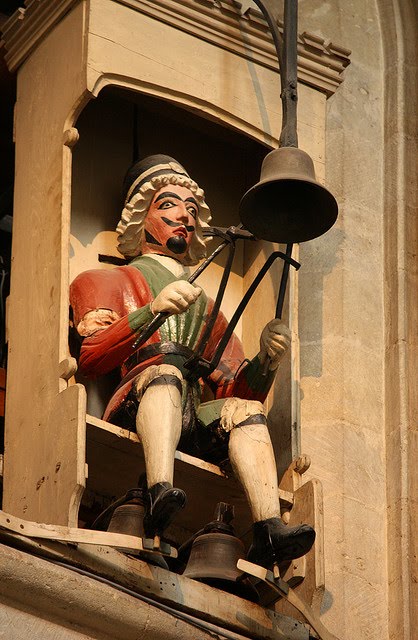
Having finished the piece on Wells I immediately went hunting for my copy of Barchester Towers. Because of Morris and, indirectly dear David, I feel a Trollope reread coming on.
29 agosto - San Giovanni Decollato
Saturday, August 28, 2010
I Am Not A Shoe Fetish! Honest!
Its just I can't get over the shoes on display here in Italy. Not just in the high fashion centres like Milano or the slightly lower fashion (except in its own mind) Roma but in the high end shops in towns like Pesaro.

Though these are not as outrageous as some of the footwear on display in Milano I am still trying to figure out where the smart upper middle class woman would wear these in Pesaro???? Though for some reason I am seeing them with a multi-pleated thirties style dress in a soft brown with matching fur at the cuffs in a revival of The Women. I really must stop watching those 30s movies!
28 agosto - Sant'Agostino d'Ippona

Though these are not as outrageous as some of the footwear on display in Milano I am still trying to figure out where the smart upper middle class woman would wear these in Pesaro???? Though for some reason I am seeing them with a multi-pleated thirties style dress in a soft brown with matching fur at the cuffs in a revival of The Women. I really must stop watching those 30s movies!
28 agosto - Sant'Agostino d'Ippona
Friday, August 27, 2010
The Highwayman - A Memory Piece
I've often thought that memory is much like one of those elaborate Chinese medicine cabinets with a hundred drawers with brass handles. Some of the drawers are opened often while others only occasionally. And then there are drawers that were opened many years ago and never touched again. One of those last drawers popped open for me tonight - though considering how long ago it was that I last opened it the wonder is that it didn't creak and resist.
Walking home from dinner at Stella Maris, our local trattoria - nothing fancy just good home cooked Sardo food and always a table available for the Canadese - I noticed a misty ring around the moon and for some reason a poem from grade school sprung to mind. I was carried back to a basement classroom at Franklin Horner Public School and Miss Vardi teaching us the words, rhythm and cadence of Alfred Noyes' most famous work: The Highwayman.
 I searched for the drawing that I recalled from our text book but nothing showed up or at least not as I remembered it. But I thought this rather dark and brooding rendering captured the spirit of the poem.
Having just reread it I can now understand why we were encourage - nay made - to learn it as both a memory and a literature exercise. It is a fine piece of action and descriptive writing. Now I can see its usefulness as a language tool - I only wish I had remember that when I was teaching English to my Polish Generals in Warsaw. The vocabulary is challenging enough - how else would I have ever learned what an ostler was; not that I ever recall using the term in general, or come to think of it even specific, conversation. But I think it is the use of action verbs and the descriptive language that make it such a great piece for teaching English. And aside from that it is, to my uneducated mind at least, still a damned good read.
I can almost forgive Noyes for his other well-known poem The Barrel Organ which includes the lines:
27 agosto - Santa Monica

Walking home from dinner at Stella Maris, our local trattoria - nothing fancy just good home cooked Sardo food and always a table available for the Canadese - I noticed a misty ring around the moon and for some reason a poem from grade school sprung to mind. I was carried back to a basement classroom at Franklin Horner Public School and Miss Vardi teaching us the words, rhythm and cadence of Alfred Noyes' most famous work: The Highwayman.
The wind was a torrent of darkness upon the gusty trees,
The moon was a ghostly galleon tossed upon cloudy seas,
The road was a ribbon of moonlight looping the purple moor,
And the highwayman came riding--
Riding--riding--
The highwayman came riding, up to the old inn door.
He'd a French cocked hat on his forehead, and a bunch of lace at his chin;
He'd a coat of the claret velvet, and breeches of fine doe-skin.
They fitted with never a wrinkle; his boots were up to his thigh!
And he rode with a jeweled twinkle--
His rapier hilt a-twinkle--
His pistol butts a-twinkle, under the jeweled sky.
Over the cobbles he clattered and clashed in the dark inn-yard,
He tapped with his whip on the shutters, but all was locked and barred,
He whistled a tune to the window, and who should be waiting there
But the landlord's black-eyed daughter--
Bess, the landlord's daughter--
Plaiting a dark red love-knot into her long black hair.
For the rest of this exciting poem, and believe me it is exciting, just click here.
 I searched for the drawing that I recalled from our text book but nothing showed up or at least not as I remembered it. But I thought this rather dark and brooding rendering captured the spirit of the poem.
Having just reread it I can now understand why we were encourage - nay made - to learn it as both a memory and a literature exercise. It is a fine piece of action and descriptive writing. Now I can see its usefulness as a language tool - I only wish I had remember that when I was teaching English to my Polish Generals in Warsaw. The vocabulary is challenging enough - how else would I have ever learned what an ostler was; not that I ever recall using the term in general, or come to think of it even specific, conversation. But I think it is the use of action verbs and the descriptive language that make it such a great piece for teaching English. And aside from that it is, to my uneducated mind at least, still a damned good read.
I can almost forgive Noyes for his other well-known poem The Barrel Organ which includes the lines:
There's a barrel organ carolling across a golden streetOnly Verdi! Shame on you Alfred, shame on you.
In the City as the sun sinks low;
Though the music's only Verdi there's a world to make it sweet
27 agosto - Santa Monica
Thursday, August 26, 2010
Dance, Dance, Dance Little Lady
Though I am no longer working - my choice by the way - I am still having a bit of trouble finding time to get the posts on Pesaro and the trip to Umbria completed but they will come - no honestly they will. In the meantime I'm struggling through the monthly task of translating items for Ballet2000. One can only hope that working with the flowery and complicated proses of dance criticism will teach me to temper my own writing when it comes to reviews.
In the meantime, as a break from making a 95 word Italian sentence with three subordinate clauses but not a principal clause in sight into readable English, I thought I'd post some dance related caricatures from the wonderful world of Einar Nerman.
 In the classical dance world of the first half of the 20th century there was no hope of success unless you had a Russian or French name. Thus Alicia Marks from Finsbury Park became Alicia Markova and Patrick Healey-Kay from Slinfold, Sussex became Anton Dolin. No matter what their names theirs was an incredible partnership that galvanized the dance world between the Wars and guided it as teachers, choreographers and company founders and directors after they retired from the stage.

There is a bit of a Rossini connection in this one. La Boutique Fantastique* (sic) was a ballet created by Léonide Massine for Serge Diaghilev's Ballets Russes in 1919 and is set to a suite of music adapted by Ottorino Respighi from piano pieces by Rossini. It is the familiar story of toys in a shop that come to life after hours. The Can-Can Doll was one of Lydia Lopokova's signature roles.
 Much as been written about Serge Diaghilev (in fact a new book was just reviewed in the New York Times), a man who's only talent was the ability to recognize and nurture the talent of others. It difficult to imagine what the world of dance, music and the visual arts would have become if he had not encouraged so many dancers, artists, choreographers, writers and composers to exercise their creativity. Here he's shown with dancer Anna Pavlova, designer Leon Bakst and composer Igor Stravinsky.
 This drawing always makes me smile - Nerman captures both the fluidity and the foolishness of the great Isadora Duncan. Just as he captures her with his lines so that remarkable writer Janet Flanner captured her in words in her profile for The New Yorker written in 1927 just after Isadora's death.

The Austerlitz kids from Nebraska did pretty damned good for themselves. Fred and his older sister Adele formed a partnership at the age most children were starting grade school. It led them to New York, London and the entertainment capitals of the world and along the way they changed their last name to Astaire. Shows, skits and songs were written for them and after their split up in 1932 they both went on to successful careers: Adele as the wife of first a British Lord and then a CIA director. As for Fred I'll once again quote from the New Yorker:
 The Music Hall of the 1920s-30s had a fascination with the pan-sexual. Perhaps it reached its zenith with Barbette - a Texas trapeze artist who performed in drag - but was certainly seen in many acts of the time. The Rocky Twins were two young and beautiful Norwegian dancers whose European careers took off when they appeared in Paris just after their 18th birthday. They were adored by the French audiences and were popular throughout Europe. They were so alike that it was often said that you could never tell which one you were talking to or which one you had slept with.
*The ballet is actually titled La Boutique fantasque and was mislabeled in the compilation of Nerman's drawings published by HARRAP.
More of Nerman's delightful caricatures are posted here and here.
26 agosto - Sant'Alessandro di Bergamo

In the meantime, as a break from making a 95 word Italian sentence with three subordinate clauses but not a principal clause in sight into readable English, I thought I'd post some dance related caricatures from the wonderful world of Einar Nerman.
 In the classical dance world of the first half of the 20th century there was no hope of success unless you had a Russian or French name. Thus Alicia Marks from Finsbury Park became Alicia Markova and Patrick Healey-Kay from Slinfold, Sussex became Anton Dolin. No matter what their names theirs was an incredible partnership that galvanized the dance world between the Wars and guided it as teachers, choreographers and company founders and directors after they retired from the stage.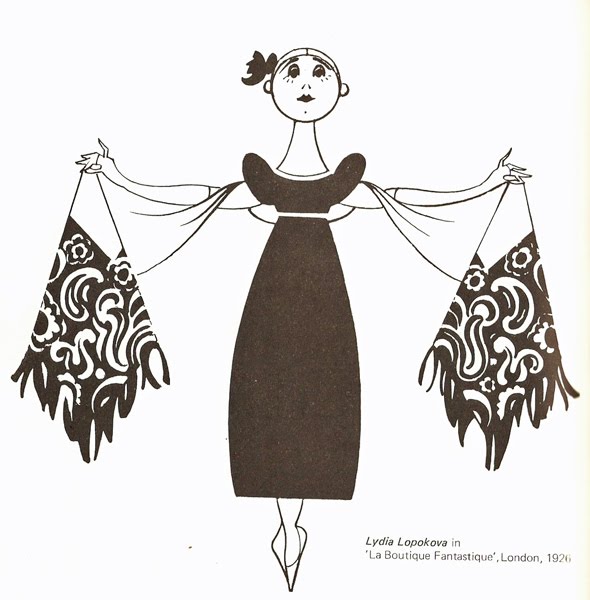
There is a bit of a Rossini connection in this one. La Boutique Fantastique* (sic) was a ballet created by Léonide Massine for Serge Diaghilev's Ballets Russes in 1919 and is set to a suite of music adapted by Ottorino Respighi from piano pieces by Rossini. It is the familiar story of toys in a shop that come to life after hours. The Can-Can Doll was one of Lydia Lopokova's signature roles.
 Much as been written about Serge Diaghilev (in fact a new book was just reviewed in the New York Times), a man who's only talent was the ability to recognize and nurture the talent of others. It difficult to imagine what the world of dance, music and the visual arts would have become if he had not encouraged so many dancers, artists, choreographers, writers and composers to exercise their creativity. Here he's shown with dancer Anna Pavlova, designer Leon Bakst and composer Igor Stravinsky.
 This drawing always makes me smile - Nerman captures both the fluidity and the foolishness of the great Isadora Duncan. Just as he captures her with his lines so that remarkable writer Janet Flanner captured her in words in her profile for The New Yorker written in 1927 just after Isadora's death.
In the summer of 1926, like a ghost from the grave, Isadora Duncan began dancing again in Nice. Two decades before, her art, animated by her extraordinary public personality, came as close to founding an aesthetic renaissance as American morality would allow, and the provinces especially had a narrow escape. But in postwar European years her body, whose Attic splendor once brought Greece to Kansas and Kalamazoo, was approaching its half-century mark. Her spirit was still green as a bay tree, but her flesh was worn, perhaps by the weight of laurels. She was the last of the trilogy of great female personalities our century cherished. Two of them, Duse and Bernhardt, had already gone to their elaborate national tombs. Only Isadora Duncan, the youngest, the American, remained wandering the foreign earth.
The Introduction to Isadora from Paris Was Yesterday
Janet Flanner
Harcourt Brace Jovanovich

The Austerlitz kids from Nebraska did pretty damned good for themselves. Fred and his older sister Adele formed a partnership at the age most children were starting grade school. It led them to New York, London and the entertainment capitals of the world and along the way they changed their last name to Astaire. Shows, skits and songs were written for them and after their split up in 1932 they both went on to successful careers: Adele as the wife of first a British Lord and then a CIA director. As for Fred I'll once again quote from the New Yorker:
From “The Gay Divorcee” (1934), two visions of the sublime. First: Fred Astaire getting ready to go out. He’s in a dressing gown, which he removes, slinging it behind his back to his butler. Singing all the while, he chooses one tie, rejects it, chooses another, moves to a mantelpiece at the side of the room, and halts. And then, in a single long take, he dances around a couch and right into his jacket, which is held by the butler, inserts a boutonnière, leaps over the couch, dances around it again, does three heel-clicking leaps, mounts a chair at the door, receives his bowler and umbrella—flipped by the butler—and goes out. Second: Astaire singing “Night and Day,” Cole Porter’s greatest song, and then leading Ginger Rogers, who has been resisting him, into a long dance of seduction, with heart-stopping episodes of aggression, temporary acquiescence, fierce pleading, and, finally, submission, all of it dramatized with dance, as dance.
 The Music Hall of the 1920s-30s had a fascination with the pan-sexual. Perhaps it reached its zenith with Barbette - a Texas trapeze artist who performed in drag - but was certainly seen in many acts of the time. The Rocky Twins were two young and beautiful Norwegian dancers whose European careers took off when they appeared in Paris just after their 18th birthday. They were adored by the French audiences and were popular throughout Europe. They were so alike that it was often said that you could never tell which one you were talking to or which one you had slept with.
*The ballet is actually titled La Boutique fantasque and was mislabeled in the compilation of Nerman's drawings published by HARRAP.
More of Nerman's delightful caricatures are posted here and here.
26 agosto - Sant'Alessandro di Bergamo
Wednesday, August 25, 2010
Fiasco
Apropos of that letter Rossini sent to his mother after the failure of Sigismondo, here's another cartoon by Fillipo Letzi that tells the tale.

I love his work - thanks to the ladies at Casetta Vaccaj for introducing me to him. I'll be posting more about them later this week.
25 agosto - San Luigi di Francia

I love his work - thanks to the ladies at Casetta Vaccaj for introducing me to him. I'll be posting more about them later this week.
25 agosto - San Luigi di Francia
Tuesday, August 24, 2010
The Scuole On Via Sara Levi Nathan
You may recall that last year on my visit to Pesaro I came across a rather unusual and touching memorial to the expulsion of the Jews under the Manifesto of Race enacted in 1938. By that time there were very few Jews living in Pesaro as much of the community had moved to Ancona and the records show that no one was actually deported from Pesaro. However Jewish refugees from Croatia, Germany and Poland had been rounded up but unlike many people they were not herded into internment camps but housed in private homes or hotels in the town. They were required to report to the police daily but there was an unspoken agreement with the local authorities so it was more observed in theory than in practice. They were the lucky ones - others in the Urbino region were not as fortunate and made the journey to camps and almost certain death.
 This poster from the Museum display at the Sephardic Synagogue gives graphic voice to the restrictions placed on Italian Jews with the enacting of the Manifesto of Race in 1938.
It was the repetition of an age old pattern of tolerance-intolerance for the community in Pesaro. There had been a Jewish settlement in the town since 1214; a community that had lived mostly at peace and in a live-and-let-live arrangement with the local rulers and populace. Over the years other Jewish merchants – expelled from the Kingdom of the Two Sicilies - came into the town and integrated into the Italian community. However with the persecution, expulsion and execution, under Papal decree, of the Marranos of Ancona a new community of Portuguese (Shepardic) Jews migrated to the town. A protest blockade of Ancona harbour shed new importance on Pesaro and Guidubaldo Della Rovere was more than happy to welcome merchants, doctors, artisans and commerce into his Dukedom. Though his attitude was to turn less welcoming when the harbour proved too shallow for major trading.
 In 1507 Gershom Soncino opened a printing house in Pesaro and worked there with some interruptions until 1520. He produced, besides books in Italian and Latin, an impressive range of classical Hebrew texts including a book of Festival Prayers thought to date from 1520.
It was at that time that construction was begun on the Shepardic Synagogue in what was the old Jewish Quarter. It is thought that Mordekhaj Volterra, a wealthy Portuguese banker, commissioned and financed the building prior to leaving the city for Firenze where he became Francesco dei Medici's financial and political adviser. This dates the building from between 1556-1559. It housed not only a scuole but community offices, an infant school, a school dedicated to the studying of the Kabbalah and a music school.
 This beautiful Passover plate - typical of the period in design - from the Pesaro Ghetto dates from 1614 and is currently in the Jewish Museum in New York City.
When the Duchy of Urbino devolved to the Papal States in the 1600s a ghetto was created and with the closing of the Italian rite Synagogue outside its boundaries only the Sephardic scuole was left for the community. The boarded up Italian synagogue was badly damaged in the 1930 earthquake and eventually demolished in 1940. During the period of Nazi occupation it goes without saying that the Sephardic Synagogue was closed down.
In 1944 the liberating British Army included an all Jewish regiment who reopened the Synagogue and services were held there for the last time. The building was left abandoned and it deteriorated rapidly. With the agreement of the Jewish Community in Ancona, who own the building, the City of Pesaro took it over and began a restoration project in 1990. Work was finally completed in 2004 and the building opened as a historical site.
 The Sephardic Synagogue is actually on Via delle Scuole a narrow street just off Via Sara Levi Nathan. A bit of investigation revealed that the street was named after the Pesarese Sara Levi (1819-1882), a friend of Mazzini and Garibaldi and the mother of Ernesto Nathan (London 1845-Rome 1921), a Mayor of Rome. The main portal faces the east (Jerusalem) and the small door at the right led to the woman's gallery.
Because it is only open on Thursday afternoon's for a few hours I've never been able to visit it in previous years. This year I decided that as this may well be the last trip to Pesaro for a while I had to see it. It is a small but fascinating piece of Italian and Jewish history.
The ground floor houses an interesting exhibition on life in and around the Synagogue and detailed explanations of the various artifacts and rituals in Italian and English. Rather amusingly of the two possible translations for the Italian Pasqua (Passover or Easter) the English version has the Sephardic community celebrating the Christian festival.
 The communal baking oven was used only for baking of the Passover matzoh which would have been overseen by the Rabbi. Given the size of the oven the matzo would have been baked in small batches - the dough kneaded as a community effort in the same room and put into the oven immediately to avoid contamination from leavening.
We were encouraged by a very friendly lady to go up the staircase to what she said - with obvious pride in her voice and on her face - was a treasure for Pesaro. And she was right - even in its current state the Prayer Room has an incredible beauty.

The large rectangular room was filled with light from three walls of large windows; the fourth wall enclosed the women's galleries. The colours were light - mostly whites, grays, blues and soft browns. Benches lined the walls - contrasting natural wood with panels painted a deep green - the only dark colour in the room.
The east end of the room - facing Jerusalem - has a large niche for the arc - a magnificent carved gilt Aron ha-Kodesh which is now in the care of the Jewish community in Livorno. Likewise the elaborately carved and gilded bimah or reading stand was moved to the Levantine synagogue in Ancona. Unfortunately no effort has been made to recreate them as part of the restoration nor into replacing what must have been the elaborate candle fixtures hanging from the richly stuccoed ceiling.
For some foolish reason I did not get a picture of the west end of the room - a balcony accessed on either side by a flight of marble stairs broken by a landing. On the landings were very badly damaged and faded frescos which I can only hope will be restored - in part at least - in the future. I'm not sure what the balcony would have been used for - perhaps a cantor or since music was so important in the Sephardic rite a choir of some type.
I have often felt when entering a particular mosque, temple, church or synagogue that centuries of people bringing their hopes, their fears, their desires, their needs and their thanks to a place works its way into the walls and gives the place a beauty that all the man made decoration in the world cannot accomplish. For me the Prayer Room of this 460 year old synagogue in the historic backstreets of a small town in Italy had that feeling.
24 agosto - San Bartolomeo apostolo
 This poster from the Museum display at the Sephardic Synagogue gives graphic voice to the restrictions placed on Italian Jews with the enacting of the Manifesto of Race in 1938.
It was the repetition of an age old pattern of tolerance-intolerance for the community in Pesaro. There had been a Jewish settlement in the town since 1214; a community that had lived mostly at peace and in a live-and-let-live arrangement with the local rulers and populace. Over the years other Jewish merchants – expelled from the Kingdom of the Two Sicilies - came into the town and integrated into the Italian community. However with the persecution, expulsion and execution, under Papal decree, of the Marranos of Ancona a new community of Portuguese (Shepardic) Jews migrated to the town. A protest blockade of Ancona harbour shed new importance on Pesaro and Guidubaldo Della Rovere was more than happy to welcome merchants, doctors, artisans and commerce into his Dukedom. Though his attitude was to turn less welcoming when the harbour proved too shallow for major trading.
 In 1507 Gershom Soncino opened a printing house in Pesaro and worked there with some interruptions until 1520. He produced, besides books in Italian and Latin, an impressive range of classical Hebrew texts including a book of Festival Prayers thought to date from 1520.
It was at that time that construction was begun on the Shepardic Synagogue in what was the old Jewish Quarter. It is thought that Mordekhaj Volterra, a wealthy Portuguese banker, commissioned and financed the building prior to leaving the city for Firenze where he became Francesco dei Medici's financial and political adviser. This dates the building from between 1556-1559. It housed not only a scuole but community offices, an infant school, a school dedicated to the studying of the Kabbalah and a music school.
 This beautiful Passover plate - typical of the period in design - from the Pesaro Ghetto dates from 1614 and is currently in the Jewish Museum in New York City.
When the Duchy of Urbino devolved to the Papal States in the 1600s a ghetto was created and with the closing of the Italian rite Synagogue outside its boundaries only the Sephardic scuole was left for the community. The boarded up Italian synagogue was badly damaged in the 1930 earthquake and eventually demolished in 1940. During the period of Nazi occupation it goes without saying that the Sephardic Synagogue was closed down.
In 1944 the liberating British Army included an all Jewish regiment who reopened the Synagogue and services were held there for the last time. The building was left abandoned and it deteriorated rapidly. With the agreement of the Jewish Community in Ancona, who own the building, the City of Pesaro took it over and began a restoration project in 1990. Work was finally completed in 2004 and the building opened as a historical site.
 The Sephardic Synagogue is actually on Via delle Scuole a narrow street just off Via Sara Levi Nathan. A bit of investigation revealed that the street was named after the Pesarese Sara Levi (1819-1882), a friend of Mazzini and Garibaldi and the mother of Ernesto Nathan (London 1845-Rome 1921), a Mayor of Rome. The main portal faces the east (Jerusalem) and the small door at the right led to the woman's gallery.
Because it is only open on Thursday afternoon's for a few hours I've never been able to visit it in previous years. This year I decided that as this may well be the last trip to Pesaro for a while I had to see it. It is a small but fascinating piece of Italian and Jewish history.


At the entrance to the synagogue there was a water stoop for the ritual thrice washing of hands before prayer (top). It still shows signs of the elaborate stucco work that capped it - it is probably that the niche wall would have been painted with an elaborate design. The mikveh (bottom) would have been for total immersion bathing as required prior to Yom Kipper and other occasions. Both were fed by a natural spring.
The ground floor houses an interesting exhibition on life in and around the Synagogue and detailed explanations of the various artifacts and rituals in Italian and English. Rather amusingly of the two possible translations for the Italian Pasqua (Passover or Easter) the English version has the Sephardic community celebrating the Christian festival.
 The communal baking oven was used only for baking of the Passover matzoh which would have been overseen by the Rabbi. Given the size of the oven the matzo would have been baked in small batches - the dough kneaded as a community effort in the same room and put into the oven immediately to avoid contamination from leavening.
We were encouraged by a very friendly lady to go up the staircase to what she said - with obvious pride in her voice and on her face - was a treasure for Pesaro. And she was right - even in its current state the Prayer Room has an incredible beauty.

The large rectangular room was filled with light from three walls of large windows; the fourth wall enclosed the women's galleries. The colours were light - mostly whites, grays, blues and soft browns. Benches lined the walls - contrasting natural wood with panels painted a deep green - the only dark colour in the room.


When the magnificently carved, gilt wooden arc was in its place in the niche it must have been an awesome sight. Even without it the detailing in the stucco work surmounting the niche is impressive. I'm not sure what the Hebrew letters say and would appreciate help from any of my friends who can read it.
The east end of the room - facing Jerusalem - has a large niche for the arc - a magnificent carved gilt Aron ha-Kodesh which is now in the care of the Jewish community in Livorno. Likewise the elaborately carved and gilded bimah or reading stand was moved to the Levantine synagogue in Ancona. Unfortunately no effort has been made to recreate them as part of the restoration nor into replacing what must have been the elaborate candle fixtures hanging from the richly stuccoed ceiling.


What catches the eyes immediately in the room is the marvelous stucco ceiling. A riot of floral and leave patterns in whites and gray it is a delight to the eye. When the few remaining sections of paint were examined it was found that the soft gray background had been achieved by mixing coal black into the paint.
For some foolish reason I did not get a picture of the west end of the room - a balcony accessed on either side by a flight of marble stairs broken by a landing. On the landings were very badly damaged and faded frescos which I can only hope will be restored - in part at least - in the future. I'm not sure what the balcony would have been used for - perhaps a cantor or since music was so important in the Sephardic rite a choir of some type.


The two frescos on the balcony landings are badly damaged but are representations of the Holy City of Jerusalem (top) and the Encampment of the Children of Israel at Mount Sinai (bottom). The three dimensional framing, again a reflection of decoration of the period, is accomplished with painted wood, stucco and trompe d'oeil.


The stucco panels on the walls (top) and over the windows (bottom) avoid any use of the human form in the decoration but reflect the taste of the time for festoons of fruits and flowers with arabesques.
I have often felt when entering a particular mosque, temple, church or synagogue that centuries of people bringing their hopes, their fears, their desires, their needs and their thanks to a place works its way into the walls and gives the place a beauty that all the man made decoration in the world cannot accomplish. For me the Prayer Room of this 460 year old synagogue in the historic backstreets of a small town in Italy had that feeling.
24 agosto - San Bartolomeo apostolo
Subscribe to:
Posts (Atom)