Showing posts with label Jan Morris. Show all posts

Friday, October 15, 2010

The Top of the World

My friend Bev seems to be constantly on the move these days - well even more so than she was in the past which is saying a great deal. When I heard from her yesterday she was in Bhutan having come there from Nepal. Her flight out of Kathmandu took her through the Himalayan range and past the highest point of earth: Mount Everest.

Coincidently I was reading a chapter in Jan Morris's A Writer's World - Morris was on the expedition and the one who broke the story of the conquest of Everest in 1953 by New Zealander Sir Edmund Hillary and Nepali sherpa Tenzing Norkay - when Bev sent out these pictures. Morris ends the chapter with an amusing aside about a formal celebratory dinner in London.
When we returned to London from Nepal we were invited to a celebratory dinner at Lancaster House, the government's official place of entertainment. I found myself sitting next to the major-domo for the occasion, a delightful elderly courtier of old-school charm, while opposite me sat Tenzing Norkay, away from Asia for the first time in his life. The old gentleman turned to me half-way through the meal and told me that the claret we were drinking was the very last of a particularly good vintage from the cellars of Lancaster House, and possibly the last anywhere in the world. He hoped I was enjoying it. I was most impressed, and look across the table to Tenzing, who most certainly was. He had probably never tasted wine before, and he was radiant with the pride and pleasure of the occasion - a supremely stylish and exotic figure. The lackeys respectfully filled and re-filled his glass, and presently my neighbour turned to me once more. 'Oh, Mr Morris,' he said in his silvery Edwardian cadence, 'how very good it is to see that Mr Tenzing knows a decent claret when he has one.'
Jan Morris - A Writer's World
Faber and Faber Limited - 2003

15 ottobre - Santa Teresa d'Ávila
Enhanced by Zemanta

Sunday, August 29, 2010

Of Manners, Mountains and Time

I was introduced to the writing of Jan Morris through my friend David Nice of I'll think of something later. Though we have only met face-to-face once - a wonderful Friday evening of words, music, food and conversation with he and his dipolmate in London back in, my god was it really, February - and our chief method of communicate is the internet I hope I am not being bold in referring to him as a friend. But I honestly feel that "blog buddy" is too casual a term for someone who has given me much - at time vicarious - pleasure with his writing and introduced me to so many authors, composers, artists and fellow bloggers over the past 2 years.

I know I've commented in more than one posting of the fact that if David says You really should read ... or hear ... or see ... he is without fail on the mark. So it was with Morris; after my posts on Trieste he recommend I read Morris's beautiful and rather sad memory book Trieste and the Meaning of Nowhere. That has led me to more of her books - travel, reportage and history. With the Pax Britannia trilogy I found myself in for the long haul - not a difficult read but a winter one if you will. However I found the perfect summer and travel book in A Writer's World; Travels 1950-2000; a collection of articles and essays that Morris wrote over the years for The Times, The Guardian, Life, Rolling Stone and various other publications. It takes us from the top of Mount Everest (Morris was there as a reporter for The Times on May 29, 1953 when Sir Edmund Hillary stood on the summit) to the chilling trial of Adolf Eichmann; through his pre-operation loneliness in Casablanca to the final retreat of Britain from the last outpost of her Empire. First as James than as Jan, Morris covers the Old World, the New World, emerging nations and fading glories from the mid-point of the 20th century to its end. It is a fascinating 50 year journey.

When I say "summer and travel book" I don't mean one of those books you simply put down having read half a chapter and then pick up again after you've refreshed your Aperol spritz. But by its nature as a book of articles and essays its easy to read in bits and pieces and out of sequence. Though reading it through from cover to cover does allow you to see the development of a style that is distinctively Morris. Her view of Hong Kong written in the 1950s has a Chinoiserie tone to it - the language a trifle elaborate. As the century ends so does A Writer's World with a description of the British handover of her Crown Colony in 1997 and Morris's style though no less descriptive and still very much Morris seems less given to baroque turns of phrase. As if, perhaps, the closing in of time has meant an economy of words.

As well as the original articles Morris give us forewards and epilogues to many of the pieces. Thoughts in 2003 of how things have changed since she penned the originals - the places, the political climate, the world, her own attitudes and not to put to fine a point on it, her sex. One of my favorites is this little addendum to her rather unsettling view of London originally written in 1975:

As to the monarchy, it was soon to lose much of its arcane magic - and its remoteness. Years later I was a guest at a Buckingham Palace reception for publishers and writers, and at the end of the evening, wishing to leave, looked around for somebody to thank. Queen, princes, dukes and all seemed to have gone elsewhere, so I left anyway, and at the palace gates I found a policeman. 'I was brought up,' I told him, 'to say thank you for having me when I'd been to a party, so as I can't find the Queen or anybody to say it to, I'll say it to you instead. Thank you for having me.'
He replied stylishly, I thought, but in the new palace mode. 'Not at all, Madam. Come again.'
A Writer's World
Travels 1950-200
Jan Morris
Faber and Faber Limited


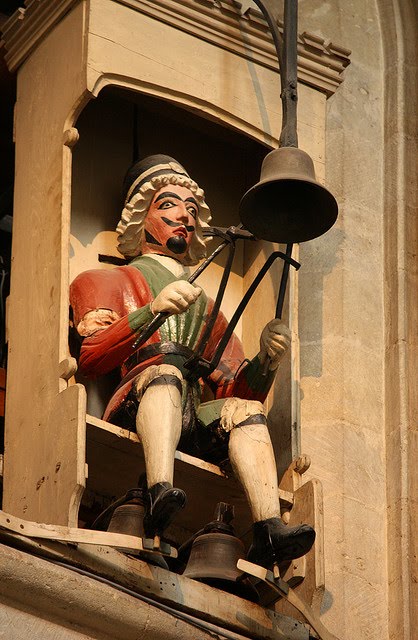
Though Anthony Trollope found inspiration for his fictional Barchester in Salisbury and its environs Morris includes an essay on the town of Wells and its cathedral which recalled for her the comings and goings of the clergy of Trollope's Barsetshire. Reading her description of Wells Cathedral and in particular its remarkable 14th century Astronomical Clock brought to mind an item that was on the BBC last week. After more than 600 years (the announcer says 900 but that would be highly unlikely given the clock dates from 1396) of being hand wound (the past 80 years by members of the same family) the clock is going electric. A click on the clock face will take you to the complete story on the BBC Video.
This photo was taken from the Somerset Church Crawl set posted on Flickr by Lawrence OP. Its one of a remarkable series which includes this fellow who Morris describes as "a dead-pan character called Jack Blandiver, sitting stiffly on his seat high on a wall near by, nods his head, hits one bell with his hammer and kicks two more with his heels."

Having finished the piece on Wells I immediately went hunting for my copy of Barchester Towers. Because of Morris and, indirectly dear David, I feel a Trollope reread coming on.

29 agosto - San Giovanni Decollato

Enhanced by Zemanta

Sunday, April 18, 2010

Back to the Books

Its been some time since I've written anything for the blog - for a few other areas yes but blog entries have been sadly lacking. And god knows that its not that I'm not at the computer! I am! Both at work and at home - often with the two hounds from hell fighting over my lap. However I've decided that I have got to get back to regular blogging but also spend a bit less time at the keyboard.

So last weekend when I joined Laurent in Palermo I didn't take my IBook with me - I won't even go into the IMac saga at the moment. I thought I'd leave the recounting of our trip to him; which he did here and here. He had left a few days before me and got to see more of the city than I, but we both enjoyed it. He had the good fortune to be given a lovely birthday present by our friend Lionel - at a loss as to what to give someone who has almost everything he gifted him with a private guide for a tour of the stunning Serpotta Oratories. It was an original and very thoughtful gift.

As for me I may not have had an IBook but I had a Book! Yes you read right, a Book! So the time spent sitting around both Fumicino and Palermo (due to a confusion in reservations I had an extra 3 hour wait there) airports and the hour long flight to and from were spent reading. Mind you there are worse things that sitting on the terrace by the seaside at Palermo Airport enjoying a good book, a coffee and canoli. Hey you can't go to Sicily and not have canoli.

My choice of reading material was a book I bought last summer when I was on a bit of a Jan Morris kick. I had been to Trieste and my blog buddy David had suggested that as a follow up I read Morris's Trieste and the Meaning of Nowhere. And speaking of David I really do owe him a post about the great evening we spent in London with him and Jeremy. A night of music, fun, food and friendship for which I thank them both and assure him that blog silence on the occasion is the result of my own recent inertia and nothing else.

I had bought, read and loved the Trieste book and followed it up with Conundrum and The World: Life and Travel. Now I felt it was about time that I started into the British Empire trilogy which is one of Morris's major works. The first book, Heaven's Command, traces the Empire from the coronation to the death of Queen Victoria. The breadth of the subject is enormous but Morris has a way of bringing history not only to life but making it intimate and personal.

I grew up at a time when a good deal of any map was pink - indicating the remains of the Empire that even as a new Queen was being crowned was dissolving. I was taught about the glories of the British conquest of India, China, South Africa and Canada - a conquest that brought with it good solid British traditions, prosperity and Christianity. Of course I wasn't taught about the cost of those conquests. Nor was there the least suggestion that being a part of that Empire was less than a privilege and honour.

Writing at a later time and freed of the constraints of that Empire Morris talks with often brutal honesty of the high cost - human particularly - of Empire. And of course there is so much we were never taught in school as it would have conflicted with the official line of the time. Yes as shocking as it sounds most of us now know that we were fed historical propaganda at school.

The chapter on the Afghan war of 1839-42 makes for fascinating reading. At the end of the war 16,000 British soldiers, families and supporters retreated from Kabul. Of that number only one man returned to tell the story of a conflict that involved flawed intelligence, lack of understanding of the people, culture and terrain, hostile locals, tribal rivalries and alliances, religious intolerance (on both sides), a resented installed government, inept British commanders and double dealing Afghan allies. Sound familiar - so much for learning from history!

As I read her chapter on the Great Irish Potato famine of the 1840s I quite honestly found myself tearing up. Her descriptions of the people and the times are heart breaking and at times almost unbelievable. And unlike so many writers she does not come down heavy on one side or the other but looks with equanimity at the natural, the cultural, the religious, the English and the Irish causes of events that changed the face of the country forever. And the same stands true of her handling of the story of Louis Riel and the uprisings in Canada. Again a page of my country's story that when I was being taught history was a whitewash of English Canada of the period and a definite condemnation of the Métis culture of Manitoba.

And so it goes in chapter after chapter - India, Hong Kong, the West Indies, Ceylon - a historical view wealthy in fact, fiction and anecdote. Morris is one of those authors whose personal life is as rich as her writing and who I am content to be returning to. If the remaining two books of the trilogy are as engaging and exciting as the first one - and given that its Morris I'm sure they are - then I'm in for a few weeks of great reading.

18 aprile - San Calogero

Tuesday, July 07, 2009

Quote ... Unquote

I was put on to Jan Morris's Trieste and the Meaning of Nowhere by a comment from David at I'll Think of Something Later and then again by my friend Simonetta. Both assured me that it was a brilliant piece of writing and as always both were right.

Morris began life as James Morris and first visited Trieste as part of the British Forces of Occupation after the war. I won't go into the details of his becoming Jan and the incredible career that has led her to prominence as a writer. Morris has said that Trieste is her last book and if so it is a touching farewell to a city and perhaps for Morris a life that is rich in memories.

The overwhelming tone of Morris's Trieste is one of nostalgia but my own few days there lead me to believe that is a constant in that often forgotten city in the middle of "Nowhere". Here are a few quotes from the book and pictures I took on our visit there.
Trieste is a historical chameleon which is reflected in its architecture. Small alley ways (like the one above down which a drunken James Joyce often wended his way home) lead into piazzas lined with facades adorned in the Austro-Hungarian style. And decorations bear the stamp of so many influences.

Across the world we may see famous old havens now neglected or debased, sometimes simply because modern ships need deeper water or different facilities, but sometimes because their fundamental purpose has been lost. Everywhere once vigorous waterfront areas have been emasculated or mutated, with reconstituted flagstones and fancy fittings, warehouses turned into trendy apartments, novelty shops smelling of pot-pourri, dry docks filled in for more office space. The quays where the lovely clippers berthed in Manhattan now form a maritime museum. The docks in London where the East Indiamen unloaded their jutes and spices have been turned into Docklands, a grim, modish city of corporations. Bristol and Liverpool, one great bases of the Atlantic trade, now find themselves on the wrong side of Britain for the European markets, just as one day Hong Kong may wish it were on the mainland of China after all. Nearly everywhere the jumble of port life, with all its stinks, noises and clashing colours, has been removed from the city centres, and so from the public consciousness.

Trieste is still very much a city of the sea. Morris is right, in that the waterfront has become gentrified and, at least when we were there, was often deserted during the day. In the evening the cafés and trattorias were very much alive but not with seafarers. Simonetta and Sheryl tell me that the Grand Canal - that juts into the city from the sea - was very busy one Thursday evening when they were there.

One evening I heard music in the street, and looking out of my window I saw two strange figures passing. One was a young man in a tall brown hat, blowing on a shepherd's flute. The other was attached by complex apparatus to a variety of apparently home-made instruments - bagpipes, drums, cymbals, a triangle I think - and in order to bet the biggest drum he had to move in an abrupt but creaky shuffle. Slowly and sporadically these engaging characters pottered down the pavement below me, tootling and drumming as they went.

In Trieste that day they were like visitors from another, less inhibited world. They brought a touch of the maverick to this ordered cit. They were musicians from the Karst, strollers from the wild side.

On one side of steps leading from the water to the Piazza is a carabinari bravely entering the Piazza flag flying and on the other side these two women engaged in what appears to be sewing. I wish now I had photographed the plaque explaining it but it seemed to me it had something to do with the World War - the first of that name.

There are places that have meant more to me than Trieste. Wales is where my heart is. A lost England made me. I have had more delicious pleasures in Venice. Manhattan excites me more than Trieste ever could, and so does Sydney. But here more than anywhere I remember lost times, lost chances, lost friends, with the sweet tristesse that is onomatopoeic to the place. What became of that innocent young man I escorted to the brothel on page 123? Dead and gone, and all his horses too, from an English countryside that is no more. The friend who came with me to the schooner on page 69? Still sailing his yacht about the seas, loaded with rank and honour now, but no longer the lithe young bravo who clambered on board with the prosecco that evening. Otto, my natural Triestine, was stabbed to death in Arabia long ago. The woman who slept one dreadful night at the Risiera has gone to her peaceful rest at last. And the stranger I bumped into that day at the Savoia Excelsior? What swinging door is he passing through today, with what arthritic difficulty, and what tender lies is he telling now that he is old and grey?

The ecclesiastical heritage of Trieste is as varied as its history. The Cathedral of San Guisto was built on the site of a Roman basilica and is now a mixture of the modern - a very ugly mosaic over the high altar - and ancient - the very lovely 12th century mosaic (above). The Anglican Church (3rd photo)only holds 6 services a year and the rector comes over from Venice. There is a very strong Orthodox presence - both Greek and Serbian. The Greek cathedral is being restored and extensive work done on its fine fin-de-sciecle mosaics.


Now that I've discovered Morris, Amazon.UK will be showing a profit - I've already ordered her book on Venice, the Pax Britanncia trilogy and Conundrum - her story of her gender dysphoria. And of course I still have much of the Benson books to finish - I really shouldn't be pursuing a job all that seriously when there's so much to read.

Note: All excerpts are from Trieste and the Meaning of Nowhere by Jan Morris, Published by Faber and Faber.

07 luglio - San Pancrazio di Taormina


Reblog this post [with Zemanta]