Showing posts with label Opera. Show all posts

Wednesday, August 13, 2014

Mercoledi Musicale

I mentioned yesterday that a story from Washington Irving's The Tales of the Alhambra was the source of a poem by Alexander Pushkin that gave rise to an opera by Rimsky-Korsekov.  Written in 1834 The Tale of the Golden Cockerel was the last of Pushkin's six fairy tales in verse.

Under the reactionary rule of Nicholas I, intellectuals such as Pushkin were subject to close surveillance and strong censorship.  The poet was angry and frustrated but like many others turned his outrage into his work with a particularly pointed satirical look at a bellicose Tzar who has fallen in to indolent old age - getting rid of his wise counselors and listening to the call of a golden cockerel to warn him of danger. The countries he has once waged war on are now looking of their revenge as they see the once mighty power reduced to feasting and sleeping.

Out of the devastation of the battlefield - in their ineptitude his two sons have killed each other in a fight against the foreign forces -  the enchanting Queen of Shemakha appears (right: Natalia Goncharov's design for the Queen in the Diaghilev production in 1914) .  She totally bewitches the King who leads her back to his Kingdom and proposes to make her his Queen.  However the Astrologer who presented him with the magical Cockerel demands the payment he was promised with disastrous results.

Rimsky-Korsakov saw a similarity between the story of Tsar Dodon, Tsar Nicholas II, the Russo-Japanese War and the events of Bloody Sunday.  Though he had considered The Legend of the Invisible City of Kitezh (1905) to be his last opera he decided that Pushkin's story would allow him to compose " a razor-sharp satire of the autocracy, of Russian imperialism, and of the Russo-Japanese war."  Needless to say when Zolotoy petushok (The Golden Cockerel) was completed in 1907 the  work was banned by the Palace censors.  It was premiered posthumously in 1909 - one year after the composer's death.

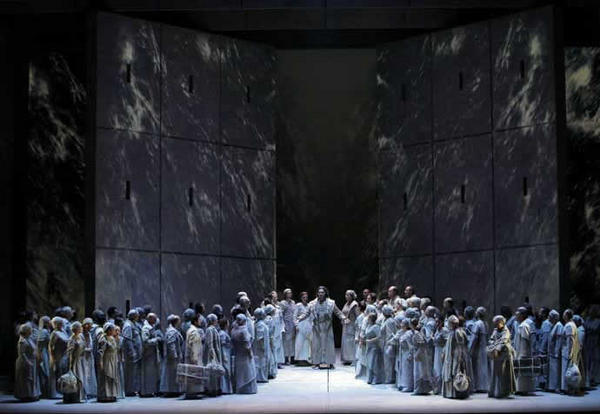
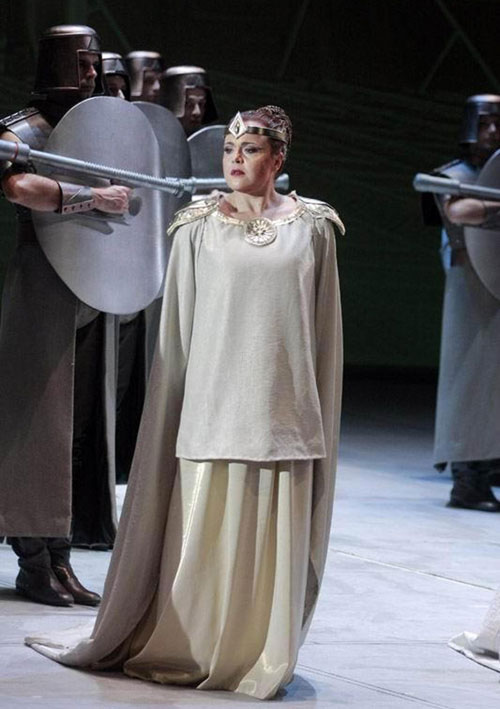
As the mist clears over the battlefield where Tsar Dodon has been mourning the death of his sons a tent is revealed.  As the sun rises the tent opens and the mysterious and beautiful Queen of Shemakha emerges and greets the rising sun.


The Hymn to the Sun is a concert favourite of many a coloratura soprano and has been recorded by many Russian sopranos, Amelita Galli-Curci, Beverly Sills, Mattiwilda Dobbs, Lily Pons and here the South Korean soprano Sumi Jo.  This was recorded during a live performance in Toulouse in 2003.  It's quite easy to see how the old Tsar could become besotted with a voice like this.

Though it is not produced all that often these days there have been some notable revivals and my good friend David saw and reviewed a production in London last month.  It was part of a Diaghilev festival and was a reconstruction of his 1914 production that combined dancers on stage and singers in evening dress at the side.

An illustration by Arthur J. Dixon from "The Arabian Astrologer" for an early 20th century edition of Tales of the Alhambra.

In Irving's Tale of the Arabian Astrologer Aben Habuz, the King of Granada, isn't pecked to death by the Astrologer's talisman but his old age is made miserable by the loss of the beautiful Princess, the forays of the surrounding nations into his Kingdom and the disappearance of the Palace of Delights he had been promised by Ibrahim Ebn Abu Ayub.  But the magical gate that was intended to led to this earthly paradise was eventually to become the Gate of Justice of the Alhambra.  And beyond it was built Al-Ḥamrā, a palace that "in some measure realizes the fabled delights of the promised Garden of Irem."

August 13 - 1792: King Louis XVI of France is formally arrested by the National Tribunal, and declared an enemy of the people.

Wednesday, February 05, 2014

Mercoledi Musicale

So this was all this to-do this past weekend about an opera singer - AN OPERA SINGER I tells ya! - performing the American National Anthem at a major sports event.   When they weren't otherwise occupied with the uproar over a song about the United States being an all-inclusive country sung in foreign languages the waves were atwitter with silliness about how well/badly this opera singer - AN OPERA SINGER I tells ya! - did.

Sorry but I had to snicker behind my hand - well okay a few times I just outright guffawed - at the way both opera fans and the "common man" were treating this as an unusual, never before in the history of human existence occurrence.

Every Sunday night we tuned in
to Ed Sullivan's "Really big show!"
Damn folks, let cast our minds back to a time, not that long ago, when an opera singer on television wasn't such a big deal just part of normal programming.  In those days opera singers were regular guests on many of the variety and talk programmes - hell at one point NBC had its own opera company and its own orchestra (anyone every heard of a guy called Arturo Toscanini?).   And then there was this guy called Ed Sullivan.  He had a show on Sunday nights - the show where Elvis Presley, The Beatles, MARIA CALLAS, the Rolling Stones, The Supremes, JOAN SUTHERLAND,  Ella Fitzgerald, Barbra Streisand, RICHARD TUCKER, the Jackson Five and a whole gang of other song birds strutted their stuff before the households of North America. 

From 1948 until 1971 The Ed Sullivan Show was the quintessential variety show and for that hour from 8:00 PM to 9:00 PM America almost came to a standstill.  It featured everything from ballet to Broadway and often opera was up there with the best and the emerging best in entertainment.

Roberta Peters as Rosina in Il Barbiere - one of her
signature roles.  Her's was a Rosina for the canary
fanciers - but what an extraordinary canary it was!
The record for appearances on Ed's show is held by two Canadians - the witty and erudite Wayne and Schuster with 58 appearances, followed by comedians Jack Carter with 49 and Myron Cohen with 43.  And right behind them in #4 place: opera singer Roberta Peters with 41!  AN OPERA SINGER I tells ya!  Who would have thunk?

Peters was a real American success story, she made her unscheduled debut at the Met in November 1950 at the age of 19 having never sung on a stage in her life.  At the time Met General Manager Rudolph Bing observed: To be thrown on the stage at the Met for the first time like that is a shock few can survive.  Peters did!.  She not only survived but she went on to become an established star at the Met and sang over 520 performances with the company in New York and on tour.   She was a great favourite there and, it would seem, with the audiences across America on Sunday night too!

Perhaps these two clips will explain, a little, why she was a favourite in both the Big Bad Apple and the heartlands.

In a broadcast from 1955 Roberta Peters sings the Doll's aria from Offenbach's Les Contes d'Hoffmann.  I'm not sure but this looks like it could be from The Voice of Firestone, another classic classical television show.


At her audition for the Met Rudolph Bing had her sing the Queen of the Night's vengeance aria from Die Zauberflöte which contains four high Fs.  He had her sing it seven times!  That's 28 high Fs for anyone who's counting.  He was unsure if her voice would carry in a house the size of the old Met and listened from all parts of the auditorium.  It did and would both at the old Broadway house and at the new Lincoln Center Met for the next 35 years.

In 1964 she appeared at the Salzburg Festival as the Queen of the Night in Otto Schenk's production of Die Zauberflöte under the baton of István Kertész.  She subsequently recorded the role with Karl Böhm.  Vocally she is completely in control but that costume and the need to be positioned on the trap seem to literally hobble her dramatic performance.


She was only one of a list of opera singers that included Beverly Sills, Robert Merrill, Franco Corelli, Renata Tebaldi, Birgit Nilsson, Leontyne Price, Anna Moffo, Lily Pons, Jan Peerce, Marilyn Horne, Dorothy Kirsten, George London Eileen Farrell and Eleanor Steber - all who appeared "right here on our stage"!

While looking up some information I came upon these opening and closing paragraphs from an entry on The Ed Sullivan Show:

The Ed Sullivan Show was the definitive and longest running variety series in television history (1948-71). Hosted by the eponymous awkward and fumbling former newspaperman, the show became a Sunday night institution on CBS. For twenty-three years the Sullivan show fulfilled the democratic mandate of the variety genre: to entertain all of the audience at least some of the time.
.............

The Ed Sullivan Show reflected an era of network television when a mass audience and, even, a national consensus seemed possible. Sullivan became talent scout and cultural commissar for the entire country, introducing more than 10,000 performers throughout his career. His show implicitly recognized that America should have an electronic exposure to all forms of entertainment, from juggling to opera.
Ron Simon
Museum of Broadcast Communications
Encyclopedia of Television

An interesting observation.

February 5 -  62 CE: Earthquake in Pompeii, Italy.
Enhanced by Zemanta

Wednesday, December 04, 2013

Mercoledi Musicale

I know that the commemoration of what would have been the 90th birthday of Maria Callas was two days ago but thought I'd wait a day or two as the internet was awash with tributes on December 2.

As a young opera queen goer I was not a big Callas fan - my taste ran more to (gasp!) Renata Tebaldi for Verdi-Puccini and Joan Sutherland for the bel canto.  I did have - and oft played - her Mad Scenes recording with its famous Anna Bolena finale.  That I had to admit was pretty damned exciting stuff.  She only made two appearances in Toronto during her career: once on October 21, 1958 when she performed in concert at the mammoth Maple Leaf Gardens hockey rink and again during her, sadly unsuccessful, farewell concert with Giuseppe di Stefano on February 21, 1974 at old Massey Hall.  

My appreciate of her came later in my opera-going life, long after she had retired from both singing and public life.  I came to realize that there is more to singing than beautiful sound - there is the ability to take a piece of music and with it create a vast array of emotions in the listener.  The sounds may not always please the ear but they touch the heart - and perhaps more to the point the gut.   I recently heard it explained that Callas was a "great artist" not necessarily a "great singer".  I think I know what the commentor was getting at - particularly as she ran into more and more vocal difficulties after 1958.

Though she sang Puccini and Verdi on stage, notably Tosca, La Traviata and Macbeth, she was best known for her bel canto roles - Anna Bolena, La Sonnambula, Norma, Il Pirata.  However in the recording studio she committed many of the Puccini and Verdi roles to disc.  Desdemona in Verdi's Otello was a role she never sang on stage and only recorded excerpts from in 1963.  By that time the voice was in decline - a decline that many claimed had started as early as 1955 - but that ability to take a piece of music and with it create a vast array of emotions was still there.  Some may not consider it great singing but no one can deny that it is great, and moving, artistry.

As her gentlewoman Emilia brushes her hair, Desdemona prepares for bed and she recalls a song that Barbara, a maid of her mother's sang after she had been deserted by her lover.  Frequently she breaks off to refer to the poor jilted mad girl; at one point the wind at the shutters frightens her; as Emilia leaves she is suddenly gripped with anguish and bids her not "good night" but "addio - farewell".   Turning to her prayers she says her Ave Maria - her voice fading away into troubled sleep as she repeats:
per noi, per noi tu prega, prega
sempre e nell'ora della morte nostra,
prega per noi, prega per noi, prega.
Ave Maria. . .
nell'ora della morte.
Ave!. . .Amen!
for us, pray for us, pray
now and at the hour of our death
pray for us, pray for us, pray
Ave Maria....
at the hour of our death.
Ave! ....  Amen


While I was doing a Google search - they did a wonderful tribute to La Divina on December 2 - for an image I came across an Al Hirschfeld caricature that I had never seen before.  It is Callas as she appeared in the finale scene of La Sonnambula in Luchino Visconti's production at La Scala in 1955.  No longer Annina, the simple village maiden of Romani's libretto but a grand diva of the ottocento - bejeweled, grand and showing us the vocal technique at her command.   As he always did I think Hirschfeld caught the essence of the character and the singer - both as seen by Visconti and projected by Callas.


December 4 -1909: 1st Grey Cup game is played. The University of Toronto Varsity Blues defeat the Toronto Parkdale Canoe Club 26–6.
Enhanced by Zemanta

Saturday, December 22, 2012

Pussy Cat, Pussy Cat Where Have You Been?

Well actually I've been to London if not to visit the Queen then to do quite a lot of things in four short days.
This delightful lithograph in the lobby of the National Theatre proves that
many cats can indeed look at a Queen!  Sadly I didn't make a note of the artist's
name or the title and the National website gives no clues.

I first visited London when I was 19 in 1969. Up until then the farthest I had been away from home was New York one Christmas with my mother (when we had the embarrassing scene with the unsuccessful attempted to "poison" me with "uncooked" hamburger at Schrafft's Restaurant) and Nassau with my friend Eugene (who saved me from drowning two hours after we arrived and has suffered with a bad back ever after). You would think that those two episodes alone might have killed any urge I had to travel but no, that May I set off on the first of many voyages to London; and I was to cross the Atlantic once again three months later en route to Austria.  In those heady years of high salaries, working for the airlines and living at home if I had been eligible for air points (if such a thing had existed) I would have had enough to do around the world within a year or two. The trips were frequent and mainly to Europe and many of the trips meant time spent in London - sometimes only for a day or two.

The reason for that first trip was opera - The Glyndebourne Festival and the Royal Opera at Covent Garden. Then there was the theatre - Love for Love with Geraldine McEwan at the National Theatre (still housed in the Old Vic back then), Sarah Miles and Eileen Atikens in Vivat Vivat Regina and a trip down to Chichester to see the incomparable Alistair Sim and a very young Patricia Routledge in Pinero's The Magistrate. 

Well 43 years later I arrived at Heathrow a week ago Thursday past for a few days and the principal motivation once again was opera - plus ca change!!

The Royal Opera House was staging a rare revival of Meyerbeer's Robert la diable  - the last time the infamous ghostly ballet of debauched nuns danced on that stage was 1890.   And in one of those strange little quirks of serendipity the National Theatre (in their South Bank home) was presenting The Magistrate with John Lithgow as the beset-upon Mr Posket.  Did I mention "plus ca change"????
Not only the shops in Mayfair were dressed up for the season;
though this little girl was not at all impressed with the Candy Cane.

And if there's a Candy Cane man, you just know there had to be
a Candy Kiss on roller skates nearby - after all it is London.

I really meant to go and check that the crows were still at the Tower after
encountering this rather exotic outfit at the M and S check-out. However the Russian gentleman
with the fat wallet with her seemed rather pleased with his lady so....  chaqu'un as they say.

There were, of course, quite a few added attractions - my dear Fotis was coming in from Athens for the opera and we had seats together (quite by accident) in the front row of the amphitheatre; Chantal, a colleague from Rome was on temporary duty at the High Commission and I had an invitation to stay with her and a night out at the National; and David and the Diplomate had issued an invitation to Sunday lunch.  It was going to be a full four days.


Although the landscapes don't quite marry up it is possible that the artist intended the portraits of Ashraf 'Ali Khan and his mistress Muttubby to be a facing each other in a book. Dip Chad is one of the few artists of the period of whom much is known and his style is distinctive for its experimentation and subtle use of colour.  For some reason the portrait of Muttubby reminded me of Magritte - funny the associations our minds make.
From the catalogue for MUGHAL INDIA, British Library

But of course being London there were all the serendipitous events that pop-up in what is still after all these visits one of the most exciting cities on the surface of this ever shrinking globe.  At 1430 on Thursday afternoon Fotis phoned to say that he had an extra ticket for the (sold-out) Hollywood Costume exhibition at the V and A and to get my lily-white over there by 1530 if I wanted to see it.  And see it I did - and met his friend Irini Kyriakidou who, as well as being a very beautiful and talented soprano in her own right, just happens to be married to Bryan Hymel who was singing the eponymous Robert.  Which then led to an opportunity to go backstage after the performance followed by a late night dinner in Covent Garden with Irini, Bryan, Fotis and their friend Sascha.  An e-mail exchange with David about Sunday's lunch led to an unplanned trip to the British Library to see a splendid exhibition of books and illustrations from the Moghul Period in India.  And Sunday lunch as well as bringing the delights of a perfectly cooked joint of lamb placed me in the company of David, Diplomate and Edward, a fascinating gentleman with an equally fascinating history.

And my faithful travelling companion Sidd accompanied me to Pink to look at shirts but frankly was more interested in getting his photo taken with Santa.  I mean where else but London would you find a Pink Santa?

Some how I managed to squeeze a trip to Seldfridge's and a quick pop by Fortnum and Mason to see their very disappointing windows this year - no moving figures and more advertisement than anything - with a stop behind them at Pink on Jermyn Street.  To make up for the disappointment of not spending £175.00 on that great shirt I headed back to the V and A again.  A walk-around their remarkable Medieval Galleries, a look-in at the Raphael's and a saunter through the English Renaissance displays was almost as good as retail therapy.

You could almost miss this beautiful little 13th century ivory fragment from Northern England in the midst of all the glories of the Medieval galleries at the V and A.  Carved from a walrus tusk it depicts Joseph of Aramathea supporting the body of Christ as it is removed from the cross.  Strange how a small piece of ivory can be turned into something so moving.

A full but strangely not exhausting few days that proved that even after the many visits I am very much not "tired of life".

"Why, Sir, you find no man, at all intellectual, who is willing to leave London. No, Sir, when a man is tired of London, he is tired of life; for there is in London all that life can afford."
— Samuel Johnson to Boswell,
September 20, 1777.

22 December -1890: Cornwallis Valley Railway begins operation between Kentville and Kingsport, Nova Scotia.

Enhanced by Zemanta

Wednesday, October 17, 2012

Mercoledi Musicale

Several years ago as I was returning from Bologna to Roma on the train I listened to a podcast that I had downloaded a year or two before.  I'm sure that most of us have those on our iPods, iPhones or whatever we listen to music on these days - those things we always meant to listen to but never got around to it.  It had been posted by Charlie Handelman on his podcast  Handelmania - a incredible series of over a hundred podcasts uploaded between March 2006 and November 2010.  Charlie produced a remarkably eclectic potpourri of things operatic - live broadcasts, old 78s, pirated recordings, private tapes - ranging from the earliest days of recorded sound to the most recent performers: his last podcast was arias by Piotr Biczala, a Slavic tenor who had just appeared with some success on the scene in New York.

Most of  Charlie's programmes were built around themes - a favourite singer on their birthday, a memorable performance from the past, a vocal type or national operatic style or a particular aria, duet or ensemble.  In the case of the podcast on the train it was devoted to one duet from an opera that has never been part of the standard rep but has recently gained a niche in European opera houses.  Erik Korngold's Die Tote Stadt had its double-premiere in December of 1920 and became a world-wide success in all the major opera houses.  It disappeared from German and Austrian houses with the advent of Nazism and after its initial success did not reappear elsewhere with any frequency.  Its rather purple prose libretto (the work of the composer's father the renowned Viennese music critic Julius Korngold) doesn't work in its favour and the lush score is not to everyone's taste but two pieces became popular as the work itself faded from sight: the baritone aria Tanzlied des Pierrots and the duet Mariettas Lied.  

Charlie Handelman's programme centred around eleven versions of this lovely melody in its original form for soprano and tenor.  But it is also a favourite as a soprano solo in recital and one of the loveliest version is by the late Spanish soprano Pilar Lorengar.  I saw this greatly underrated singer three time on stage - as Euridice in Orfeo with Shirley Verrett at Covent Garden, in a ghastly production of Mitradate, Re di Ponto at the Salzburg Festival and in concert in Toronto.  It was at the later that I committed one of my numerous faux pas when approaching a celebrity for an autograph.  A very gracious smiling Lorengar was signing my program as I gushed:  I saw you in that dreadful Mitradate last summer!  No I mean it was dreadful not you!  You were wonderful! It was the production that was dreadful! Unfortunately I kept putting the emphasis on the word "dreadful". Fortunately my friend Alan was there to push me aside and do his normal charming shtick, leaving a rather perplexed soprano wondering why this mad man had called her dreadful! 


Glück, das mir verblieb,
rück zu mir, mein treues Lieb.
Abend sinkt im Hag
bist mir Licht und Tag.
Bange pochet Herz an Herz
Hoffnung schwingt sich himmelwärts.

Wie wahr, ein traurig Lied.
Das Lied vom treuen Lieb,
das sterben muss.

Ich kenne das Lied.
Ich hört es oft in jungen,
in schöneren Tagen.
Es hat noch eine Strophe --
weiß ich sie noch?

Naht auch Sorge trüb,
rück zu mir, mein treues Lieb.
Neig dein blaß Gesicht
Sterben trennt uns nicht.
Mußt du einmal von mir gehn,
glaub, es gibt ein Auferstehn.

Joy, that near to me remains,
Come to me, my true love.
Night sinks into the grove
You are my light and day.
Anxiously beats heart on heart
Hope itself soars heavenward.

How true, a sad song.
The song of true love,
that must die.

I know the song.
I heard it often in younger,
in better days.
It has yet another verse--
Do I know it still?

Though sorrow becomes dark,
Come to me, my true love.
Lean (to me) your pale face
Death will not separate us.
If you must leave me one day,
Believe, there is an afterlife.
Original text by Julius Korngold under the pseudonym Paul Schott
English ranslation by Lisa Lockhart (aida_figaro@hotmail.com)


In the context of the opera itself it is sung by the music hall entertainer Marietta to Paul - who is obsessed with his dead wife Marie, who Marietta resembles.  There are several versions on YouTube and one of the best dates from a gala at the Deutsche Oper Berlin in 1986.   By then soprano Karen Armstrong's voice was beginning to show signs of wear but Marietta had been one of "her" roles and she shows why.  One wonders how Siegfried Jerusalem was able to resist her charms.


A quick google to find out what Charlie Handelman is doing these days reveals that he has revived the podcasts in November of 2011 and has added a web version in the past few months.   And he continues to delve into his treasure chest of rare and wonderful items from the past - the first thing I heard from the new iTunes podcast was excerpts from an 1929 Aida that he had transcribed from 78s.  He tells us that this was the first opera recording he ever heard and that he had lugged them home from the lending library in Flatbush.  He rather amusing remarks that "If not for this recording, I would have been a normal human being."

I've now discovered over a hundred more items to download and listen to on the bus in the mornings.  Thank you Charlie.

October 17 - 1814: London Beer Flood occurs in London, killing nine.


Enhanced by Zemanta

Friday, January 28, 2011

The Ring Continues - La Scala December 10, 2010

As I mentioned in December I went up to Milano mid-month to see the opening opera of the new season at La Scala: Die Walküre , the second installment of their new Der Ring des Nibelungen. I been there in May last year when the cycle began with Das Rheingold and reviewed it at that time for Opera Britannia. Once again the kind editors (Faye and Anthony) had arranged for me to be there as both an opera lover and their critic.

Unfortunately a combination of Holidays and a hacker - the deadly H and H combo - resulted in many of the December reviews at Opera Britannia being delayed in posting but they were finally able to get things sorted out and my thoughts on the new season's opener where published today.

A left click on the poster from the December 10, 2010 performance will take you over to Opera Britannia and my review.


28 gennaio - San Valerio di Saragozza
Enhanced by Zemanta

Monday, January 17, 2011

San Riccardo di Roma

This observation - I won't call it a review because I am becoming more and more aware of my limitations as a reviewer - of the December 9th performance of this season's opening work at the Opera here is long overdue. But finally here it is.

Perhaps it is no mistake that Riccardo Muti has found his way to a city known for its churches and priestly population. More and more in the past few years he has taken on an almost priest-like aura as he mounts the podium in opera houses and concert halls in Salzburg, Ravenna, New York or Chicago. Going to a Muti performance seems to have become an almost religious experience for his followers. A hush falls about the hall as he enters the pit and god help the person that interrupts the mysteries with unnecessary movements, coughing or applause before the final note has sounded - they are liable to be silenced by the horrified reaction of the devout or even worse a glare from the high priest himself.

Moïse (Ildar Abdrazakov) and the Hebrews hear the Mysterious voice issuing from the flames telling them to leave the yoke of Eygpt. The flaming pillars are an example of the effective use Pier'Alli made of projections in this production of Moïse et Pharaon at the Teatro dell'Opera di Roma.

Now I am a Muti follower and devotee myself - I have been since I first saw him conduct Don Pasquale in 1971 at Salzburg - what a year that was! Abbado with Rossini, Karajan Verdi, Boehm Berg and Mozart and Muti Donizetti! One of the great joys of the past few years is having the opportunity to see performances he has conducted both in Salzburg and here in Roma. However I am starting to question how far we can go with the hero worship and reverence - we are after all in the opera house or the concert hall not a church or a temple. Music was meant to be responded to and unless its Ambrosian Chant was not meant to be heard in a sepulchred vacuum.

Take in point last month's Muti-led season opener at the Teatro dell'Opera: Moïse et Pharaon. This was Rossini's reworking for the Parisian audience of his earlier Neapolitan work Mosé in Egitto. Many of the big numbers were carried over from the earlier work and others added to meet the requirements of the Opéra for spectacle, dance and the talents of the resident singers. Yes the subject is of a religious nature - though librettists Balocchi and de Jouy somehow work the Burning Bush into the Plagues on Egypt!!!! - but it also has good old fashioned operatic situations woven into the story. Oh sure Moses keeps saying "let my people go" and Pharaoh says "yes, no, maybe" but there's also the forbidden love of Aménophis, Pharaoh's son, for Anaï, Moses' niece, and the conversion of Sinaïde, Pharaoh's wife, to the faith of the Hebrews thrown in for good measure. It pretty much ends according to C. B. deMille - the Hebrews escape through the Red Sea and Pharaoh and the forces of Egypt are drowned but there's a fair bit of digression along the way.

This photo doesn't half catch the brilliant effect of the final scene as the sea parted and Moïse and the Children of Israel made their way through the cascading waters to the other side.
There are quite a few ensembles, chorale moments and the incredibly beautiful Des cieux où tu résides quartet with chorus - but a great deal of the music is Rossini writing for star singers to show off their vocal chops. The very beautifully produced programme - I really must do a posting on the remarkable programmes published here one day - included pictures of all the principle singers, both in costume and civilian dress, who sang at the primiére but search as I might I found no picture of the conductor nor even a mention of his name.

Such was not the case here in Roma in December, the name foremost on the posters was Muti. Though there was "names" among the singers they were secondary to the maestro and were not the reason we were making the journey to Piazza Beniamino Gigli. Not that the maestro in anyway failed us. This is the third time he has led this particular work and his love and familiarity showed. The forces in Roma may not have been as first rate as those at La Scala or Salzburg but the orchestra is constantly showing what can be achieved when working with a demanding taskmaster. However I am starting to wonder - given both that evening's performance and the next evening at La Scala - if all Italian orchestras have problems with their brass sections? Riccardo Zanellato's chorus did some of the finest work I've heard from them in the past four years - and Moïse is one of those works where the chorus is as important as the soloists.

Muti's soloists were a variable and in one a case a questionable choice. Ildar Abdrazakov (above left) has sung Moïse in Muti's two previous productions and his is a powerful, if not dominating, performance and in Nicola Alaimo's Pharaon he had a worthy opponent.
I was expecting much of Sonia Ganassi (right) as Sinaïde but have noticed in the past few performances I've experience that her voice has taken on a very uncharacteristic harshness. Her duet with the equally rough sounding Eric Cutler (Aménophis) almost became a shouting match. Though it should be noted that Ganassi was cheered to the rafters while Cutler received a few jeers from the normally timid galleriste. Juan Francisco Gatell (Éliézer) and Barbara Di Castri (Maria) offered strong support in their few solo passages and to the ensembles. The one miscalculation was Anna Kasyan in the role of Anaï - her is a pleasant but thin voice and she seemed to lack both the breath control and the technique for her big scene. This music was written originally for the great Colbran and adapted for the equally admired Cinti-Damoreau, and no matter how brilliant the conductor requires a singer of equal brilliance.

Director/Designer Pier'Alli's design for the opening of the Red Sea - a spectacular use of projections, lighting and a semi-permanent architectural set. The entire production was the best example I've seen of using modern technology as scenography.
I am not an admirer of Pier'Alli as a director and have yet to see anything staged by him where there has been any real solid characterizations or emotional core but this time I was overwhelmed with admiration for his designs - his use of architectural elements, lights and multiple projections were exceptional. For the first time in my opera going experience I saw modern technology used effectively and seamlessly to enhance and illuminate a production - as a sidebar it made the sloppy projections in the La Scala Die Walküre the following evening look like the work of amateurs. Highest praise to Alli for his designs, Guido Levi for his exceptional lighting and the technical staff at the Teatro for putting it all together.

Shen Wei's modern choreography was an remarkable match for the extended dance sequences Rossini wrote for the original production in Paris.
Equally as praise worthy was the choreography of Shen Wei for the extended dance sequences that make up most of the third act of the opera. Dance was a must for any production at the Opéra in those days and Rossini met the requirement with 20 minutes of pleasant, highly dancable, if not memorable, music. I had read much about Wei in the translations I had done for Ballet2000 but wasn't expecting the simple beauty of his dance patterns and movements. Like Alli's designs his choreography reflected an innate sense of musicality.

And that might well be the watchword for the entire evening - musicality. That sensitivity to, knowledge of, and talent for music that is the mark of a Muti performance. But what was lacking, and frankly seems to now elude the maestro, was any feeling of spontaneity; less a feeling of awed worshipping at the altar of art and more of feeling of joyful participation in the art itself would have made a good evening more than that.

To celebrate the 150th Anniversary of the Unification of Italy Maestro Muti will be giving us Nabucco in March - another work with a religious theme and the added strong patriotic subtext. It is early Verdi, raw and a little rough around the edges a bit like the Risorgimento itself. I can only hope that the Maestro will give us more of the rough and raw and a little less of the religious.

Photos: Falsini for the Teatro dell'Opera di Roma


17 gennaio - Santa Nadia
Enhanced by Zemanta

Tuesday, August 03, 2010

And Music! Always Music! - I

That title will only mean something to CBC radio listeners who tuned into The Transcontinental on Sunday afternoons in the 80s-90s. Hosted for 22 year by Otto Lowy, a charming Czech who found a home in Canada after the war, it was a "musical excursion across Europe" stopping in various places for coffee, pastry, a bit of history and "music, always music!" And it - and he - was always a delight.

My August is going to be a bit like that - except I guess we could say seafood, wine, a bit of history and "opera, always opera". Over the next three weeks I'll have travelled, if not Europe, a fair bit of Italy and seen five operas.


It starts next weekend with a sort of mini-VerdiFest - in anticipation of the real thing in October in Parma. Saturday morning I'm heading up to Verona - five hours by train with a change in Padova now that there's no direct trains - for the opening of Il Trovatore at the Arena (above). Opera in the Arena has been a tradition since the first performance of, what was to become its signature piece, Aida in 1913. This is "GRAND" opera and gave rise to the tradition of elephants, horses and - in one production - giraffes as the stars of big productions of the Italian warhorses. Though it may not have all the glamour of the big names of the old days Saturday hasn't got such a bad line up - Russian barithunk Dmitri Hvorostovsky, Sondra Radvanovsky, Marianne Cornetti (okay she's no Simonato but who these days is?) and Marcelo Alvarez (okay I could do without Alvarez but who else sings Manrico these days?). The whole conducted by Marco Armiliato - who isn't such a bad stick waver.

And apparently directed and designed by Franco Zefferelli as indeed are all five operas at the Arena this year. I say apparently because I'm still trying to figure out how the Zeff will work his trademark bare-chested hunks, donkeys, children and, reportedly, a troupe of Spanish dancers into Verdi's great gloom and doom revenge tragedy. It should be interesting. (That's a scene from his production of Turandot above.)

Sunday its back to Rome on morning train and off to the Baths of Caracalla for the last performance of Rigoletto. Given the track record the past few seasons: a very good Turandot; an Aida that began with the ballet that Verdi forgot to write music for (so it was danced in silence); a Madama Butterfly where little Trouble was more audible than the tenor; a dreadful Tosca (only the second time I have left a theatre before the end of a performance in 57 years); and a disappointing Carmen I was almost willing to forgo this year's offerings. However my friend David Nice - of I'll Think of Something Later and so much else fame - mentioned that an up and coming soprano would be appearing here this year. So I will be heading off to the Via Appia and Caracalla's old bath house to see Jessica Pratt as Gilda. If David says she's someone to hear and keep an eye on - then hear and eye I will. The rest of the cast is so-so but at least conductor Donato Renzetti is a known quantity.

Then its my last two days at work - let's not go there - and then... 10 days on the road. Our annual ferragosto in Pesaro with a detour through San Franscico di Assisi country before coming back to Rome. A bit more about that will follow shortly.

03 agosto - Sante Mara e Lidia

Sunday, June 06, 2010

Salzburger Zeitung - Betulia Twice Liberated - Part I

As has become the tradition of the past few years the PfingstFestspiele began with an opera conducted by Riccardo Muti. The first two years were opera buffa (comic operas) last year an opera seria (tragic opera) and this an Azione sacre (Sacred Theatre piece) - all in the Napoletano style.

Azione sacre was a particularly genre of opera meant for the period of Lent when the theatres theoretically were closed but the impresarios still had singers under contracts and seats to fill. A Biblical subject would be chosen, preferably one with a good moral message and set to music that was often so similar to that heard in opera that there was really very little difference. The azione sacre often included more chorus work as most of those uplifting religious subjects involved crowds praying, imploring or if they were horrid Babylonians cavorting so a choir was needed. And the work was seen in a simplified staging but often with some scenery and costumes. It was a crafty work-round the religious restrictions of the season.

Pietro Metastasio, the great Italian librettist, considered Betulia liberta (Bethulia Liberated) to be his finest azione sacre and it is easy to see why. His take on the apocryphal story of the widow Judith and her victory over the Assyrians is unusual for the subject - it was normal to accentuate the erotic end of things with the beautiful but pious widow seducing the foreign commander but in this case Holofernes never appears. Metastasio centres his story around the inhabitants of the town of Bethulia and their faith under fire during the siege. The seduction and beheading is only described by Guiditta (Judith) in a passage of recitative which is perhaps one of the most powerful descriptions of a murder I have ever heard. And the second act includes a dialogue between Ozia, the Prince of Bethulia and his captive the Assyrian Achior that is a masterpiece of Christian rhetoric and was often cited in theological discussions. It is a solid, concentrated piece of theatre with a clear message of the Power of God through faith - just the message wanted for the Lenten period.

It is thought that Metastasio's work was set to music on at least 40 occasions and for this year's Festival Muti decided to perform two version with music composed at different periods by two composers at very different periods in their artistic lives.
Italo Grassi's model for a scene from Act I of Betulia Liberata - an interesting trio of semi-circular walls revolved around each other. It was an effective use of abstract forms to convey locale and, with Marco Filibeck's lighting, mood.

In 1771 during a tour through Italy a 15-year old Wolfgang Mozart was commissioned to set the libretto by a rich patron in Padua and it was to be presented there during Lent in 1772. For some reason it was never performed then nor during Mozart's lifetime. It is obviously the work of a young composer - Mozart did not have the confidence, or his patron's leave, at that point to so much as change or omit a word of the libretto - but the music that accompanies Guiditta's retelling of her act is intensely dramatic and matches the power of Metastasio's words. And as performed by Alisa Kolosova became, rightly, the centre piece of the work. Theatrically it was stunning as words, music and performance.

It is telling that as a conductor Muti seemed to give a much importance to the recitative throughout the performance as he did to the big arias and choral moments. Speranza Scappucci's provided a pointed continuo that kept the story moving without that often mindless plunking and plucking when everyone wants to just get through it and on to the next big aria.

Though big arias there are: as can be expected some are very formula - a young man writing what is expected of him; while others show the undeniable talent that was forming. All follow the AABA format of the period i.e. Section A is sung, then repeated, Section B (often a contrasting text or emotion) is sung, then Section A repeated with variations. However often the arias are bracketed by the chorus - this is particularly true of the music for Guiditta and Ozia to heighten the emotional impact. It is a well crafted work by any composer, exceptional when you think it was written by a teenager.


With the exception of Maria Grazia Schiavo the young singers in the cast were all new to me. Schiavo appeared in last year's opera at Whitsun and this year after a slightly unsteady start - I may be wrong but I believe she was pregnant unless it was a costume decision to heighten the effect of her pleas on behalf of the besieged people of Bethulia - she delivered her arias with an honest intensity and some lovely but subtle ornamentation. It should be noted that though Muti allows his singers to ornament the da capo section of most arias it is always within certain boundaries of taste. Michael Spyres (left with Alisa Kolosova) sang the strenuous tenor lines of Ozia, the Prince of Betulia, with a fine lyric sense of style and his handling of the theological duologue with Nahuel Di Pierro's fine bass Achior was a model of recitative singing. Di Pierro brought power to his final aria as the foreign Prince recognizes and accepts the power of the God of the Jews.

Amital (Maria Grazia Schiavo) rejoices as Achior (Nahuel Di Pierro) praises Jehovah, the one god as Ozia (Spyres) and Giuditta (Kolosova) look on.

The production by Italian director Marco Gandini was a simple clear telling of the story within Italo Grassi austre setting of three revolving semi circular walls. The chorus - the remarkable Philharmonia Chor Wien - were treated as individuals and the direction of the soloists pointed up the tensions in a group under siege, the people, their leaders and the brave woman who saves them. Gabriella Pescucci's costumes were subdued and vaguely oriental in style with only Giuditta bringing any colour onto the scene - a deep marine blue gown as she adorned herself for her mission and for her triumph a red dress almost the colour of the blood she had shed to liberate her community.
Giuditta (Alisa Kolosova) describes her beheading of the drunken Olfernes in a powerful accompanied recitative that is the pivotal point in both Metastasio's libretto and Mozart's score.

If the costuming kept Giuditta as the focus of the piece so did Kolosova's performance. The young Russian mezzo has only recently appeared on the international scene and appears to have taken a path through various Young Singers projects to her current position with the Atelier Lyrique at the Paris Opera. Muti may have been taking a chance on casting her in the title rule of the centre piece of the Festival but it was a chance that paid off. As I mentioned her handling of the "azione" recitative was riveting and her arias showed a rich voice which promises much for the future.

Muti's Mozart may be a bit old-fashioned but it suits this particular work well. I am always astounded by how he is able to communicate his incredible musicality to his singers and the orchestra. His Orchestra Giovanile Luigi Cherubini is, of course, the "house band" for the festival and play beautifully under his command. The key to anything that has been presented here since he took over four years ago has been the thorough preparation that goes into what is being presented.
The entire team behind Betulia Liberata - production team, conductor, soloists, chorus and orchestra - take their final curtain call at the end of the first performance.

This may have been "minor" Mozart but as always with Muti and his troupe it was a "major" performance. It was going to be interesting to see how the older and more famous - at the time - Niccolo Jommelli handled the same subject in 1743.

All photos by Silvia Lelli for the Salzburg Festival who graciously allows free use of them.

06 giugno - San Norberto di Premontre


Reblog this post [with Zemanta]

Tuesday, March 30, 2010

From The House of Janacek

Its been a mad month of opera going - From the House of the Dead at La Scala at the beginning of March, Mefistofele here in Roma in the middle and last week it was down to Napoli's San Carlo for Maria Stuarda on Tuesday and up to La Scala again for Tannhauser on Saturday. And April 1st brings a new Tosca here at Teatro dell'Opera Roma. I recall there were times in my life when one live performance a year was a treat. Now its seems to be an unending goodie basket!

A few of my thoughts and opinions on some of these outings will be appearing on Opera Britanna, a website devoted mainly to opera and concerts in the United Kingdom but with excursions to North America and Europe.

A click on the La Scala poster will take you to my view on Janacek's From the House of the Dead as presented in Milan on March 4.


30 marzo - Sant'Irene

Friday, January 08, 2010

Things to Come

So the winter season has started musically here in Roma and I'm looking over the next few months and figure we have a fair smattering of good stuff. And quite a few evenings booked.

First up Ute Lemper the German chantootsie - as Walter Winchell use to say - will be doing her Last Tango in Berlin show at the Parco del Musica on January 20. Lemper is an acquired taste - like many of the singers who specialize in this type of music. I find her very much to my taste and a review of her New York performance - in a somewhat smaller venue - by Squirrel over at Parterre Box has definitely whetted my appetite.

The season at Teatro dell'Opera starts here on January 23rd - we have tickets for all the opening nights this year - with my favorite Verdi: Falstaff. It a "new" production by Franco Zeffirelli, conducted by Asher Fisch. Now Zia Zeff has been in the news here lately for making rude comments about, amongst other people, Daniella Dessi, left-wing politicians and reporters and sadly seems to becoming a bit of a joke. His over bloated La Traviata closed this past season to decidedly mixed notices. I have a sinking feeling that this "new" production will be a retread of the one I saw at the old Met back in 1964 - except we won't have Bernstein in the pit.

The Red Poppy
is the first ballet of the new season. This classic of 1920s Soviet ballet was scheduled for November past but replaced at the last minute by more performances of Swan Lake but with big names. It is a real oddity, I'm not even sure its still in the repertory of any of the Russian companies. I'm glad to see that it wasn't canceled altogether as originally thought - its one of those works, like last season's Cleopatra that I've often read about but never thought I'd have a chance to see.

If Bernstein is missing from the new Falstafff, his music will be heard at the Academia Santa Cecilia. Conductor Wayne Marshall will be leading the Orchestra in a mixed programme of suites from West Side Story and Candide but best of all that marvelous chorus will be doing the Chichester Psalms.

The beginning of March brings a trip up to Milan to see the only thing that I found interesting in La Scala's 2010 line-up: Janacek's From the House of the Dead. This is a co-production from several sources including earlier this season at the Met. It was the hottest ticket of the New York opera season so far - the Patrice Chéreau production has been highly praised as has the conducting of Esa-Pekka Salonen. The ensemble work of the cast have made this a must-see piece of great music theatre. Not surprisingly given the audiences in Milan their musty old production of Rigoletto is a sell-out but there are plenty of tickets left for all six performances of this ground breaking piece of music theatre.

The season here will continue with a revival of Boito's Mefistofele in a production using designs from the turn of the last century. As will be the case with the Tosca that is set for April - for some reason the Zeffirelli production from 2008 has been shelved in favour of a reconstruction of the sets and costumes from the premiere back in 1900. I'm not sure what that's all about; it may be an interesting artistic decision though I have a feeling its more about cost cutting. The house owns the designs, the artists are dead and copyright has long since expired so it just may be cheaper. Funny how cynical you become about these things as you watch the political maneuvering that surrounds opera houses here.

The ballet company has another work deferred from last season sandwiched in between revivals of Giselle and Don Chiscotte - L'heure exquise. Based on Sam Beckett's Happy Days it was choreographed by Maurice Béjart for Carla Fracci and Micha van Hoecke. Though I have complained about Fracci inappropriately taking centre stage in so many things here this is one performance of hers I don't want to miss.

March also brings us Woody Allen and his New Orleans Jazz band. And Martha Argerich and a group of friends are doing two programmes of a Brazilian Getaway - tangos and the like by Piazzolla, Ginastera, Ramirez, Guastavino. Unusual programming but should prove interesting. And spring comes in with Claudio Abbado making a rare appearance at Santa Cecilia with a fairly traditional programme of Mendelssohn's Italian Symphony and Mozart's Jupiter but Abbado's traditional should be worth its weight in gold.

And that's just what we have tickets for in the next three months - there's still the stuff we'll hear about at the last minute. Or those performances that my dear Opera Chic will suddenly mention that have me hustling to Vivaticket and the TrenItalia website for those last minute bookings.

08 gennaio - San Lorenzo Giustiniani

Reblog this post [with Zemanta]

Thursday, October 15, 2009

Mercoledi Musicale + 1*

When I was an opera princess neophyte Anton Dvořák's Rusalka was something I remember reading about but it was seldom performed outside of, what was then, Czechoslovakia. The only thing that was ever heard from it was The Song to the Moon - Rusalka, the water nymph who has fallen in love with a mortal Prince, asks the moon to tell him of her love.

I saw it for the first time in London back in the 1980s and I recall it more for the revolutionary - now consider classic - David Pourtney production than the music. A performance of it here last season in an indifferent production made me more aware of Dvořák's incredibly beautiful writing for the orchestra. It has become cliché to say that the orchestra is almost another character but in this particularly work - as in Pélleas et Mélisande which we saw last week - I believe it is true.

It is nice to see it entering the repertory in many places now - New York, Boston, Paris, Toronto - and that more people are becoming familiar with it. The Song to the Moon is a wonderful introduction to it.

Here are two very different but each in their own way unique and extremely beautiful performances of it.


The death, from cancer, at an early age of Lucia Popp robbed the music world of one of the most remarkable voices of the later part of the 20th century. Her Mozart and Strauss were things of beauty. Silvery with a purity that is astounding, she never resorted to tricks she just seemed to open her mouth and the glorious sound rushed forth.


Frederica Von Stade is still very much with us though she is now on her "farewell" tour after a career that spans some 40 odd years. I was a "Flicka" groupie for a long while and followed her around a bit: Donna del Largo in Houston, Cenerentola in Paris, Ullise at Glyndebourne, Cendrillon in Ottawa. She was always a delight - on stage and in person. Hers is a different take on the Song to the Moon but again no tricks just sheer vocalism.

I'm not sure if these two glorious voices ever appeared together but I can only imagine what they would have sounded liked in Rosenkavalier or Cosi.


14 ottobre - Callisto I Papa


Reblog this post [with Zemanta]

Sunday, October 04, 2009

Things to Come - Musical

I wrote this introduction back on September 5 - and never got around to completing the post. Thought I'd keep it and finish off what I was going to say.
Now that feragosto is over things are returning to normal - or a least normal for Rome. Over the past week shops, bars, trattorias and super markets have been reopening or going back to regular hours, though a few places are still doing half-day Saturdays. Just a word on shop hours here - most places are open from 1000 until 1300 or 1330 then open again at 1530 or 1600 until 2000. Many places close on Saturday at 1300 or 1330 and most are not open on Sunday. Trattoria and restaurants are open from 1230 until 1500 for lunch and 1930-2000 often until last guest for dinner. It takes some getting use to - and we have had colleagues who just never catch on - but after a while it makes perfect sense.

Traffic has also returned to normal. During feragosto it was quiet, there were days when you could cross Via Nomentana and not see a car from Porta Pia to the bend at the Russian Embassy - about 3 kms; the hornet hum of motorinos was a mere buzz and the blaring sirens of ambulances heading to near-by Policlinico were few and far between. This morning as we sat with our friend Walter on Regina Margherita everything was as it is for 11 months of the year.
It is now a month later and believe me everything is really back as it was - for better or for worse. But what is for better is that the music season has started. Both the ballet and the opera are back in operation - if on reduced schedules because of the budget cuts. So here's a few things on my calender for the next little while.

  • La Gitana, a 19th century ballet premiered in 1836 in St. Petersburg, is on the cards for this weekend. One of the fine things that former Prima Ballerina Carla Fracci has done with the company here is to revive or re-stage some works that are known only from the history books. They are presented at the small Teatro Natzionale with a reduced company of dancers and orchestra but with fine production values. Next in the series will be August Bournenville's La Sylphide (Maria Taglioni as the Sylph 18th century print) which I recall seeing many years ago in Toronto with the magnificent Eric Bruhn. As well come November we will get a full staging of The Red Poppy - one of those ballets from the Soviet era about the poor Chinese girl trapped in the Western-based opium trade but saved by the love of a Soviet sailor. I recall the Bolshoi performing it - to general derision - when they first toured North America in 1959.
  • The fall season at the Teatro dell'Opera has opened with Debussy's Pelleas et Melisande - and I just saw the cast list and we are getting the second cast. As I have mentioned before most operas here are double cast and you pays your money and takes your chances. That is not to say second casts are bad casts just not necessarily the ones you want to see. And this time around I am frankly disappointed: all the singers are Italian in what is one of the quintessential French operas. The first cast was a top notch French one - this is one time when I honestly feel double casting is a rip off. And it will interesting to see how Maestro Gelmetti and his orchestra handle a work that is really not in their blood.

  • Then I'll be off to Athens in mid-month to visit my friends Yannis and Fotis and go to the ... wait for it... opera. I shouldn't feel ripped off there, one of my operatic idols Anna Caterina Antonacci (left) - who I saw this time last year in Medea - will be singing Gluck's Alceste. And American tenor Gregory Knude is in the cast as well - he was so remarkable in Zelmira at this year's Rossini Fesival. They are doing the French version which I've never heard and Fotis promises me that there may be a chance of making a fool of myself over Mme Antonacci after the performance. He made good on his promise with Agnes Baltsa so... problem is that I am known for saying the wrong thing as I abase myself before celebrities. I will have the infamous Marilyn Horne Ottawa 1986 exchange forever on my conscience.

  • I'm hoping to get up to the Verdi Festival for the Nabucco but tickets are currently not showing as available but I'll keep trying. I always enjoy Parma - the city, the food (yes Dora the ham!) and the Festival.

  • Our concert season starts at the Academia at the end of the month and though it may not be as starry a season as last year its still a pretty good line up. A Russian mini-Festival, under the rather romantic title Passione Russa, will be highlighting some of the better and lesser known works of Čajkovskij, Rachmaninoff and company. Most will be conducted by music director Antonio Pappano (left, photo courtesy OC) though Opera Chic's Uncle Solly - Yuri Termirkanov - is going to show us how the natives do it on at least one occasion. Michael Tilson Thomas will give us his thoughts on the 9th as part of an on-going Beethoven Fest. And Wayne Marshall, who blew us out of our seats literally last year with a very loud Porgy and Bess, is returning to try his hand at Bernstein and Broadway. Claudio Abbado plans to be a bit more traditional with his Mozart and Mendelssohn's Italian. Vladimir Jurowsky with take us to Firezne with a concert performance of Gianni Schicchi starring Juan Pons. Pappano comes back in his yearly foray into Mahler and Georges Prêtre promises to take us through some Brahms. And that's just our subscription, there's a whole pile of other stuff going on throughout the season.

  • The rest of the season is up in the air where opera is concerned. The budget cuts mean that many of Italy's opera houses have no idea what will be happening come the new year. Rome has given hints but a recent letter from Genova suggested they may have to close the house for the rest of the season. La Fenice still hasn't said anything about the new season nor has San Carlo. Bologna and La Scala have both put out their calenders but without much to raise the old opera queen's operaphile's interest though I will definitely go up to Milan to see From the House of the Dead. Palermo may have some interesting things coming up and we are planning to go to Sicily at some point in the new year but other than that nothing else has captured my attention. But then, of course my dear Opera Chic will probably write about something and I'll be rushing to Termini to catch a train to Cremona or Bolzano or Trieste.
Other than that nothing much planned musically over the next little while.

04 ottobre - San Francesco d'Assisi - Patrono d'Italia
Reblog this post [with Zemanta]