Showing posts with label Exhibitions. Show all posts

Friday, February 27, 2015

Exhibition Hopping - Part III

I began writing this post after my second visit to this exhibition in October, 2014, somehow it never got finished and posted.  It ends April 6, 2015 and I think I may just pay another visit.

Douglas Cardinal's design for the Canadian Museum of History (formerly the Canadian Museum of Civilization) was much criticized when it opened back in 1989, as were what was considered the
Disneyfied exhibits.  It has proven to be the most popular of the museums in the Capital region
with over 1 million visitors a year.
The Canadian Museum of Civilization recently changed its name to The Canadian Museum of History.  Other than the cost of all the changeover - signage et al - and the opportunity for new political appointments I'm not sure what exactly the change accomplished.  The building is still the landmark structure that Douglas Cardinal created in the late 1980s - though strangely the Wikipedia entry for the museum made no mention of the First Nations architect until a week or so ago.


The stunning sweep of the Grand Hall has been home to the largest collection of First Nations' totem poles in the world.  And it also houses a plaster cast of one of my favourite pieces:  Bill Reid's The Spirit of Haida Gwaii.
The Grand Hall is an astonishing feat of design and houses an amazing collection of West Coast totems.  At the moment Canada Hall, one of the main exhibition areas has been "closed to make way for the new Canadian History Hall, opening July 1, 2017."  God only knows what new wonders are in store but given the current government's attitude to heritage I am afraid - very afraid.  However the rest of the museum is open and they are still staging interesting exhibitions tracing our history including a fascinating exhibition on the sinking of the Empress of Ireland.

Empress of  Ireland, Canada's Titanic - Canadian Museum of History


A left click on the catalogue cover
will take you to the exhibit website.
For some reason - that well-known Canadian passive-aggressive trait? - the curators felt that it was necessary to add the tag-line "Canada's Titanic" to the name of the exhibit.  Perhaps because it is an unknown marine disaster even to most Canadians they felt it was needed to draw in the crowds.  Mind you this is not an unusual trick in the art world, I recall an exhibition in Milan that trumpeted  Caravaggio where the angle was not the very posthumously trendy artist but his influence on Northern artists. 

And so it was with The Empress of Ireland,  Canada's Titanic: a passing mention of the White Star liner of iceberg fame, but the focus was on the disaster in 1914 that took the lives of 1032 of the 1477 people on board in the 15 minutes that it took the Canadian Pacific steamship to sink.  On May 28 the Empress left the dock at Quebec City an hour and half after it's scheduled departure time of 1500; by 0220 on May 29, not twelve hours later, she lay at the bottom of the St Laurent.  A voyage that had begun with music, laughter, no doubt some tears and high expectations ended swiftly and without warning.

One of two Canadian Pacific steamships that plied the Atlantic the Empress of Ireland was launched
on January 27, 1906 and arrived in Quebec City for the first time on July 7th of that year.  Before
that foggy evening in 1914 the liner had made 95 eastbound crossings of the Atlantic.
The exhibition itself begins with music, laughter and dockyard sounds as you approach the  space via a small gangplank.  One of the most striking things about the exhibition (arranged with the Canadian Museum of Immigration at Pier 21, Halifax) is the sound-scape.   As you progress through the areas the sounds of shipboard life follow you.  The first sound is a Salvation Army Band playing "God Be With You Till We Meet Again" - particularly poignant as 150 members of that religious group lost their lives on that fateful voyage.  As you leave the exhibition it is also the last sound you hear - faintly in the background after having passed a shadow outline of the ship created by the names of all those on board.

A piano - much like the one that graced the Grand Salon of the Empress - is all set appropriate  music
for the first evening out:  The Empress of Ireland Waltz composed in 1906 by Myrtle Wallace.

Between there are the sounds of shipboard life - the ship's bell ringing the hour,  the genteel sounds of first class and the more earthy sounds of life in third class.  The sight and sound images of the ship that tranquil late spring evening are evoked in small items such as the bugle that called first class passengers to dinner, an ingenuous fold out sink from third class, a Sally Ann sing-song in the music room, the murmur of a late night card game, the eerie sound of the engines in the fog covered night.
As the viewer moves closed to that terrible moment when the fog cleared and both the crews of the Empress and the Swedish collier Storstad became aware of what was about to happen the atmosphere becomes heavy, almost menacing - again an effective piece of design.

Abandon ShipAwakened in the nightThe icy watersImage Map
Abandon Ship | Awakened in the night | The icy waters | Image Map
A left click on the ship's bell will enlarge each photo.

As the ship's bell rings the sounds of panic draw you into the heart of the disaster:  a darkened space with one of those bells dramatically spotlit at it's centre.  At first glance the surround projections of drownings and people in panic treading the icy water (the currents at Pointe-au-Père are particularly treacherous and the temperature in the river was around 6C) seemed a bit over-the-top and almost cartoonish; but when mixed with the lighting and sound-scape have an overpowering effect.

A page from the exhibition catalogue shows the impact the disaster had on the culture of the region.
Thought the event is at the centre of the exhibition the aftermath is well chronicled.  The impact on the surrounding communities is documented with photographs of the rescue and retrieval efforts. Newspaper headlines blare the local and international magnitude of the tragedy, letters and wires - CP corporate, news service and more touchingly personal - record the desperate attempts of families to get information about passengers.  And the industry built up around the tragedy - souvenirs, first-hand accounts in tabloids, broadsheets, song sheets and books - are displayed and prove that human disaster has always been big business.

Sailors taking the coffins of children - of the 138 children on board only 5 survived
including Grace Hanagan - off the vessel Lady Gray at the pier in Quebec City.
Photograph: Library of Congress

Within days of the disaster the Government had set up a commission of inquiry - an emergency amendment to the Canada Shipping Act was rushed through Parliament to allow this unprecedented move.  The work of the Commission and the subsequent court battle between CP and the Swedish ship again are documented and well-explained for what were complicated and often politically motivated proceedings.  By the time it had been settled by the British Privy Council in 1919 other events had relegated the disaster into the back pages of history.

Passengers posing for a group photo on board The Empress of Ireland as it departs. 
The stories of many of them can be found on the commemoration website Empress 2014.
Throughout the exhibition we catch glimpses of passengers: some wealthy and well-known, others known only to family and friends:  Sabina Barbour and her two daughters, Edward and Marian Adie, Egildo and Carolina Braga and their young son Rino and many others.  The passenger list was a diverse one including actor Lawrence Irving (brother of Sir Henry Irving), his wife Mabel Hackney and members of their theatrical troupe, the Salvation Army delegation and 300 immigrant workers who had recently been laid off at the Ford Motor Plant in Detroit.

Amongst the 465 survivors was Grace Hanagan, the seven year old daughter of Salvation Army bandmaster Edward Hanagan.  Both her mother and father died in the tragedy and Grace grew up with the memory of that horrible night.  Towards the end of the exhibition there is a CBC video *of the annual Salvation Army memorial for the members who were lost on the Empress and Grace remembers the events of May 29, 1914.  She died at the age of 87 in 1995, the last remaining survivor.

"God Be With You Till We Meet Again" can be heard faintly in the background as visitors walk by a
silhouette  of the ill-fated Empress made up of the names of her passengers and crew.  A moving
commemoration of the worst marine disaster in our history

*A few of the figures given in this 1986 video differ from what is listed in the exhibit.

February 27 - 1861: Russian troops fire on a crowd in Warsaw protesting against Russian rule over Poland, killing five protesters.

Saturday, August 30, 2014

Exhibition Hopping - Part 1

Over the past two months I've seen three exhibitions that have shown the impressive curating teams at three of our Canadian museums. Two have been right here in Ottawa and the third in Montreal.

Gustave Doré: Master of Imagination - National Gallery of Canada


Traditionally the NGC attempts to mount a "blockbuster" for the summer months when the tourists are flocking to the National Capital to stare through the fences at the now inaccessible Parliament Buildings and manouveur the detours and construction that is Ottawa.  In past years it has included a Van Gogh Exhibition (with not a sunflower in sight!!) that drew the biggest crowds in the history of the Gallery.  This year's Exhibition deserves to have a similar success but unfortunately a drop in tourism, road construction that makes access difficult and the sad fact that Doré is not a household name has meant that attendance has been disappointingly low.

The National Gallery and Musée d'Orsay used Doré's well-known illustration of Le Chat botté as their poster for Gustave Doré: Master of Imagination.  A click on the picture will take you to their mini-site devoted to this exceptional exhibition.

If attendance has been low the quality of the exhibition is of the highest.  Of course Doré the illustrator is a known quantity: it is Doré the sculptor and, for me at least, Doré the landscape artist that astounds the most.  As you enter the exhibition area it is difficult to miss Poème de la vigne, the massive (4 metres high and weighing in at 6000 lbs) bronze that was brought to Ottawa on a flatbed from its home at the Golden Gate Park in San Francisco.  But as is often the case as impressive as the large pieces are it is  the smaller exhibits that cause that little catch in the throat that says you are looking at a master at work.

Frolic (Leapfrog) is a bronze from 1881 - a brilliant piece of suspended animation.  Its form and fluidity are a prime example of the talents of the artist as more than an illustrator.  The delicate balance of the work is an astounding piece of calculation.

If his bronzes impressed it was his landscapes, particularly those of Scotland and the Pyrenees that came as a complete surprise.  Unfortunately I found that most of his religious paintings - and he did a great many - reeked of that faux-sanctitity that was typical of French art of the period.  But those landscapes! 

A range in the Pyrenees painted in 1860 - Doré's landscapes are romanticism at its highest - and that is meant as a compliment.

Several years ago the summer show was a brilliant exhibition: The Great Parade: Portrait of the Artist as a Clown.   It celebrated the history of the circus with some 200 lithographs, paintings, photographs and sculptures.  Though Picasso's overwhelming show curtain for Parade had me near tears with its sheer exuberant glory what stuck in my memory were two paintings of French street performers:   Grimaces et Misères (Les Saltimbanques) (1888) by Fernand Pelez and an earlier work by Doré: La famille du Saltimbanque: L'enfant blessé (The Family of Street Acrobats: the injured child (1874).  


 The artist's comment on the painting removes any taint of maudlin sentiment and places the scene in the very real world:
He (the child) is dying.  I wished to depict the tardy awakening of nature in those two hardened, almost brutalized beings.  To gain money they have killed their child, and in killing him they have found out that they had hearts.
When curators Paul Lang, Édouard Papet and Phillipe Kaenel set up the exhibition they wanted to show the often overlooked influence that Doré has had over visual arts up to our own time.  In the work of cinema directors as diverse as George Méliès, Jean Cocteau, Cecil B. DeMille, Carol Reed, Terry Gilliam,  and Roman Polanski entire frames mirror the work of the Illustrator.   And the sway he has held over cartoonists and graphic artists to this day is another aspect of this remarkable man that, until now, has been neglected.

That rocket struck Moon in George Méliès La voyage dans la lune bears a more than passing resemblance to Dore's Frost-Bitten Sun.

During a recent members' night a series of Méliès' films were shown including a Cendrillon which was Doré inspired by way of the Folies Bergère.   At times it was like one of Doré's Contes de Fées come to life at other times pure escapism for the tired tycoon.  And the special effects were remarkable considering Méliès was working with one camera and very primitive techniques.  And a recent viewing of L'Inferno - the first full length silent film ever made in Italy - reveals that many of the tableau vivant and effects are straight out of Doré's famous plates for Dante's masterpiece.  And in more recent times take a look at that Dream Works Puss in Boots?  He remind you of anyone?


Two very different views of Street People by Doré.  Above:  London from a series of studies of Victorian London that accentuate the grim and smog laden atmosphere of the world's largest city of the period.  Below:  The Beggars of Burgos, the former capital of Castille have a more romantic appearance than their Albion neighbours.   Doré's views of Spain were to add to the Romantic notions the French seemed to harbour about the people beyond the Pyrenees.


There are only two weeks left before the exhibition ends (September 14) and I urge anyone in and around Ottawa to catch it while you can.  I certainly plan to make a visit in the next few days - once was not enough.

"How long must one be an illustrator before they become illustrious?" - Gustave Doré

August 30 - 1918: Fanni Kaplan shoots and seriously injures Bolshevik leader Vladimir Lenin. This, along with the assassination of Bolshevik senior official Moisei Uritsky days earlier, prompts the decree for Red Terror.

Tuesday, January 28, 2014

A Gondola on Sherbrooke Street

 They gave the city the name Venetia as if to say Veni etiam – Come again!

Francesco Sansovino
Citta Noblisissima et Singolare - 1581
I have a confession to make: in the many times I've been to Venice I have never taken a ride in a gondola. Nope, not even the traghetti that Venetians use (at €1 a ride) to cross from one side of the Canale Grande to the other.  Oh I've watched the gondolas a million times and even taken the odd picture of a Gondolieri or two - just as a cultural observer of course.  But to actually fork out the money - the last price I heard was €80 for a 40 minute ride* - for a tour through the canals: not going to occur during the lifetime of the reigning monarch. But then I said that about going to Venice during Carnivale and look what happened!


One of the scenographic features of the recent exhibition at the Musée des Beaux Arts was a long wall cut by irregularly placed windows.  Through the windows you could see a gondola - not a priceless antique ceremonial gondola but an ordinary 20th century Venetian gondola.  Not that there is really anything ordinary about a gondola:  they are still handmade of 8 different types of wood (fir, oak, cherry, walnut, elm, mahogany, larch and lime) and are composed of 280 pieces. 


 The etymology of its name gondola is uncertain; it may be a portmanteau word -  the verb dondolare (to rock gently) and the Middle Age Greek kondura or short-tailed boat - older gondolas had a less soaring stern than today´s ones.  Or it may come from the Latin cunula or rocking crib.

The design has evolved greatly over the centuries and to govern further changes was codified by the city of Venice in the mid-20th century.   The gondola is still evolving: its sesto, the scalar ratio between the frames in its shape, is frequently updated.  This allows for changes to be made as gondolas fight the rise of the waves caused by motor boats and cruise liners.  Unlike older gondolas a modern gondola is asymmetrical to account for the position of the gondolier at the right on the stern (yes gondolas are right hand drive!). 

The elaborate stern decoration is called a risso or ringlet (that lovely brass decoration in the picture above) and is said to resemble the swirl of water in the wake of the vessel.  The prow decoration (and somehow I didn't get a proper photograph of this one - how the hell did that happen?) is called a dolfin (dolphin) because of the resemblance to a dolphin's muzzle.  The shape of both decorations has changed over the centuries.  The risso has become smaller and the dolfin has become redolent with symbols of Venice: the upper part recalls the Corno del Dose/Capello del doge (Crown of the Doge); the shank the meandering of the Grand Canal;  the arch signifies il ponte di Rialto and il bacino di San Marco; the comb the city´s Sestieri (six districts); the opposite tooth is Giudecca; while the decorated points between the teeth represent the three main Islands of the Lagoon (Torcello, Burano, Murano).  It should be noted that the cemetery island of San Michelle is missing from this symbolic icon - no point in tempting fate.


Though in the 17th and 18th centuries there were between eight to ten thousand gondolas in the Republic an earlier map from the 1500's by Jacopo de'Barbari suggests that batellas, carolinas and galleys were the major modes of transportation.   Many gondolas where privately owned though there were also gondolas for hire.   Today there are approximate 400 gondolas, all of which are used in the tourist trade or for sporting events.

Gondolas were brightly, at time garishly, painted and laden with gold or silver ornaments and silk draperies and trappings.  In reaction to the extravagant nature of many of the private gondolas the Senate issued a sumptuary law in 1609 that all gondolas were to be painted black.  This did not stop people from adding elaborate  parecio or removable metal ornaments that served no real purpose other than decoration.  Elaborate metal-work (gold, silver, iron or brass), draperies and carvings often graced the felze or cabins that were a feature on gondolas up until the late 1940s.  However these enclosures that served as a source of protection from the sun, rain or prying eyes were removed after complaints from tourists that it blocked their view. 


The rèmo, or oar, is specially made by the rèmer (oarmaker), who exclusively builds oars and fórcola or oarlocks. The wood used for the rèmo is split beech, well-matured and without knots. It is carefully crafted to have a tapered blade at the end; the thickness of the oar gradually diminishes, which allows the oarsmen to row more with greater ease and agility.   A gondola is rowed not punted and the design of the boat and the oar mean that the effort required to paddle one with two people on board is equivalent to what a person would expend walking at the same speed.

The fórcola or oar lock is a highly personalized feature of any gondola.  It is a basic form that is adapted to the height of the gondolier, his arm length and rowing technique.  Its complex design allows for eight rowing positions the chief being a slow forward row, a powerful forward row, turning, slowing down, a backward row and stopping.  The process of creating this deceptively simply looking piece of wood takes several years and the knowledge of a craft and tools that are centuries old. While searching for information about this unique oar lock I came across an interesting site created for Saverio Pastor a master rèmer of Venice who creates oars and oarlocks.   A click through the various pages of Maitre Pastor's site give visual life to the creation of the fórcola, its use, history and construction.

In the 17th century there were several thousand gondoliers and often they were run as a small private collective - three gondoliers and one dispatcher.  History suggests that they were the "secret holders" of the city:  conversations, assignations, plots and family (monkey) business were all overheard by the "family" or "taxi" driver.   Today the profession is controlled by a guild, which issues a limited number of licenses (425 regular - 175 fill-in) after 400 hours of training, a period of apprenticeship and a comprehensive exam of knowledge of Venetian history and geography, foreign languages and, of course, safe and efficient navigation of the gondola.  Few secrets or intrigues are overheard today other than mutterings about the price of a Bellini at Harry's.  Prior to the Second World War the standard uniform for gondolieri was a black outfit however in modern times the more colourful blue and white or red and white stripped blouse has become the norm. 


It was not until 2010 that male dominance on the profession was challenged by Giorgia Boscolo who became a licensed gondolier (I'm not sure there is a feminine ending for the title) in August of 2010.   She was one of three female students that year - unfortunately the other two did not pass.  Her father, a retired gondolier, had some reservations and was quoted as saying:  I still think being a gondolier is a man’s job, but I am sure that with experience Giorgia will be able to do it easily.  Giorgia's response was a typical Venetian shrug and the observation that "Childbirth is much more difficult." 


Back to the exhibition that started me on the Veniza nostalgia trip:  so how do you get a slender (1.4m/4ft 6in) but long (11m/36ft) boat up to the third floor exhibition rooms of the Desmarais Pavilion?  Why the way you get anything into an upper story in most cities in Italy:  through an upstairs window!


While going through the many posts, articles and webpages available about gondolas and gondolieri I came across this rather fun quiz:  How Stuff Works - Gondola Quiz.   The first time I've ever put a "check for understanding" on a post.


*To be fair that is per gondola not per person and is the tariff set by the city of Venice. A gondola holds up to six people so the cost per person depends on the number in the group.  The routes are set and agreed upon prior to leaving the statzione.  And the gondolier does not - repeat - does not sing!

January 28 -1958: The last episode of the British radio comedy programme The Goon Show is broadcast.

Enhanced by Zemanta

Friday, February 18, 2011

Great Artist - Bad Citizen

Not so long ago his paintings could be had for a song - and a dance too I would think - but now Caravaggio is among the hottest painters in the world.   It seems every time I turn around in Rome there's another poster advertising another Caravaggio Exhibition.  Last year we had the big blockbuster at the Scuderie del Quirinale - people were lining up for 4 to 5 hours in the hot sun to get in - you'll notice there was no first person in the statement.   Then we had La Notte di Caravaggio on July 18 to commemorate the 400th anniversary of his death - notice the use of the first person for that event.  Yes I did the rounds of two of the three churches that boast Caravaggios and lined up for three hours to get into the Villa Borghese then tromped home at four in the morning which for the Master, if tales that are currently being told are true, would have been early.
Now the Archivo di Stato di Roma (Archives of the City of Rome) have mounted an exhibition that reveal some of the dire and dirty deeds surrounding Michel(I'm no Angelo) da Caravaggio.  Deeds  that heretofore had only been whispered about in dark alleyways and smokey taverns.  Documents from the archives detail a criminal dossier that would make lesser men blush.  Here's the short list of his police file:
  • May 4 1598: Arrested at 2- 3am near Piazza Navona, for carrying a sword without a permit
  • November 19 1600: Sued for beating a man with a stick and tearing his cape with a sword at 3am on Via della Scrofa
  • October 2 1601: A man accuses Caravaggio and friends of insulting him and attacking him with a sword near the Piazza Campo Marzio
  • April 24 1604: Waiter complains of assault after serving artichokes at an inn on the Via Maddalena
  • October 19 1604: Arrested for throwing stones at policemen near Via dei Greci and Via del Babuino
  • May 28 1605: Arrested for carrying a sword and dagger without a permit on Via del Corso
  • July 29 1605: Vatican notary accuses Caravaggio of striking him from behind with a weapon
  • May 28 1606: Caravaggio kills a man during a pitched battle in the Campo Marzio area
The good people over at the BBC have a great inter-active article on a few of the police files and documents on display at Sant’Ivo alla Sapienza.  He really was the bad boy of Renaissance art. 

18 febbraio - Santi Massimo, Claudio, Prepedigna, Alessandro e Cuzia

Enhanced by Zemanta

Friday, February 11, 2011

La Biblioteca Vaticana - Musical Manuscripts

An engraving from 1578 by Etienne Duperac of the Sistine Chapel shows the full pomp of a papal religious ceremony with the singers in their "cantoria"  (lower right) gathered around a lectern.  The bottom of the hand coloured engraving has been cut off but other copies show that  every important participant is identified by a number corresponding to a legend at the bottom of the page.  (From the V&A website)
There was a time when the finest composers and musicians were attached to the Papacy. Music at both Saint Peter's and the Sistine Chapel were of a quality equal to any in the world. Many great composers are recorded to have been associated with the music making in the Papal chapels and court: Dufay, Ninot le Petit, Festa, Josquin, Palestrina, de Morales,  Landi - a roll call of the major talents of the late Middle Ages and the Renaissance.  The development of Western music can be traced through the records of the Vatican Library.

The earliest complete extant constitution (1545) of the Papal Choir outlines the duties, privileges, and code of behavior for members.  It offers detailed rules for their daily personal and professional life and the fines levied for lateness and absence . The beautiful illuminated full-page opening miniature portrays Pope Paul III presenting the constitution to the master of the papal chapel, with the singers of the chapel kneeling behind him.

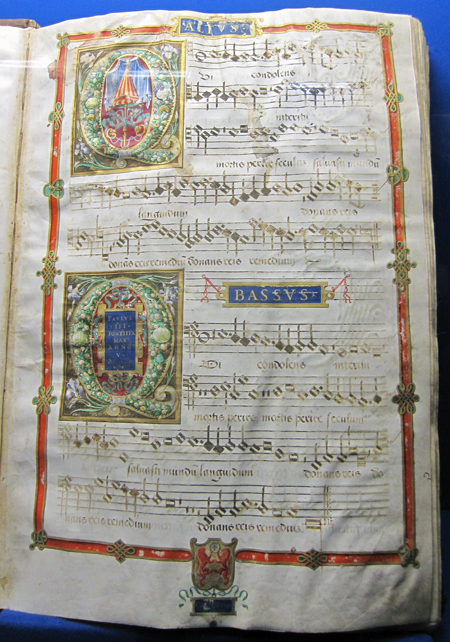
This collection of hymns and Magnificats by Costanzo Festa (ca. 1480-1545), an Italian who served as a singer in the papal choir from 1517 until his death in 1545, is prominently displayed among the illuminated manuscripts in the Library exhibition. A holding from the Sistine Chapel it is the earliest folio by a single composer in the collection.  Festa was born in Piedmonte and prior to joining the Sistine Chapel choir had studied and worked in France and in Firenze. He was strongly influenced by his travels and he brought that influence with him into music of the time.

The opening of the polyphonic Advent hymn Conditor alme siderum (Creator of the Stars of Night) by Festa. The exact date of composition of this piece to the 7th century text is unknown but the compiled manuscript dates from 1538-1539
Giovanni Parvo, a scribe at the Papal Choir College began work on the manuscript in November of 1538 and he completed the copying by October of the following year. His colleague Appollonio de'Bonfratelli was charged with the illuminations and decorations before it was presented to Pope Paul III. The two men were to work together on many of the choir books used in the Papal Chapel.

 The parts are set out with the Cantus firmus - a pre-existing melody, Gregorian chant (as in the case of Festa's hymn) or a secular piece - that is the basis of the hymn.  The Tenor, Aultus and Bassus lines would then elaborate and expand on the cantus and by the time of Festa often take over the main melody. As shown in the engraving at the top of the page the singers (lower right in the engraving in a box like enclosure) would gather around a lectern on which rested a common choir book.

De'Bonfratelli decorated the pages with a red ribbon marginalia adorned with celtic knots worked in gold leaf.  The part indications are fancifully set out as enamel plaques attached to the page by trompe d'oiel  ribbons.

The Initials (Q the first letter of the second strophe: Qui condolens interitu) are composed of identical garlands enclosing the various coats of arms of and a dedication to Paul III.  The dedication shows that the manuscript was produced in the 5th year of his papacy. 

It is believed that the coat of arms at the bottom of the right hand page may well be the personal arms of Costanzo Festa himself.

11 febbraio - San Benedetto di Aniano

Friday, February 04, 2011

Happy Belated Birthday Quinquin

Or perhaps I should say belated greetings to, to give him his full name, Octavian Maria Ehrenreich Bonaventura Fernand Hyacinth Rofrano. January 26th was the 100th anniversary of the first appearance of the young Count at the front door of the Von Fanninal residence bearing a silver rose for young Sophie and autumnal heartbreak for Princess Marie Thérèse von Werdenberg.


Throughout the week in Salzburg and Vienna we had heard Mozart, Berg, Haydn, Shostakovitch, Handel, Schubert and J.C. Bach but not a note of Strauss. As compensation we saluted the composer and Der Rosenkavalier, perhaps his most famous work, by stopping last Sunday at a small but beautifully curated exhibition at the Austrian National Library.

It was mounted among the towering book shelves in the baroque splendour of the State Hall (click here for a virtual view of this splendid room) - the great central room built in the 1720s for Emperor Charles VI by Joseph Emanuel Fischer von Erlach to plans drawn up by his father Joseph Emanuel. As the opera takes place the 1740s, the early years of the reign of Charles' daughter Marie Thérèse, the venue was highly appropriate.

The room serves as the repository for over 200,000 books dating from 1501 to 1850 and includes display cases that change regularly of many of the great early treasure of incunabula, manuscripts and illuminations in the Library collection. The most fascinating, for me at least, was a Book of Hours written in silver ink on velum that had been stained black. It is one of only four known to exist and was more awesome in reality than these examples would indicated.

Arranged around the statue of founder Charles VI the Rosenkavalier exhibition showcased Strauss's original score, Von Hofmannsthal's manuscript with Strauss' musical notations, photos, letters and documents from its premiere and the composer's life in Vienna. And included a wonderful life-size display of Alfred Roller's costume designs for that first performance, rotating mirrors reflecting both the designs and the relationships in the opera.


For the video in HD *just left click here to go to YouTube.

For such a old fellow I must admit that QuinQuin is looking and sounding pretty youthful and is still able to break hearts. As the Marschallin so rightly muses: Die Zeit, die ist ein sonderbar Ding - Time, it is a strange thing!

*And as I've just realized if you want to read the commentary!!!!

04 febbraio - San Giovanniccio


Enhanced by Zemanta

Thursday, September 16, 2010

Clothing the Music

We were up in Milano in late July to see Il Barbiere di Siviglia and other than the opera had no planned itinerary. It was a weekend to wander Centro, window shop - though we did get break down and buy some fantastic sheets on sale at Frette and I did get that Borsolino - eat, drink, visit the miraculous Duomo and just relax. There was a great deal going on and as always some fascinating exhibitions but only one was on my must-see list: Il costumi veste la musica (The costumes [that] clothe the music) at the Palazzo Morando. It was a peek into the Wardrobe workshops at La Scala.

With the renovation of theatre in 2002-2004 the physical plant of the house was moved out to the Ansaldo Workshops on the outskirts of the city. All the productions are created there and transported to the theatre for final rehearsals and performances. The Benois Pavilion (named after famed designer Nicola Benois) houses the scenery workshop; the Visconti Pavilion (named after director Lucchino Visconti) has rehearsal halls and a stage area identical to the theatre's; and the Caramba Pavillion is the costume atelier.

I had no problem identifying who the first two workshops were named after but Caramba meant nothing to me. A quick search revealed that Luigi Sapelli, who went by the name of Caramba, was a renowned designer of sets and costumes for La Scala, La Fenice, Regio di Torino, Opera di Roma and the Metropolitan Opera. A self-taught artist, he established his own costume design studio and from 1921 until his death in 1936 he was director of decor and costuming at La Scala. So the costume workshop at the new facility was named in his honour.

The shop houses pattern makers, cutters, seamstresses, tailors, milliners, boot and shoe makers and the various other artisans needed to bring a designer's creations to life. In a normal season they will create between 800 and 1000 new costumes and up to 1500 are taken from the warehouse to be repaired and retailored to fit the current company of singers and dancers.

The warehouse currently has an inventory of almost 60,000 costumes for over 280 productions. Some of the costumes date back to 1911 and are kept for their historic value. Others - such as the one worn by Joyce DiDonato as Rosina (right) designed 40 years ago by Jean-Pierre Ponnelle - are used time and time again. The storage wardrobes take up 1400 sq metres (about 15,000 sq feet) of the workshop area.

There is also a full laundry on site as each costume is washed before being sent to the theatre and washed again after the final performance. There is a smaller laundry at the theatre for quick clean ups and freshening.

The exhibition allowed a view into the workshops with examples of costume books for productions, designers' notes and buyers' lists, the materials used and most important a chance to have a close up look at the costumes that are worn on stage.

A left click on the thimble and thread below will take you to a slide show of a few of the photos I took of the exhibition. (And if you wish to stop and look at a photo more closely just use the pause button and simply click through them - many of these costumes are worth a closer look for the sheer artistry involved in creating them.)

A left click on the poster will take you to a slide show of exhibition photographs.

More photos can be found at my friend Opera Chic's - who had an article on the exhibition in August. It was while going through her archives that I remembered I had a few photos myself and should really put them to use.

As an amusing little side note - I saw the poster for the exhibition outside the opera house but no one at the La Scala Bookshop or at their Administration counter could give me directions on how to get to the Palazzo Morando. At least the receptionist had the good grace to apologize and say he hadn't seen the exhibition himself.

The photo of Joyce DiDonato from the La Scala Barbiere is by
Marco Brescia & Rudy Amisano, Archivio Fotografico del Teatro alla Scala

16 settembre - Santi Corneilo e Cipriano


Enhanced by Zemanta

Sunday, September 13, 2009

Siren with a Lens

I fell in love with the circus and Burt Lancaster when I was about 10 or 11. Back in 1956 my brother took me to see Ringling Bros Circus in one of their last appearances under canvas and I was enchanted. That same year Trapeze was released and I remember having the comic book and reading about it in one of the screen story magazines. And it had some poster! Lancaster and Tony Curtis in white circus tights. And standing between them Gina Lollobrigida all spangles, cleavage, doe eyes and pouty lips. But even at 10 the sight of Burt in tights did more for me than Gina in spangles.

La Lolla was one of those buxom foreign stars that came into the studio system as it was fading into oblivion. She was exotic, she was beautiful, she was Italian and she was hot. But she was always more than just T & A - she had a solid career in Italy and proved herself an accomplished actress in several other films that were popular in North America including The Hunchback of Notre Dame and Buona Sera, Mrs Campbell (the inspiration (?) for Momma Mia).

But there were other things besides film work that interested La Lolla. She began taking photographs of places she went and people she knew and saw. Her career as a photographer soon became as important to her as her movie stardom. She branched off into sculpture and painting and proved a major talent in those fields also.

We were fortunate to catch an exhibition of her work - 250 photographs - at the Palazzo delle Esposizion. We had gone in to see the Bulgari exhibition that Laurent talked about earlier this week -40,000,000.00 euros worth of bling!!!! A pretty spectacular show but frankly I was more impressed by the Lollobrigida exhibition on the 2nd floor.

Her photos range from the exotic to the every day - from unknown natives in jungles to world famous celebrities. And in everyone she has something to say about the human condition or the world she saw around her. Some really remarkable stuff.

I did a search on the web to see if I could find a portfolio of some sort and attempted the url for the website given in the exhibition catalogue but it was inactive. The best I could do was a few scans from the catalogue published by Damiani. It was difficult to choose there were so many wonderful photos but here are a few examples of the remarkable photographic talent of Gina Lollobrigida.

Perhaps the most loving photos are those of Italy. There are so many that truly capture the spirit of the country including one where the entire population of Subiaco, the village where she was born, showed up for a "family photo". Above left: Finally the show begins! Above right: The Monks of San Miniato al Monte.

Old age in the Old World and the New. Above left: Waiting to go to church, Calabria. Above right: Waiting, Denver.
Caught unawares or posed she captures the essence of her famous subjects. The toughness of a Bette Davis or the chameleon face of Ralph Richardson.

She said it took her a week before she could bring herself to go into the streets of Calcutta to take photos. Most of them are not as romantic as the Tomato seller, she captured the poverty and squalor as well as the beauty.
My first thought was that these were two grandmothers - one in Manila, the other in Shanghai. But apparently the top photo is a mother - old before her time - and her child. Such a contrast between it and the child with the noddles -a photo that brought a smile of recognition to Laurent's face when he saw it.

As I said it was difficult to choose what to scan without doing the whole catalogue, I only wish it was available online so I could share it with you. She is a remarkable talent.

13 settembre - San Giovanni Crisostomo

Reblog this post [with Zemanta]