Showing posts with label Teatro dell'Opera di Roma. Show all posts

Monday, January 17, 2011

San Riccardo di Roma

This observation - I won't call it a review because I am becoming more and more aware of my limitations as a reviewer - of the December 9th performance of this season's opening work at the Opera here is long overdue. But finally here it is.

Perhaps it is no mistake that Riccardo Muti has found his way to a city known for its churches and priestly population. More and more in the past few years he has taken on an almost priest-like aura as he mounts the podium in opera houses and concert halls in Salzburg, Ravenna, New York or Chicago. Going to a Muti performance seems to have become an almost religious experience for his followers. A hush falls about the hall as he enters the pit and god help the person that interrupts the mysteries with unnecessary movements, coughing or applause before the final note has sounded - they are liable to be silenced by the horrified reaction of the devout or even worse a glare from the high priest himself.

Moïse (Ildar Abdrazakov) and the Hebrews hear the Mysterious voice issuing from the flames telling them to leave the yoke of Eygpt. The flaming pillars are an example of the effective use Pier'Alli made of projections in this production of Moïse et Pharaon at the Teatro dell'Opera di Roma.

Now I am a Muti follower and devotee myself - I have been since I first saw him conduct Don Pasquale in 1971 at Salzburg - what a year that was! Abbado with Rossini, Karajan Verdi, Boehm Berg and Mozart and Muti Donizetti! One of the great joys of the past few years is having the opportunity to see performances he has conducted both in Salzburg and here in Roma. However I am starting to question how far we can go with the hero worship and reverence - we are after all in the opera house or the concert hall not a church or a temple. Music was meant to be responded to and unless its Ambrosian Chant was not meant to be heard in a sepulchred vacuum.

Take in point last month's Muti-led season opener at the Teatro dell'Opera: Moïse et Pharaon. This was Rossini's reworking for the Parisian audience of his earlier Neapolitan work Mosé in Egitto. Many of the big numbers were carried over from the earlier work and others added to meet the requirements of the Opéra for spectacle, dance and the talents of the resident singers. Yes the subject is of a religious nature - though librettists Balocchi and de Jouy somehow work the Burning Bush into the Plagues on Egypt!!!! - but it also has good old fashioned operatic situations woven into the story. Oh sure Moses keeps saying "let my people go" and Pharaoh says "yes, no, maybe" but there's also the forbidden love of Aménophis, Pharaoh's son, for Anaï, Moses' niece, and the conversion of Sinaïde, Pharaoh's wife, to the faith of the Hebrews thrown in for good measure. It pretty much ends according to C. B. deMille - the Hebrews escape through the Red Sea and Pharaoh and the forces of Egypt are drowned but there's a fair bit of digression along the way.
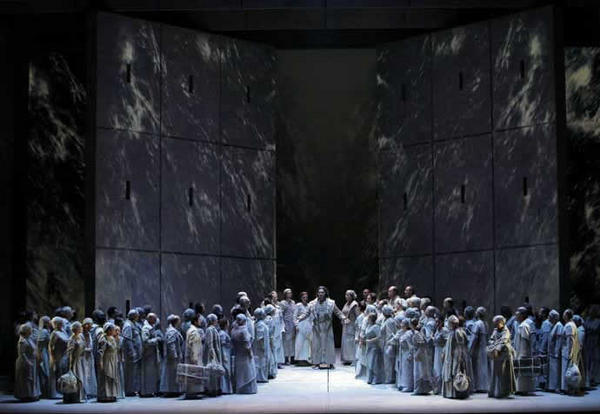
This photo doesn't half catch the brilliant effect of the final scene as the sea parted and Moïse and the Children of Israel made their way through the cascading waters to the other side.
There are quite a few ensembles, chorale moments and the incredibly beautiful Des cieux où tu résides quartet with chorus - but a great deal of the music is Rossini writing for star singers to show off their vocal chops. The very beautifully produced programme - I really must do a posting on the remarkable programmes published here one day - included pictures of all the principle singers, both in costume and civilian dress, who sang at the primiére but search as I might I found no picture of the conductor nor even a mention of his name.

Such was not the case here in Roma in December, the name foremost on the posters was Muti. Though there was "names" among the singers they were secondary to the maestro and were not the reason we were making the journey to Piazza Beniamino Gigli. Not that the maestro in anyway failed us. This is the third time he has led this particular work and his love and familiarity showed. The forces in Roma may not have been as first rate as those at La Scala or Salzburg but the orchestra is constantly showing what can be achieved when working with a demanding taskmaster. However I am starting to wonder - given both that evening's performance and the next evening at La Scala - if all Italian orchestras have problems with their brass sections? Riccardo Zanellato's chorus did some of the finest work I've heard from them in the past four years - and Moïse is one of those works where the chorus is as important as the soloists.

Muti's soloists were a variable and in one a case a questionable choice. Ildar Abdrazakov (above left) has sung Moïse in Muti's two previous productions and his is a powerful, if not dominating, performance and in Nicola Alaimo's Pharaon he had a worthy opponent.
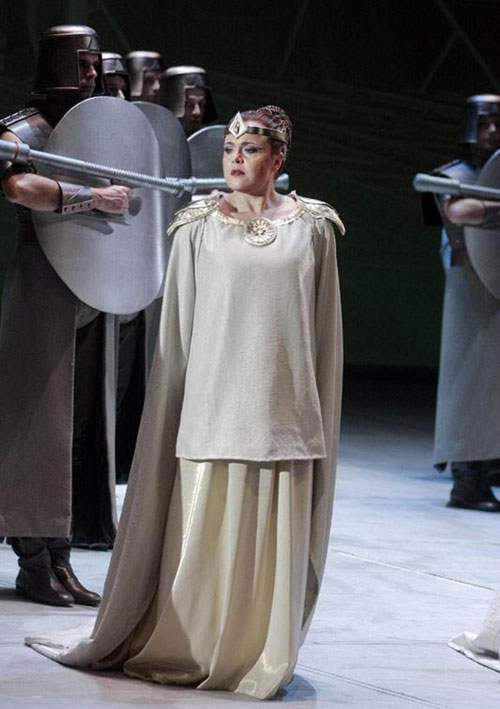
I was expecting much of Sonia Ganassi (right) as Sinaïde but have noticed in the past few performances I've experience that her voice has taken on a very uncharacteristic harshness. Her duet with the equally rough sounding Eric Cutler (Aménophis) almost became a shouting match. Though it should be noted that Ganassi was cheered to the rafters while Cutler received a few jeers from the normally timid galleriste. Juan Francisco Gatell (Éliézer) and Barbara Di Castri (Maria) offered strong support in their few solo passages and to the ensembles. The one miscalculation was Anna Kasyan in the role of Anaï - her is a pleasant but thin voice and she seemed to lack both the breath control and the technique for her big scene. This music was written originally for the great Colbran and adapted for the equally admired Cinti-Damoreau, and no matter how brilliant the conductor requires a singer of equal brilliance.

Director/Designer Pier'Alli's design for the opening of the Red Sea - a spectacular use of projections, lighting and a semi-permanent architectural set. The entire production was the best example I've seen of using modern technology as scenography.
I am not an admirer of Pier'Alli as a director and have yet to see anything staged by him where there has been any real solid characterizations or emotional core but this time I was overwhelmed with admiration for his designs - his use of architectural elements, lights and multiple projections were exceptional. For the first time in my opera going experience I saw modern technology used effectively and seamlessly to enhance and illuminate a production - as a sidebar it made the sloppy projections in the La Scala Die Walküre the following evening look like the work of amateurs. Highest praise to Alli for his designs, Guido Levi for his exceptional lighting and the technical staff at the Teatro for putting it all together.

Shen Wei's modern choreography was an remarkable match for the extended dance sequences Rossini wrote for the original production in Paris.
Equally as praise worthy was the choreography of Shen Wei for the extended dance sequences that make up most of the third act of the opera. Dance was a must for any production at the Opéra in those days and Rossini met the requirement with 20 minutes of pleasant, highly dancable, if not memorable, music. I had read much about Wei in the translations I had done for Ballet2000 but wasn't expecting the simple beauty of his dance patterns and movements. Like Alli's designs his choreography reflected an innate sense of musicality.

And that might well be the watchword for the entire evening - musicality. That sensitivity to, knowledge of, and talent for music that is the mark of a Muti performance. But what was lacking, and frankly seems to now elude the maestro, was any feeling of spontaneity; less a feeling of awed worshipping at the altar of art and more of feeling of joyful participation in the art itself would have made a good evening more than that.

To celebrate the 150th Anniversary of the Unification of Italy Maestro Muti will be giving us Nabucco in March - another work with a religious theme and the added strong patriotic subtext. It is early Verdi, raw and a little rough around the edges a bit like the Risorgimento itself. I can only hope that the Maestro will give us more of the rough and raw and a little less of the religious.

Photos: Falsini for the Teatro dell'Opera di Roma


17 gennaio - Santa Nadia
Enhanced by Zemanta

Thursday, April 29, 2010

The Devil to Play

I wrote the following review last month but unfortunately my good friends at Opera Britannia were not able to publish it. Though it is a bit late I thought I would post it anyway for anyone who cared to give it a read.

The 2010 season at Teatro dell'Opera di Roma got off to a dull start in January with a Falstaff under Asher Fisch that was musically lacklustre and theatrically dated. We had been promised a “new” production and what we got was an “old” retread of the same ideas Franco Zeffirelli had back in 1964 when he staged the Verdi-Arrigo Boito masterpiece at the Old Met. For Boito's Mefistofele, the second of the season's offerings, we were promised a new “old” production. “Old” in that the designs were inspired by sets created in the 1930s by Camillo Parravicini, a principal designer in Italy and more specifically Rome in the mid-20th century. The “new” was director Filippo Crivelli and scenographer Andrea Migilio's concept that used computer technology and video projections of the Parravicini's water colours in an effort to bring pictorial life to Boito's words and music.

Unfortunately too often the gap between concept and realization is a wide one. Though Miglio and video designer Michele della Cioppa gave us more than a few remarkable stage pictures the fixed set of risers – like an Industrial age Odeon – did not allow for much more than background effects. Some of those effects were stunning but there is only so much that can be done with projections when dealing with a stage full of singers, chorus and dancers. At certain points the production team seemed to have run out of ideas and resorted to old fashioned follow sports and set pieces.

The curtain rose in total silence on a loan figure in 19th century costume, reclining in the centre of the risers he was regarding a musical score. As much had been made in the programme notes of the failure of Mefistofele at its first performance at La Scala in 1868 (what we see today is the composer-librettist's 1875 revision) and the projections were Milan of the period it was implied that the figure was Boito himself. Though this was not totally clear even when at the end the same figure appeared on high and scattered sheets of music paper over the body of Faust.

As the music began he was joined by the chorus in drab period dress who settled around him to hymn the Almighty. At that point Miglio and della Cioppa showed what they were capable of. Elements of the Parravicinni decor were projected onto a scrim at the front of the stage. We saw close ups, long shots and pans of his conception of Heaven; it was a stunning visual counter point to the trumpet calls and the varied choruses of mystic voices and cherubs. It must be recorded with a touch of amusement that just as the Devil himself entered a Microsoft pop-up appeared warning of a rise in temperature and a possible overheating of equipment. But other than that one small glitch it was a stunning example of what can be done to wed music and technology. Unfortunately nothing else for the remainder of the evening was to equal it in invention or execution. Strangely the opportunities offered by the Witches' Sabbath were either missed or half-baked: the globe proffered to Mefistofele was nothing more than a large disco ball that swung across the stage. Perhaps the production team had indeed run out of ideas, perhaps time – the season was planned very last minute – or, more likely, money – opera house budgets here have been cut by 30% - but the entire concept had an air of the half-baked. Perhaps we will have to wait for the next revival to achieve its creators' full intentions.

That revival may be a while in coming; it should be noted that this was the first performance of Mefistofele at the Teatro, as opposed to the Caracalla summer seasons, since 1959. Despite its considerable worth it is one of those works that sits on the fringe of the repertoire waiting for a star bass who wants to impress his public with his range, whistle and charisma. In the past the presence of a Chaliapin, Pinza, Christoff, Rossi-Lemeni, Treigle or Ghiaurov have been sufficient reason for its revival. More recently Samuel Ramey made it his calling-card in various houses, most often in the witty, tongue-in-cheek production Robert Carsen originally stage for Geneva and that is available on DVD.

As is customary Teatro dell'Opera fielded two sets of principals for this revival. The opening night Mefistofele was given to Bulgarian bass Orlin Anastassov (right). A young singer, he certainly had all the voice necessary for the big moments and there are times when the part seems to be one big moment after another. However what was missing was the charisma, the sort of stage presence that I recall Ramey bringing to the role in Chicago in 1992. Mefistofele must dominate the evening and here for all his vocal abilities Anastassov failed. Clad in a red vest and shirt, reminiscent of Michael Levine's design for Carsen, he spent a great deal of the time flicking his long hair like a Milan model and for some reason kept looking and often seemingly wanting to wander into the wings. He also was awkward when asked to handle cloaks and robes. He bungled the moment when the Friar reveals himself as the Devil and more importantly when he envelopes Faust in his red cloak to take him on his devilish journeys. Unfortunately that rendered the projections that followed incomprehensible. To make it work Mefistofele, the opera and the character, needs a protagonist who's abilities go beyond the musical.


A good deal was written about Stuart Neill on opera blogs and in the media after the La Scala opening night to-do in 2008. Much of it was unflattering comments more about his size than his voice and much was unjustified. Yes, Neill is a very large man and it may be necessary to suspend disbelief when imagining him as a young cavalier but vocally his Faust was the most consistent and thrilling performance of the evening. He has a big Italianate voice that he uses to fine effect if at times with a certain lack of refinement. He is not afraid to let loose in some thrilling fortissimo when needed but is also capable of delicacy in his phrasing. As thrilling as the big sounds were , and they were thrilling, the small phrases – an almost whispered “Pace, pace” as he first approaches Marguerite in prison and the musings of the elderly Faust - also left an impression. And he successfully scaled his sound down to blend with Amarilli Nizza in “Lontano, lontano, lontano” which had a sweetness and melancholy that saved it from descending into bathos.

Nizza had begun the evening in the Garden scene with her voice sounding covered, a very unflattering costume and wig and coquettish stage direction giving her the air of a superannuated school girl. By the prison scene, hair shorn and in a brown shift, she had found herself vocally and dramatically and confirmed the impression she made in 2008 in the Caracalla Butterfly. “L'altra notte” had the required pathos and power but also was of a piece with her singing during the entire scene. Doubling the role of Helen of Troy she delivered a dramatic vision of the burning Troy and she and Neill blended well again in a beautiful “Ah! Amore! Misterio celeste”. Though once more I question the less than flattering costume and wig that designer Anna Biagiotti felt was befitting the most beautiful woman in the world.


Also questionable was choreographer Gillian Whittingham's needless attempt to turn “Notte cupa, truce” into a Merce Cunningham dance piece. The rest of her choreography was pretty standard village may-poling with the perquisite semi-naked couple and it would be a challenge to see the operatic concept of hellish behaviour go beyond the Fellinesque caressing of thighs and lascivious licking of lips.

What was never in question was work of the splendid Rome Opera chorus. Under Andrea Giorgi they have proved to be a saving grace in several productions this past three years. Along with the Voici Bianche di Roma children's chorus – can anything be more delightful than that swarm of cherubs Boito created to worry his Demon – they gave full voice to the miraculous invocation of Heaven which opens and closes the opera. But they also excelled as the demonic voices in the Brocken Scherzo even at the breakneck speed taken by conductor Renato Palumbo.

Despite a worrisome tentativeness to the opening trumpet calls – what is is about Italian orchestra brass sections, even the horns of the famed Orchestra Santa Cecilia have problems – he led a performance that was bold and when required bombastic but he never allowed the orchestral sound to swamp the singers. At times he may have taken the score a little too seriously – the rather enchanting merry-go-round accompaniment to the Garden quartet needed more sparkle – but he had the full measure of the Prologue and Epilogue.

As a sidebar the often distracting Italian surtitles have been jettisoned for this production and quite frankly were not missed.

29 aprile - Santa Caterina da Siena

Monday, January 25, 2010

Tutti Il Mondo E Burla*

*All the world's a joke ..." so ends one of the greatest of operas: Verdi's Falstaff. Written at the end of his life it is a work of great joy, laughter and a touch of melancholy. As the aging Falstaff is let in on the joke that has been played on him, he, his cronies and the rest of the residents of Windsor, remind us that in the end we are all the butt of a joke and the best thing to do is laugh at it all.

On Saturday night at the opening of Teatro dell'Opera's season it was the opera going public who seemed to be the butt of a not very funny joke. The first sign of trouble was the multiple cast lists: in eight performances there are 4 Falstaffs, 3 Alices, 3 Fords, 3 Nannettas, 2 Fentons and 2 Mistress Quicklys plus two conductors sharing the podium. And none of the cast remains the same for more than 2 of the performances. Now above all Falstaff is an ensemble opera - except for two rather lovely, and slightly intrusive arias and a great monologue it is mostly a work of ensembles and small ariettas. It depends on close interaction between the singers, a great deal of subtlety from a conductor and the sure touch of a director. All three were missing on Saturday night.
Act 1, Scene 2 - The garden of the Ford household as pictured by Franco Zeffirelli still a lovely if now slightly coarser stage picture.

This was billed as a "new" production by Franco Zeffirelli, the once respected director-designer who has lately become the butt of not a few jokes himself because of some frankly outrageous behavior. This production was "new" back in 1964 when I saw and was enchanted by it at the Old Metropolitan Opera. I remember it as a wonder of beautiful design and witty staging that seemed to wed perfectly with the miraculous score. The designs have changed little - though what were once stands of hollyhocks in the Ford's garden have turned into some sort of day glow flowers that had been overfed MiracleGro - and are still lovely to look at. However what is not acceptable are the 10 and 15 minutes intervals between scenes that it takes to change them. Falstaff may be the work of an old man but it demands quicksilver in the performing. And the Zeffirelli staging has coarsened along with the designs. I recall Luigi Alva as Fenton nestled in the crux of the Great Oak singing his aria bathed in moonlight - here the fine young American tenor Taylor Stayton just wandered aimlessly in a cloud of stage fog. And for the most part the singers were going through the motions listlessly and mechanically. I will borrow a word from Laurent who, though he had not seen that 1964 production, had the feeling that the whole thing had been "reheated".
Act 2, Scene 2 - Again a lovely design but the 10-15 minutes waits between scene spoiled the momentum of a work that should move like quicksilver.

One of the glories of that 1964 production was the conducting of Leonard Bernstein and another the remarkable ensemble cast. Though Asher Fisch has shown himself to be a fine conductor in several venues he has come to Falstaff a little too early in his career. This is a score that demands a fine balance between stage and pit that was missing on Saturday night. Often the singers were swamped by the orchestra and Arrigo Boito's brilliant text, so integral in this opera, was inaudible. There were also problems with coordination between stage and pit during the finale of Act 1 and the wayward horns had some problem with their key passages in Ford's jealousy monologue.
Renato Bruson has sung the role of Falstaff for almost 30 years including a memorable performance under Guilini.
Photo: Rome Opera - Falsini

It gives me little or no pleasure to write this next paragraph as I have the greatest respect for this singer and what he has achieved. Back in 1982 Renato Bruson sang a wonderful Sir John under Carlo Maria Guilini and he has sung it many times since. It is a role that he once inhabited and could rightfully claim as his own but at 74 he no longer has the power to make the big moments memorable and was often inaudible. L'Onore! Lardri!, Va vecchio John and Quand'ero paggio went for very little and he honestly had some difficulty with the stage movements. Only in the scene outside the tavern as the drenched Falstaff bemoans his sorry state did his Fat Knight take flight. Perhaps it is now time for Bruson to allow us to hold on to our memories of his past performances and gracefully retire from the stage.

Carlos Alvarez was a fine in not particularly individual Ford shining briefly in the Jealousy monologue and Stayton was a mellifluous Fenton both in his aria and in the duets and ensembles, he is a young singer to watch. Mario Bolognesi, Patrizio Saudelli and Carlo di Cristoforo gave generalized portrayals of Caius, Bardolfo and Pistola.
Top: Act 2, Scene 1 - Sir John and the disguised Master Ford meet in the Garter Inn.
Bottom: Act 3, Scene 2 - The arrival of Nannetta as the Fairy Queen in Windsor Forest.
Photos: Rome Opera - Falsini.


Of the quartet of women the two lower voices were the most satisfactory. Francesca Franci did what could be done with Mistress Page and Elisabetta Fiorillo sang with good humour if not all the required deep velvet of Quicklys of the past. Myrtò Papatanasiu appears to be a Rome favorite these days and she has sung both a fine Nedda and I understand a very well-received Violetta here in the past year however she was out of her depth as Alice. Her voice was almost lost in the nero Cacciator narrative and it did not soar over the Gaie comari di Windsor ensemble. I felt she would have been happier cast as Nannetta. Lauro Giordano's Nannetta sang a lovely Sul fil d'un suffio esesio but prior to that her voice had been thin sounding and at one point noticeably off pitch.

The wonder of the evening was Verdi and his collaboration with Boito: Falstaff is a masterpiece. It is an opera made up of small miracles and the big miracle was that even with a tired production and less than inspired conducting and singing the genius of this remarkable work still shone through.

26 gennaio - Santi Timoteo e Tito
Reblog this post [with Zemanta]

The "Beautiful People" are Scary

Saturday evening was opening night of the opera season here in Roma and the "beautiful people" of Roman society were out in full force. The great, the use to be great, the not so great and the I'm a nobody but I'm decorative and with someone great.
The decorations of the sala were tasteful and understated - perhaps as befits these times of economic restraint. They were perhaps one of the few tasteful understated things about the evening. That and the de Grisogono chocolates.

The opera house lobby was tastefully decorated in trees created from masses of Spathiphyllum that wonderful red flower I can never remember the name of, students from the ballet school lined the staircase bowing to each of us as we ascended, further massive bouquets adorned the front of the boxes, the Caribinari were in full dress guarding President and Mrs Napolitano, he's an opera lover, who sat in the Royal box with Signore Allemano, our mayor and de facto director of the opera. At the first interval presseco and delicious de Grisogono chocolates where set out on brocade covered tables and the "beautiful people" air kissed, hugged, shrugged, glad-handed and shoved their way to the freebies in the various lobbies.
Carabineri guarded the front entrance as the "beautiful people" shoved their way into the theatre. Those flowering trees were a lovely touch to the very 30s lobby of the Teatro as where the lovely little girls from the ballet school greeting us as we ascended to auditorium.

Shoving seems to be a trait of the "beautiful people" here - they shoved to get into the theatre, shoved to get to the coat check and shoved their way into the sala - stopping every so often to air kiss, hug, shrug, glad-hand and then resume the shoving. And they shoved their way in front of the cameras that were constantly flashing during the intervals in both the lobbies and the theatre proper. We have tickets this year on the parterre and there was much attention being paid to palco 14 directly behind us. Given my own age I am not an ageist but I swear that the combined tally for the inhabitants was in the hundreds. Swathed in mauve from head to toe holding court at the front of the box sat Valentina Cortese, doyenne of the Italian cinema, with director Franco Zeffirelli and ballet director Carla Fracci and several other worthies a bit more discretely behind. The only reason the age average was lower than I expected was the presence of a not unpretty young man who attended to their various whims and wants.

What was unpretty was the number of people - men and women alike - sporting botoxed lips and brows, too even to have been from St Moritz tans and hair of no shade actually on the colour wheel. The requisite number of bungled face lifts - most of which ended at the chin giving that appearance of a teenage face, if teenagers really do have faces as smooth as bowling balls, attached to a museum body. Though many of the dresses where haute couture in most cases they were designed to be worn by the daughters and in some cases the grand-daughters of the wearers. Some of the exposed flesh should not have been! That is not to say that there were not some beautifully gowned, coiffed and bejeweled ladies nor some handsome elegant perfectly turned out gentlemen - just that given the venue, the city and the country they seemed to be in the minority.

And as an audience they were rude and inattentive. Bejeweled cell phones rang, expensive wrist watches chimed and chatter ensued. It took forever to get people seated and quiet for each act to begin so that with the lengthy scene changes the evening stretched to Wagnerian lengths if not depths.

The opera? Oh yes there was an opera! And one of my favorites, Verdi's last great masterpiece: Falstaff. That I will be commenting on very shortly. At this point I am heading off to the local church to light a candle asking that - imploring that - begging that - the rest of the season's openings not be the same. I've already had my fill of the "beautiful people" for this season!

25 gennaio - Conversione di San Paolo

Reblog this post [with Zemanta]

Monday, August 03, 2009

Canoodling at Caracalla

There was more passion going on in the row in front of me at Friday night's Carmen then on stage. The young couple - she: pretty, green chiffon dress with a shoulder strap that wouldn't stay in place, big cascade of hair; he: slender, tanned and been told by his mother since birth that he was the most gorgeous boy on earth - cuddled, cooed and had a disagreement during the 3 hours we spent at Caracalla. Would that we had seen half that much passion on stage!

But of passion there was little evidence in conductor Karle Mark Chichon's interpretation of Bizet's best known work. His approach was flabby and lacked any sort of zest. Not quite lifeless but certainly not evocative of gypsy life and liberty. And there were moments when coordination between stage and pit went painfully awry - particularly the smuggler's chorus that opened Act 3. With the elimination of most of the dialogue/recitative it seemed he was conducting a "Carmen: the greatest hits" often with one well-known number following right after the last. It also meant that some of the action was a little confusing - what the hell was Zuniga doing back at the tavern? Oh yeah he told Carmen he was coming back, except that bit had been cut so who knew?
Director/Designer Renzo Giacchieri used the bridge from last year's Madama Butterfly very effectively to set the four scenes of Carmen. With budget cuts of up to 30% economy is the watch word in Italian culture today.

After the horror that was Tosca two weeks ago it was nice to see a more traditional approach without a director's subtext imposed upon it. Director/designer Renzo Giacchieri used the stage wide bridge from last year's Madama Butterfly as his main design feature and adapted it effectively for each of the four scenes. His direction - with one major and devastating exception - was inoffensive and any "innovations" did little harm to the drama. The exception? His - and perhaps mezzo Elina Garanča's - conception of Carmen. This was the hip swaying, legs splaying, thigh hugging, Carmen as slut school! Wrong! Wronger! Wrongest! Carmen is not, I repeat, not a prostitute! You take that approach and the whole story becomes nothing more than a tart getting her come uppence from an angry john. And ladies and gentlemen that is not the opera that Bizet, Meilhac and Halévy wrote. Hell it isn't even the novella that Mérimée penned.

And frankly Garanča had problems pulling it off. Physically she is a beautiful woman - unfortunately a black wig hid some of that beauty - and the voice has a slightly smoky seductive quality, though that wasn't evident until the Seguedille. Many of her videos have a highly charged sexuality when she just stands and sings but when she moved - or perhaps because of the way she moved - sensuality was a quality that was missing. And the dark tone needed for the Card scene just isn't there - the repeated "La morte" lacked the needed sense of immovable fate. Granted the sounds were never less than beautiful - not a given these days - and I can see why she is being regarded as one of the emerging stars of the operatic world. I would like to see her in one of her Rossini or Bellini roles because, without wanting to sound like commentors on some blogs, I just don't think she is on the same level as the Carmens of my experience.

Originally Marcello Alvarez had been announced as the Don José but his name disappeared from the notices about three weeks ago and was replaced by that of Valter Borin, who appears to be specializing in the role in Italy's outdoor venues this summer. His is one of those big blaring voices that seems to start at forte and gets louder from there. His Air de Fleur lacked the necessary lyricism but he did rise above the ordinary in some of the bigger moments. The same can be said for Carlo Colombara's beefy Escamillo who gave a respectable version of the Toredor Song, no doubt inspired by the large part of the audience who thought they would encourage him by humming along.

Though the character is a bit of cipher - come now who really cares about the girl he left behind when you got a hot blooded gypsy on stage - Ermonela Jaho's Micaela was the best performances of the evening. She sang with a lovely floating tone and brought real sense of the girl's plight to her Act 3 aria. She's a singer I would like to hear more of. With the exception of the very squally and strident toned Frasquita and Mercedes the smaller roles were adequately sang.

The generally reliable Teatro dell'Opera chorus marched, smoked, brawled, threw flowers, quaffed wine and generally behaved the way an opera chorus should while not making as beautiful a sound as they normally do. Both in the Tosca and in the Carmen they have been off form - perhaps it is the uncertainty of their future that is distracting them.
Elina Garanča leaving the stage to get conductor Karl Mark Chichon during the curtain calls at the end of Saturday night's Carmen. She was not pleased about something and gave both the conductor and tenor glaring looks - wonder what was going on backstage?

And things at the Opera are very uncertain at the moment - I won't rehearse the Byzantine turn of events that have put the future in question but performances of the level presented at Caracalla this year do raise concerns about artistic standards. Sure the tourists will buy tickets because its Rome, its Italy, its a historic site and some because they enjoy opera but for the first time in three years I noticed empty blocks of seats at both performances.

Oh and our canoodling couple - well by the time Don José got around to doing Carmen in they had made up and were on their way to the happy ending denied Bizet's gypsy.

03 agosto - San Nicolò Politi

Friday, July 17, 2009

The Shabbiest of Shockers

I have always disagreed with Joseph Kerman's famous assessment of Tosca as being Puccini's "shabby little shocker" (Opera as Drama 1956). When well done it can be the most exciting of operas - the drama of the Te Deum, Scarpia's pursuit of the frightened Tosca ending in his stabbing death and that final leap from the battlements - this is the stuff of great theatre - when well done!

Last evening at the Baths of Caracalla Teatro dell'Opera di Roma seemed bent into proving Kerman right and presented us with the shabbiest of shockers. This will have to go down as one of the worst evenings I've spent at the opera and only the second time in 57 years that I have left before the end of a performance. And though most of the members of our party remained I was not alone on my escape walk to the exit - there was a general exodus towards the Via Appia just after Tosca killed Scarpia with a well placed crucifix to the old Scarpian family jewels.

Yes you did read that right. Poor old Scarpia died not from multiple stab wounds but from a smack in the cullones! And this was just one of director Franco Ripa di Meana's many "innovations". Other fascinating concepts included turning Scarpia into a prelate of the church which meant that the stage was frequently filled with phalanxes of black soutaned priests bearing down relentlessly on the principals. Oh I get it the oppression of the church - very cutting edge but I still question turning the celebratory Te Deum into the auto-de-fe scene from Don Carlo. And the burst of flames and fiery cross that closed ACT I lasted all off 2 seconds and blinded most of the audience not astounded them. And why exactly was Tosca costumed like a 19th century hooch dancer - slit skirt, bustier and all - surely Queen Caroline had a stricter court protocol than that? And wasn't it rather louche of her to walk on Scarpia's dinner table. And since when was Cavaradossi a pavement artist spreading his canvases out on the floor and having them walked on by thoughtless sacristans? And what was with that murder? First she hit him in the stones with the crucifix then she brandished it at him like a vampire killer. And rather than the drama of the placing of candles around the body and retrieving the liaise-passe from the hands of the dead man she picked it up off the table/prie-deux/chair and as a platoon of priests bore down on the corpse, escaped through the audience - to a round of applause that destroyed the climax of Puccini's music. "Sadly" I did not see what "improvements'" had been thought up for Act 3 but I'm sure it was just as original.
Edoardo Sanchi's set was a gigantic map of Rome with the locales of the opera circled in red. And once again it was one of those singers' nightmares - ramps and rakes of various levels always great fun to negotiate in elaborate costumes. It was the first sign that we were in for an evening of "innovations".

Now all of this would have been acceptable if it had been possible to close your eyes and listen to incredible singing - though given the "wrong-headedness" there may not be singers alive who could make it acceptable. I never take pleasure in criticizing singers - theirs is a difficult profession and in many ways an ephemeral one. So believe me I take little or no joy in what follows. Aside from having to fight some of the most hideous costumes ever created poor Michaela Carosi spent a good deal of the evening fighting to stay in tune. At several points I was reminded of a comment made during a performance of Fidelio by my friend John: if that woman screams at us one more time I'm going to stand up and scream back. I would have spent a good time standing and screaming at Madame Carosi which would have made for a duet of out of tune voices, Fabio Armiliato is a singer I admire but he must have been having an off night - the sounds he produced where throaty and at points he sounded strained. He was not helped by having to singing Recondita armonia in a prone position. His Vittoria! Vittoria! was thrilling but does not a Cavaradossi make. Giorigo Surian gave a generalized Scarpia - the voice is more bass than baritone and was swamped by the orchestra on more than one occasion. The remainder of the cast did nothing to make up for the deficiencies displayed by the principals. The normally exceptional Opera chorus was having a bad night - the underpowered Te Deum was a real disappointment. And even the children's chorus were more members of some penitent youth organization than merry, prank playing choir boys. The miking was not particularly successful and on several occasions static and voice placement went awry. Paolo Olmi led a routine performance bringing no special insights into the piece and the orchestra gave yeoman service but again the miking seemed slightly awry.

I had heard some comments while waiting in line at Santa Cecelia the other day about how dreadful this Tosca was so word of mouth is spreading through the city. That and the general decline in tourists trade would account for many blocks of empty seats at the beginning of the performance. And a productin as bad as this would account for the growing numbers that left at each intermission.

Arts money is tight here in Italia - most budgets have been cut 30% - and it is sad to think so many people will go away thinking this is the best that Roma can do. This a company that has a beautiful (and dramatic) Zeffirelli Tosca in its repertory along with some very fine productions of both standard and little known works. This is a company that gives adventuresome seasons, like the one currently in progress - Le Grande Macabre, Pelleas, Iphigenia in Aulide. This is a company where Riccardo Muti has conducted Otello and Iphigenia in the past year and is scheduled to lead Nabucco and Idomeneo in the next. Despite what the Caracalla Tosca could lead you to believe it is not an inconsequential company - but sadly this is the impression many people will carry away with them.

PS: I felt particularly bad for several of our group who were coming to an opera for the first time. This was a sorry introduction and certainly didn't give them much encouragement to give it another try.

PPS: This comment from my friend Flipstinger who has a very good source:
oh my! very unfortunate indeed.... i think it was a good idea to leave after the 2nd act because after i found out more info; the shepherd boy came in on the 3rd act with a llama or a goat which started to make noises and the audience, confused with what's happening on the stage, just burst out in laughter....AND after the show, my informer told me the director, Olmi was frustrated that the audience behaved in such manner and was heard saying "the audience don't get it....how could they have acted that way....they are just clueless."

UHMMMM, i'd say...this director needs to be a part of the audience and watch carefully the product of his so called vision and then look at the libretto again! VERY FAR OFF!

I am so glad I didn't stick around for the 3rd Act - laughter would have been the least of their worries.

17 luglio - Sant'Alessio

Friday, December 19, 2008

Esultate? - Yes and No!

Otello - Cassio and the chorus get drunk in Act 1.

I received an e-mail from a friend suggesting that after talking about anticipating the Muti Otello last week I had been remiss in posting anything about it. What's your problem he asked - or words to that effect. Well as I've said in the past if I were a critic I'd be better off working for a weekly or a monthly. Sometimes I just can't meet deadlines. But here goes.

Last week I wrote
After its summer break-in at Salzburg how will this first collaboration between Muti and the Teatro turn out? Certainly with the change of venue things will be different - the Grosse Festspeilhaus is such a bloody barn that voices can get lost and details in productions swamped by the mere size of the stage and auditorium. Will the more traditional opera house be kinder to the voices? Will the producer have rethought some of his ideas after the unkind reviews? How will Muti handle a chorus and orchestra that are a few steps below the forces he commanded in Salzburg?
Let me answer the last question first. Otello is one of those operas that can be spoken of in terms of tenors or conductors. I have seen or heard Vickers' Otello, Domingo's Otello, Del Monaco's Otello and MacCracken's Otello. I've also seen or heard Von Karajan's, Solti's and Toscanni's Otello. And on one occassion saw a Vickers-Von Karajan Otello. Ever since it was announced last December there was no mistaking what sort of Otello we were going to get here in Roma. The posters announced it, the press talked about it and frankly when my friend Parsi asked me who was singing I couldn't remember but I knew who would be conducting. This was going to be Riccardo Muti's Otello.

And so it was. And it had all of his familiar trademarks - dramatic push and tension as well of moments of incredible translucent beauty. There was no stopping for applause - though several moments cried out for it - nothing was allowed to interfere with Verdi's music and Boito's libretto. And on two occasions noisy members of the audience were treated to that glare that makes musicians' mouths turn dry and brows break out in a cold sweat. The Teatro orchestra responded to what ever magic he holds over his orchestras - pax La Scala - and played to an exceptional level. There were some incredibly beautiful sounds coming out of the pit and the brass had a golden edge to it that was entirely new. Andrea Giorgi's chorus can always be counted on to do a fine job but in full-throated cry as the opera began gave me chills.

And the singers? I can only believe that the more intimate acoustic of the Teatro made a great deal of difference. Though perhaps not meeting the standards of the Golden Age - that's my golden age - they worked well within the framework of Muti's musical vision of Otello. At this stage of his career Aleksandrs Antonenko simply doesn't have all the voice or the experience that is needed for the part of Otello - these days who does? His Esultate! was slightly underpowered but unlike at Salzburg, if reports are to be believed, he did not run out of steam before Act 4. His is a Slavic voice with the tendency that voice type has to turn slightly steely under pressure and he lacks the stage charisma that a Vickers or Domingo brought to the part.

Russian soprano Marina Poplavskaya (Desdemona) is one of those singers that divides opinion - I often wonder if the commenters have been to the same performance. Here she gave a lovely performance, again her's is a Slavic voice and finally lacks the creamy tones of a Tebaldi or Freni in the part. But it did give her Desdemona an edge: here was no Kewpie doll waiting to be murdered but a proud daughter of La Serinissima. The ultimate test of any Desdemona is the final scene and here the combination of Muti in the pit, Poplavskaya on stage and the staging itself - for the first time all evening possibly - came together to create moments of sadness, tension and heart-stopping drama. Barbara di Castri's Emilia came into its own at this point, lovingly attending to her mistress, her darker voice underscoring the drama. Huddled barefoot on the floor in front of a single candle Poplavskaya almost mummered the tale of poor mad Barabara in a chilling but beautiful half-voice. Her despairing cry after the departing Emilia was shattering and the Ave Maria sang in a half-whisper ending in a pianissimo Amen as she drifted into troubled sleep.

The most satisfying singing of the evening came from Giovanni Meoni's Iago. His was a subtle portrayal and he avoid that generalized Verdi baritone sound we get so often today. His Credo was strongly delivered and reeked of an almost Jesuitical cynicism. It was one of those moments that called out for applause but the Maestro was having none of that.

I find it difficult to say anything about Stephen Landgridge's production as a good deal of the action was not visible from our palco stage left. No doubt when we were able to see what was going on our friends at stage right had the same predicament. He had obviously not restaged with a traditional theatre in mind. George Souglides' dull unit set of metal walls and fracturing glass floors had been altered for width but not for depth and much of the upstage action was lost. Emma Ryott's costumes were fine in a generalized Renaissance style but with little variety in colour - Cyprus was a pretty dreary post if these designers are to be believed. As I mentioned Landgridge did stage the beginning of Act IV beautifully and the ending - Otello crawling towards the body of his dead wife, straining but failing to touch her before he dies, heightened the tragedy. Sadly, from what I could see, nothing in the rest of his direction was as dramatic.
Otello - The entrance of Lodovico, the Venetian envoy.

Which brings us back to Maestro Muti - most of the drama for the evening was being generated in the pit and that may be the way he wanted it. And we knew from the beginning that this was going to be a Muti Otello.

Production photos for the Teatro dell'Opera di Roma by Falsini.

19 dicembre - San Dario di Nicea

Thursday, December 11, 2008

Anticipation

I've heard it said that anticipation is half the pleasure of any event but unfortunately it can lead to much of the disappointment. Tonight may prove that point of view.

Back in December last year I booked my subscription for the 2008 season at the Teatro dell'Opera Roma and Riccardo Mutiaside from the convenience factor there was the BIG EVENT in December: Riccardo Muti conducting Verdi's Otello. It was going to be a hard ticket to get but back in December 2008 I knew that - god willing and the Tiber don't rise* - Laurent and I would be sitting in Ord. II, Box 6 on December 11, 2008 with our friends Linda and Nazareno.

Now as anyone who has read my Salzburg Whitsun Festival postings knows I worship, along with a damned fine crowd including my dear Opera Chic, at the shrine of Muti. However reports coming out of this summer's Salzburg Festival, where the production originated, where not all that encouraging. Apparently Muti achieved some great sounds form the Vienna Philharmonic and Statsoper chorus and conducted a driven, highly dramatic performance. About the soloists and production itself the word of mouth was decidedly mixed. Now mind you, as always, some of those words were being spoken or typed by people who had only heard or seen a broadcast or heard from others, but they certainly have added to the anticipation.

After its summer break-in at Salzburg how will this first collaboration between Muti and the Teatro turn out? Certainly with the change of venue things will be different - the Grosse Festspeilhaus is such a bloody barn that voices can get lost and details in productions swamped by the mere size of the stage and auditorium. Will the more traditional opera house be kinder to the voices? Will the producer have rethought some of his ideas after the unkind reviews? How will Muti handle a chorus and orchestra that are a few steps below the forces he commanded in Salzburg?

So here I sit, a few hours away from a performance I have been anticipating for a year with all sorts of questions running through my head. Answers should come, possibly, tomorrow.

*I had no sooner written this than the Mayor declared a city-wide "State of Calamity" - don't you love the wording, its so bloody operatic. The torrential rains of the past two days have left majors areas of the city flooded, at least one person dead and some roads impassable. And according to forecasters there is more to come. And the Tiber is indeed rising.

11 dicembre - San Damaso I

Wednesday, October 22, 2008

Mercoledi Musicale

Last week the opera season opened here and we were treated to the rarely performed Amica by Pietro Mascagni. When operas are rarely performed there is often a very good reason - they aren't worth performing. I love to say that Amica was the exception but sadly not. When the intermission last longer than the second act and when the heroine throws herself off a mountain top and you don't give a damn then there is a problem.

However being Mascagni there was a really nice orchestral introduction to Act II and the full stage of the Teatro was used to project the lovers escape into the mountains. As stage craft it was the high point of the evening.


Perhaps he should have written music for travelogues?????

22 ottobre - Santa Maria Salome

Friday, June 27, 2008

Ma Carmen Adoré

Let me start off by saying that if anyone is looking for a Bocelli-bashing you should stop reading right now. Likewise if you're expecting a gushing endorsement of his appearance last Friday night perhaps it would be best to look elsewhere. And just as an aside all flames will be extinguished the minute they are set!

Carmen programmeLast Friday evening the Teatro dell'Opera was almost full - something I haven't seen since that incredible Roberto Bolle Gala last December. It wasn't a regular subscription night except for those of us on what, for marketing purposes, is called Fantasia Opera so these were mostly off-the-street ticket sales. It is notable that only one of Mr. Bocelli's scheduled evenings was subscription the other three were box office and agency sales only - Francesco Ernani, the Teatro director, seems to have recognized the drawing power of his name. And its a good guess that most of the audience were there to see Mr. Bocelli more than Carmen. Which is just as well, as this production did poor service to Bizet's masterpiece and was almost as vulgar as the giant red lips they used for the poster.

Since arriving here in Italy I've seen two productions staged by director-designer Pier'Alli - the first was Oberto in Parma last October - and I can only hope I will never see another. However I'm not counting on it as he seems to be everywhere. The staging began promisingly enough with a holograph bullring projected onto a scrim at midstage but P'A doesn't like an unpeopled space. So we were treated to members of the less than stellar Teatro ballet all tarted up in Spanish-drag doing their morning calisthenics in time to the overture. And they just never stopped - every number was accompanied by cape swirling, mantilla twirling, cigarette puffing, pose striking dancers doing their best to distract the audience from the bothersome singing that was going on. And though that midstage scrim allowed for some picturesque effects the truth is that a cloth between singers and audience dampens the sound and in the case of most of the voices left one wishing for that bugaboo of all opera lovers - amplification!

Power was not the problem with Ildiko Lomlosi's Carmen. Mme Lomlosi is a large raw boned Hungarian mezzo with a large raw voice to match. She and P'A's concept favoured the Carmen as slut school. Her gypsy seductress was brash, brazen and frankly gave the impression that she could arm-wrestle any man in the audience and win. Poor Don Jose didn't stand a chance. And if her Carmen lacked charm so did Cinzia Rizzone's small-voiced Michaela. Simone Alberghini cut a good figure as Escamillo and managed a nicely-judged Toreador Song despite having to dodge bouncing banderilla bearing ballet boys. The smaller roles ranged from the unhearable to the adequate. And despite being stuck behind that bloody scrim - are you getting the idea I don't like scrims - our fine Teatro chorus turned in some stirring sounds. Its bad when the chorus turns in the best performance in Carmen!

Andrea Bocelli as Don JoseHowever the big question was - how would Bocelli fare in all this? The staging worked around any difficulty he might have had reasonably well. Dramatically he was no less wooden and unresponsive than a few José's I've experienced - my first, Raoul Jobin springs to mind. The fights were brief but effective and the death scene worked reasonably well. The opéra-comique version was used and he delivered his dialogue convincingly. His "La fleur que tu m´avais jetée" was pleasant if thin sounding but by no means unacceptable. But the problem still remains that he is not an opera but a concert singer and there is a big difference between singing in front of an orchestra and singing surrounded by other singers, a full chorus and the depth of an Italian Opera House orchestra pit separating you from your audience. By the third act his voice was sounding tired. Fortunately at that point most of José's big sings are over but that third act ensemble is a killer and he just wasn't able to get there. His next appearance here is scheduled for October, as the Italian Tenor in Der Rosenkavalier. It a brief cameo in the first act - one and a bit stanzas of a pseudo-Italian aria. Unfortunately it smacks of stunt casting but one can hardly expect his fans to flood in for the three hours of Strauss's musical Sacher Torte if all they are going to get is two minutes of their Divo as whipped cream topping.

I mentioned in an earlier post that at times Alain Lombard did tend to let his orchestra swamp the singers - I should say that this did not apply to Bocelli. Lombard was careful to ensure that during his solo passages the orchestra was held in check. In other places his handling of the score suggested an affection and knowledge that would have worked wonders with a stronger cast.

For a taste of P'A's busy staging and the final scene the Teatro dell'Opera's video clip can be found here.

27 giugno - San Cirillo

Monday, June 23, 2008

Searing Question - Answered!

I was surprised at a few of the comments left in response to my little poll as well as astounded by 2 of the several e-mails I received. Being a devoted fan is one thing, being abusive to anyone who isn't is another.

Here's the results of my totally unscientific poll:

Web Poll Powered By MicroPoll

And I'm glad to say the majority were right. There was no miking of any sort involved. Would it have benefited from it - to be honest more than a few of the singers could have used some increase of volume. However that was chiefly because of Director-Designer Pier'Alli's fondness for sound-deadening scrims and a tendency of conductor Alain Lombard to allow the orchestra to swamp the singers.

I will be putting up a posting of Bizet's Carmen as presented at the Teatro dell'Opera di Roma last Friday night in the next day or so, you all know how long it takes me to write that sort of thing - thank god I'm not working to deadlines anymore. And I emphasis I'll be talking about Bizet's Carmen!

23 giugno - San Giuseppe Cafasso

Friday, June 20, 2008

Searing Questions?

Okay tonight is the night we see Andrea Bocelli singing Don José in Carmen. And here's the big question:


Answer on Monday.

20 giugno - San Silverio

Tuesday, June 10, 2008

Parlo del Piu e del Meno

Via Rodolfo Belerizani
As well as a few random thoughts and events I thought I'd post pictures of the doorways of the Renaissance palazzi that line Via Rodolfo Belerizani in Trento. These marvelous Renaissance buildings have been preserved and adapted to modern usage and the street, in fact the whole historic town centre, is reserved primarily for pedestrians. But then this is normal in most towns in Italy.

A Renaissance doorwayA Renaissance doorway
  • When I complain or whine - yes I know its hard to imagine me doing either - about life here in Italy most people suggest I look at a few of my own pictures. And I must admit they do paint a rather romantic tourist view of la Bella Italia. And there is much to enjoy here - food, music, wine (yes I've broken down one or two times), history, beauty and people. But there is also much here that frustrates both the Ex-pats and, at times even, the Italians. And to prove the point Bruno Bossetto made this little film. It sums it all up perfectly.

A Renaissance DoorwayA Renaissance Doorway
  • I've mentioned before that when you buy your subscription for the opera season here, except for the first night, you can never be sure what cast you're going to get. So far we've hit it lucky but I just knew our luck would run out eventually. Carmen is coming up later this month and three tenors - no not The Three Tenors Lorraine, this isn't that much like PBS - were announced to sing Don Jose. One of them is Andrea Bocelli. He will be singing on June 20th, our subscription night.

    Now first let me say I have nothing against Andrea Bocelli so I don't want all sorts of flames thrown. For what he is - a popular singer - I think he's just fine and I'm glad he has had a successful career. And I can forgive him for singing with Sarah Brightman and Celine Dion. But when he's hired as what he isn't, that bothers me. Sorry but he's not an opera singer - he is someone who sings operatic arias in concert. And performing in a concert setting as a solo performer is very different from a staged production with other soloists, chorus and full orchestra. And Don Jose is a killer role - dramatically and musically. And I honestly question if his voice is big enough to fill an opera house without amplification.

    Subscription tickets cannot be exchanged - a practice which I find strange and may be particular to Italy - and it was suggested that we just not go. However that would be condemning someone without giving them a chance. So we'll go, hopefully be able to put aside any prejudices or preconceived notions and report back honestly at some point.

A Renaissance DoorwayA Renaissance Doorway
  • A week ago today two things changed in my life. Last Tuesday I received my Permeso di Soggiorno, which means I am finally legally in Italy. Don't even ask what I was before! Basically it means my presence is recognized by the Italian Government and that I can now work in Italy.

    Which brings us to the second change - coincidentally the same day I started getting up at 0615 so I could be to work on time. Yes I said work! I now have a job! I am no longer a man of leisure. Oh how the mighty have fallen. Its a short term contract working at the Embassy for the next two months - Monday to Friday - 0800 to 1700. I like to think of it as a summer job to pay for all those opera jaunts hither and yon - though my friend Jon Penner says it makes me an opera-whore????

    What ever effect it may have in my moral standing in the world, sadly it means I have a little less time to work on some of the postings I've been thinking about. But I'm still going to try and keep things up to date - if I don't collapse the minute I get home from the stress of - gasp, groan, shudder - working!

Renaissance DoorwayPiazza Duomo in Trento
10 giugno - San Maurino