Showing posts with label Opera observations. Show all posts

Thursday, October 23, 2014

Gaie comari di Windsor - Part the second


I started this entry on October 10th and am finally getting around to finishing it - family, Thanksgiving and life got in the way.  The dates are all wrong of course but .....

Paris 1894: Verdi rehearsing Falstaff as
captured by Maurice Feuillet.

It seems only appropriate that on the 101st anniversary (October 10, 1813) of Guiseppe Verdi's birth and after several postings about the opera itself that I finally get around to writing something about last Friday (October 3rd) evening's performance of Falstaff  by the Canadian Opera Company.  Last presented in 2004 at the Hummingbird (O'Keefe, Sony, whatever) Centre in the elegant but very traditional Jean-Pierre Ponnelle production this new production was in the purpose built Four Seasons Centre for the Performing Arts in a new production by Robert Carsen.  The production is a joint undertaking that has already been seen at La Scala, Covent Garden and the MET with further performances to come at the Dutch National Opera.   It also marked the greatly anticipated return of Gerald Finley to the COC after an absence of 20 years and his debut in the title role. 

This was my first visit to the "new" opera house since it opened in September 2006 with the first Canadian performance of the complete Ring Cycle. When it opened the Centre, with its five-tiered, horseshoe-shaped auditorium, was praised for its superior sight lines and acoustics and on first viewing I can only second that praise.  From my seat at centre in Ring 3 I had an uninterrupted view of the stage.  The sound was warm and immediate and there was never a problem of balance between the pit and the stage.


My only caveat has to do with a personal preference:  I despise surtitles!  Yes I know they are a Canadian invention - yeh Canada! - but I find them distracting and from my seat (for the entire season I might add) I am at direct eye level with the proscenium surtitle panel.  However that is my only gripe with the facility - the buffet does an excellent chocuterie plate, prices are reasonable for a glass of bubbly, the public areas spacious and the washrooms plentiful.  Now on to the performance itself.


Main Lobby and Staircase
Image Map
Several of my opera mad loving friends have expressed puzzlement at my love for Falstaff - one friend went as far as to say that neither Verdi nor Wagner should have been allowed (gasp!) to write comedies.  And I can understand their feelings - it's not an easy work and I grappled with it for a long time.  However I think I've made it fairly obvious that this is a piece I love and this performance only made me aware of how much joy and laughter there is in it.

The Ford's kitchen updated to Windsor 1950s by designer Paul Steinberg: Mistress Ford had all the mod-cons but still did her laundry by the Thames! 
Much has made of director Robert Carsen's decision to update the action to the reign of Queen Elizabeth, the second of that name. After the Second World War many of the British nobility (Sir John Falstaff) were impoverished and the affluent middle-class (the Fords) were on the rise.  It is not a new idea - Graham Vick's staging at Glyndebourne in 2009 was set in almost the same time period - and in many ways it made sense and much of it worked.

Blinded by bling Falstaff (Gerald Finley) is easily
duped by Signor Fontana (Russell Braun).  Two great
Canadian baritones match wits and voices!
Photo: Michael Cooper
Very little of the comedy was the traditional operatic schtick - I still don't understand why opera audiences find a baritone imitating a female voice in falsetto hysterically funny? - and being Carsen all of it sprang from the music.  To my mind where he misjudged was setting the second scene of Act One in the posh restaurant of the Windsor Arms and in having that wonderful meeting of Mistress Quickly (Marie-Nicole Lemieux) and Falstaff (Gerald Finley) take place in the men's smoking room of the hotel.

And unfortunately Russel Braun was given some ridiculously over the top business leading up to, and during, Ford's great jealousy monologue.  Surely this is not a time for comedy?  The man is almost insane with jealousy and there is nothing to suggest that either Verdi or Boito intended this as satire or a source of amusement.  Braun overcame the staging to deliver a gripping, almost frightening, portrayal of a man giving voice to the overwhelming, though unreasonable, emotion of betrayal. 

Mistress Quickly (Marie-Nicole Lemieux) tempts Sir
John with the promise of an assignation with Mistress
Ford "dalle due alle tre".  Photo: Veronika Roux-Vlachova
Lemieux has appeared in this production previously at the Met and La Scala and has honed her Quickly dramatically and vocally.  She has the deep rich tones and just the right timing to make the mere word "Reverenza" hysterically funny.  And she gave the proper chill to the beginning of the nero Cacciator narrative - it's unfortunate that business with grooms sweeping up the hay left by the horse (?) Falstaff had shared his musing on an unjust world with undermined what can be an atmospheric introduction to the scene that follows.  The balance of the women were fine without delivering a great deal of individuality.  If Simone Osborne's Nanetta sounded a trifle unsteady during her Act 3 aria it was understandable given that she was being trundled around on a wheeled table.

Again the supporting men did not seem to have a great deal of individuality - perhaps the fault is Verdi's?  I was hard pressed to distinguish Bardolpho (Colin Ainsworth) from Pistola (Robert Glaedow) though Michael Colvin's Dr. Caius was a finely drawn comic creation.  Frédéric Antoun was a lyrical Fenton if again not quite hitting the mark in his lovely aria in the final scene.

The COC chorus destroyed the Ford kitchen and tormented Falstaff in fine fashion.  The orchestra responded to Johannes Debus youthful approach with brio.  This was his first go at a very complex work and he caught the brio and sparkle if not any of the autumnal overtones.  Only once - and briefly - in those tricky ensembles in the second scene did he seem to lose control of his forces.

It takes Gerald Finley over two hours get into the various prosthesis that turn him into
Verdi's Fat Knight. The process was captured in video and photos by the Toronto Star.
Anne-Marie Jackson / Toronto Star
And Gerald Finley?  "What of him?", you ask.  After all the opera is called Falstaff and it was his role debut.  I willingly join the choruses of praise that are being sung in reviews in the media and in blogdom.  Often the role is seen as an opportunity for an aging baritone/bass to bark his way through it in buffo style, which betrays everything that Verdi put into it. That Finley would be able to actually sing the part was never in question.  And sing it he did - richly and gloriously.   That glorious singing was matched by a comic timing that was perfect.  And much of the comic delight was in the small details - as an example, the slightly hurt look he gave Mistress Ford before launching into Quand'ero paggio.  It was possible to believe that this Falstaff had been quite the gallant before gluttony and a fondness for the bottle took over.  And this was a Falstaff who could say with total conviction:  You laugh at me, but it is I who makes you clever.  My wit creates the wit of others.   It's a portrayal which, given Finley's vocal and dramatic abilities, will grow richer over time.  I am more than happy to be able to say:  I was there when ......

Falstaff (Gerald Finley) and friends raise their glasses and assure us that "he who laughs last, laughs best!"
There was a light drizzle/mist as I walked out onto University Ave after having been reassured that "All the World is a joke and all men (including me I can assure you) are clowns."  On the brief trot up to the hotel I felt, as I have done after every performance I've ever seen of Falstaff, that there was much that was right with the world.


The following is the promotional video from the COC website for the production.  I was more than pleased, as I'm sure they are, to see that all seven performances were sold out.


October 23 - 1867: 72 Senators are summoned by Royal Proclamation to serve as the first members of the Canadian Senate.


Monday, January 17, 2011

San Riccardo di Roma

This observation - I won't call it a review because I am becoming more and more aware of my limitations as a reviewer - of the December 9th performance of this season's opening work at the Opera here is long overdue. But finally here it is.

Perhaps it is no mistake that Riccardo Muti has found his way to a city known for its churches and priestly population. More and more in the past few years he has taken on an almost priest-like aura as he mounts the podium in opera houses and concert halls in Salzburg, Ravenna, New York or Chicago. Going to a Muti performance seems to have become an almost religious experience for his followers. A hush falls about the hall as he enters the pit and god help the person that interrupts the mysteries with unnecessary movements, coughing or applause before the final note has sounded - they are liable to be silenced by the horrified reaction of the devout or even worse a glare from the high priest himself.

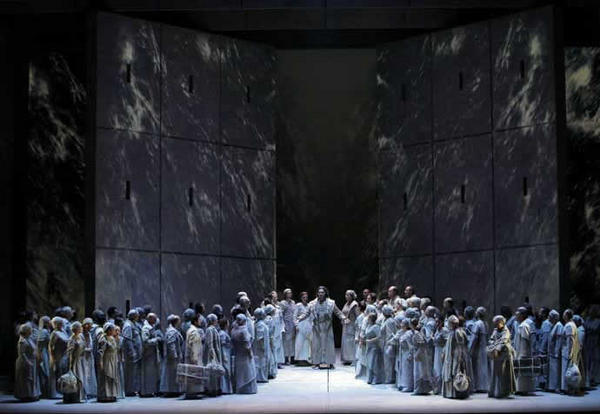
Moïse (Ildar Abdrazakov) and the Hebrews hear the Mysterious voice issuing from the flames telling them to leave the yoke of Eygpt. The flaming pillars are an example of the effective use Pier'Alli made of projections in this production of Moïse et Pharaon at the Teatro dell'Opera di Roma.

Now I am a Muti follower and devotee myself - I have been since I first saw him conduct Don Pasquale in 1971 at Salzburg - what a year that was! Abbado with Rossini, Karajan Verdi, Boehm Berg and Mozart and Muti Donizetti! One of the great joys of the past few years is having the opportunity to see performances he has conducted both in Salzburg and here in Roma. However I am starting to question how far we can go with the hero worship and reverence - we are after all in the opera house or the concert hall not a church or a temple. Music was meant to be responded to and unless its Ambrosian Chant was not meant to be heard in a sepulchred vacuum.

Take in point last month's Muti-led season opener at the Teatro dell'Opera: Moïse et Pharaon. This was Rossini's reworking for the Parisian audience of his earlier Neapolitan work Mosé in Egitto. Many of the big numbers were carried over from the earlier work and others added to meet the requirements of the Opéra for spectacle, dance and the talents of the resident singers. Yes the subject is of a religious nature - though librettists Balocchi and de Jouy somehow work the Burning Bush into the Plagues on Egypt!!!! - but it also has good old fashioned operatic situations woven into the story. Oh sure Moses keeps saying "let my people go" and Pharaoh says "yes, no, maybe" but there's also the forbidden love of Aménophis, Pharaoh's son, for Anaï, Moses' niece, and the conversion of Sinaïde, Pharaoh's wife, to the faith of the Hebrews thrown in for good measure. It pretty much ends according to C. B. deMille - the Hebrews escape through the Red Sea and Pharaoh and the forces of Egypt are drowned but there's a fair bit of digression along the way.

This photo doesn't half catch the brilliant effect of the final scene as the sea parted and Moïse and the Children of Israel made their way through the cascading waters to the other side.
There are quite a few ensembles, chorale moments and the incredibly beautiful Des cieux où tu résides quartet with chorus - but a great deal of the music is Rossini writing for star singers to show off their vocal chops. The very beautifully produced programme - I really must do a posting on the remarkable programmes published here one day - included pictures of all the principle singers, both in costume and civilian dress, who sang at the primiére but search as I might I found no picture of the conductor nor even a mention of his name.

Such was not the case here in Roma in December, the name foremost on the posters was Muti. Though there was "names" among the singers they were secondary to the maestro and were not the reason we were making the journey to Piazza Beniamino Gigli. Not that the maestro in anyway failed us. This is the third time he has led this particular work and his love and familiarity showed. The forces in Roma may not have been as first rate as those at La Scala or Salzburg but the orchestra is constantly showing what can be achieved when working with a demanding taskmaster. However I am starting to wonder - given both that evening's performance and the next evening at La Scala - if all Italian orchestras have problems with their brass sections? Riccardo Zanellato's chorus did some of the finest work I've heard from them in the past four years - and Moïse is one of those works where the chorus is as important as the soloists.

Muti's soloists were a variable and in one a case a questionable choice. Ildar Abdrazakov (above left) has sung Moïse in Muti's two previous productions and his is a powerful, if not dominating, performance and in Nicola Alaimo's Pharaon he had a worthy opponent.
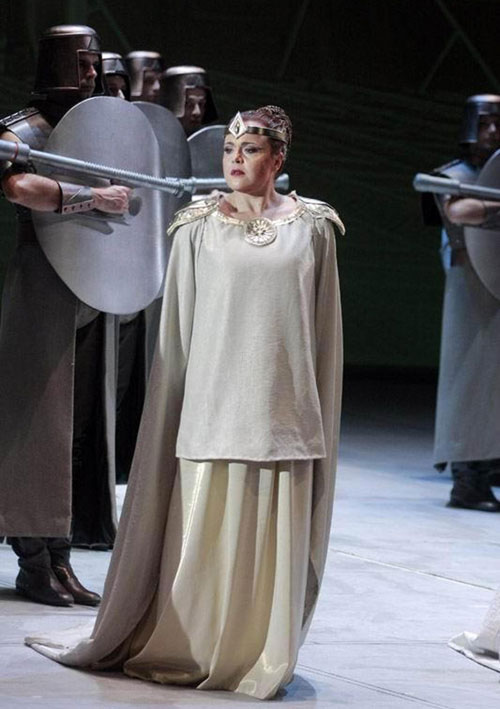
I was expecting much of Sonia Ganassi (right) as Sinaïde but have noticed in the past few performances I've experience that her voice has taken on a very uncharacteristic harshness. Her duet with the equally rough sounding Eric Cutler (Aménophis) almost became a shouting match. Though it should be noted that Ganassi was cheered to the rafters while Cutler received a few jeers from the normally timid galleriste. Juan Francisco Gatell (Éliézer) and Barbara Di Castri (Maria) offered strong support in their few solo passages and to the ensembles. The one miscalculation was Anna Kasyan in the role of Anaï - her is a pleasant but thin voice and she seemed to lack both the breath control and the technique for her big scene. This music was written originally for the great Colbran and adapted for the equally admired Cinti-Damoreau, and no matter how brilliant the conductor requires a singer of equal brilliance.

Director/Designer Pier'Alli's design for the opening of the Red Sea - a spectacular use of projections, lighting and a semi-permanent architectural set. The entire production was the best example I've seen of using modern technology as scenography.
I am not an admirer of Pier'Alli as a director and have yet to see anything staged by him where there has been any real solid characterizations or emotional core but this time I was overwhelmed with admiration for his designs - his use of architectural elements, lights and multiple projections were exceptional. For the first time in my opera going experience I saw modern technology used effectively and seamlessly to enhance and illuminate a production - as a sidebar it made the sloppy projections in the La Scala Die Walküre the following evening look like the work of amateurs. Highest praise to Alli for his designs, Guido Levi for his exceptional lighting and the technical staff at the Teatro for putting it all together.

Shen Wei's modern choreography was an remarkable match for the extended dance sequences Rossini wrote for the original production in Paris.
Equally as praise worthy was the choreography of Shen Wei for the extended dance sequences that make up most of the third act of the opera. Dance was a must for any production at the Opéra in those days and Rossini met the requirement with 20 minutes of pleasant, highly dancable, if not memorable, music. I had read much about Wei in the translations I had done for Ballet2000 but wasn't expecting the simple beauty of his dance patterns and movements. Like Alli's designs his choreography reflected an innate sense of musicality.

And that might well be the watchword for the entire evening - musicality. That sensitivity to, knowledge of, and talent for music that is the mark of a Muti performance. But what was lacking, and frankly seems to now elude the maestro, was any feeling of spontaneity; less a feeling of awed worshipping at the altar of art and more of feeling of joyful participation in the art itself would have made a good evening more than that.

To celebrate the 150th Anniversary of the Unification of Italy Maestro Muti will be giving us Nabucco in March - another work with a religious theme and the added strong patriotic subtext. It is early Verdi, raw and a little rough around the edges a bit like the Risorgimento itself. I can only hope that the Maestro will give us more of the rough and raw and a little less of the religious.

Photos: Falsini for the Teatro dell'Opera di Roma


17 gennaio - Santa Nadia
Enhanced by Zemanta