Showing posts with label Rossini. Show all posts

Sunday, July 13, 2014

Salzburger Zeitung 2014 #3


Though the food, wine and sights of Salzburg are part of what draws me back so often to this lovely city, central to it all has always been the music.

Whither it was in those early years for the Summer Festival, the Mozart-werk one winter or the visits to the Pfingstenfestspeile that started in 2008 the main attraction has always been the music - and the music makers.

As with any Festival there are going to be banner years and then there will be times when the stars - both astrologically and musically - don't quite align.  I'm afraid this year was one of the later.  Given the line-up of performers and works being performed it should have been a success but there was something that didn't quite work.  Perhaps it was the effect of the numerous last minute cancellations for the Stabat Mater and the Rossini Gala; perhaps it was the less than sparkling conducting in the two operas (more of which later); perhaps it was the poor choice of venue for the Otello  - even Verdi's version, as I recall from 1971, did not sit all that well on the sprawling stage of the Grosses Festspeilhaus; or perhaps it was simply that the programme didn't gel the way it was intended to.  Of the six Pfingstenfestspeils we have attended this was the one that had the the least impact musically and left the least impression.

June 8, 2014 - Religiously Rossini


Unlike many of his contemporaries Rossini did not have to rely on the church for his commissions.  He had been a church singer as a child and written several small pieces (a lovely Cantemus domino and the Faith, Hope and Charity triptych) but things of a religious nature - masses, te deums and canticles, Aves and Salves, those corner stones of church music - he composed little.  And oddly, for a composer known for the speed at which he wrote,  the two major "church" pieces that are most often performed took an inordinately long time to complete.  We were to hear both those pieces on, appropriately,  Whitsunday.

Stabat Mater/Libera me - Grosses Festspielhaus 12:00 Uhr


A photo-montage created of Giuseppe Verdi and Gioachino Rossini.
Photo Shop in Paris in 1860. akg-image/De Agostini Picture Lib./A. Dagli Orti
This midday concert had been plagued by cancellations: of the four scheduled soloists only one, Erwin Schrott, actually performed.  As I mentioned previously, several days before the concert the Festival sent out a notice that due to illness Krassimira Stoyanova and Piotr Beczala had been forced to cancel; and that Elīna Garanča felt it was too soon after her encouchement to return to singing.  Maria Agresta, Lawrence Brownlee and Sonia Ganasssi had graciously agreed to replace their ailing colleagues.  Not a bad set of replacements - though it was interesting to note that all three have very different voices from the singers they were replacing - particularly Brownlee.

I'm not sure if this - or the acoustics in the Grosses Festspeilhaus - was the reason that on several occasions Antonio Pappano and his Orchestra dell'Accademia Nazionale di Santa Cecilia overpowered the soloists.  In more than one post I have expressed my fondness and admiration for Santa Cecilia - they were my "home" orchestra for four years but I have also remarked on more than one occasion that Pappano does have a tendency to occasionally pull out the stops and swamp his singers.  However in the past the Orchestra and Chorus  have given me quite a few memorable moments and  I will include this concert - and the one that followed - amongst them, particularly in the Verdi Libera me.

A facsimile of Verdi's  autograph score of the 1869 Libera Me composed for the unperformed
Messa per Rossini.  Later it was to become the starting point for his 1874 Requiem.

Verdi wrote this first attempt at a passage for a Requiem in 1868-9 as his contribution to a commemorative Messa per Rossini  that had been commissioned by Giulio Ricordi as an observation of the first anniversary of the death of the Swan of Pesaro.  Each section of the Requiem was to be composed by a different hand and Verdi choose and completed the concluding words.  Unfortunately a combination of political, financial and "artistic" difficulties meant the mass was never performed.  Verdi was to use the Libera Me as the foundation of his 1874 Requiem to commemorate the death of Alessandro Manzoni.

My friend David mentioned that he had heard Maria Agresta in the difficult and thankless role of Abaigaile in Nabucco in Palermo and asked if, in my opinion, this was the right repertoire for her.   I wasn't sure if he meant the Verdi or the Rossini but frankly she seemed more comfortable in the later than the former.  Given the late replacement she may not have had enough rehearsals in what is a tricky hall but she didn't seem to have the power to ride over the chorus and orchestra.  There was an emotional coolness in her performance - in my mind this work needs some fire and brimstone:  we aren't talking redemption here but being saved from hell fire!  Though by the end she had gained power for that final pleading cry of Domine.   There is nothing quite like the Santa Cecilia Chorus in either its hushed entry after that frightened and frightening soprano entry or in full cry of terror at the day of wrath - I have heard them in the complete Verdi  Requiem three times and this is music that is in their soul and it shows forth even in this brief piece.

Antonio Pappano, soloists and the Orchestra e coro dell'Accademia Nazionale di Santa Cecilia accept the applause after Sunday's performance of a Verdi/Rossini programme at the 2014 Whitsun Festival.   (Photo: Sylvia Letti - Salzburg Festival)

The Rossini Stabat Mater also had a difficult birth: Rossini composed it on commission from Manuel Fernánde Varela.  Rossini revered the Pergolesi setting of the medieval hymn and did not wish to be seen as challenging the older composer.  One of the conditions of the commission was that the manuscript remained with Varela and was not to be published.  Ill health meant that he had not completed the work by the time of its scheduled premiere on Good Friday, April 5, 1833 and half the piece was composed by Rossini's friend Giovanni Tadolini. Rossini was not to complete the work until 1841 and the work that premiered, to great acclaim, on January 7, 1842 was all Rossini.

Again I'm not sure if it was my seat in the Grosses Festspielhuas - about half way back centre - or perhaps a question of balance because of the change of voice timbres from the originally announced singers but there were several instances when again Pappano's orchestra overpowered his singers. This is not to say that it was less than satisfactory performance though perhaps not as self-satisfying as Schrott seemed to find it.

Maria Agresta, Sonia Ganasssi, Antonio Pappano, Lawrence Brownlee and Erwin Schrott seem as
pleased as their audience was with this performance of the Rossini Stabat Mater. (Photo: Sylvia Letti - Salzburg Festival)

I have heard more powerful Cujus animam than Brownlee's but I doubt I will ever find one that touched the heart so closely - the piercing sword was one of sorrow.  Sonia Ganassi is a singer that I heard and enjoyed often during our years in Italy however the last few times I heard her she seemed to have developed a roughness to her singing - whatever the problem was it has been overcome and she was back to a sound like black velvet shot with silver.  Her voice blended well with Agresta in the Quis est homo and both singers gave fine accounts of their respective aria - though again a touch more fire from Agresta in the Inflammatus would not have gone amiss. Schrott (Hot Schrott to his many admirers) gave a heft to the Pro peccatis - rather amusingly being a tall athletic man he  towered over his colleagues and conductor and seemed to take secret delight in it.

Once again the Coro di Santa Cecilia proved to be the backbone of the performance particularly in the hushed delicacy they brought to the lovely "paradisi gloria" passage of the final quartet and chorus.  Aside from those odd moments when the balance favoured the orchestra Pappano conducted a good if,  perhaps, not Festival standard performance.

Petite Messe Solennelle - Stiftung Mozarteum - Grosser Saal - 17:00 uhr


Pappano, Brownlee and a small group of the Coro were on double duty for the day with a performance of the Petite Messe Solennelle  scheduled just a few hours after they had finished the midday Stabat Mater

As has often been said the work is neither "petite" nor particularly "solenelle" - however it was intended more as a chamber work.  Rossini had set it for 12 singers including four soloists accompanied by two pianos and a harmonium.  It was meant for a church setting however the Papal ban on mixed choirs in church (castrated men where acceptable - fully equipped women not!) meant that it could not be performed as a liturgical act.  Rossini had been in correspondence with Pius IX in an attempt to get the ban lifted but without success.  Fortunately the edict did not apply to private chapels and the first performance took place in the personal chapel of Count and Countess Pillet-Will.  It was intended for family and friends - with Auber, Meyerbeer and Thomas being amongst the later.

The title page of the autograph manuscript of the Petite Messe Solennelle - Rossini specifies the
number of singers and instrumentation he intended. In 1866-67 Rossini expanded the work
for performance by larger forces and orchestra.


The work was  orchestrated by Rossini in1866-67 but the first performance of this expanded version did not take place until three month's after his death on February 28, 1869 - the closest date to his birthday in a non-leap year.  For the Festival performance Pappano choose to use the original chamber version with a larger chorus and four soloists.  Though the Grosser Saal of the Mozarteum may not be as "homey" as the chapel chez Pillet-Will the atmosphere was still intimate.

Pappano led from the piano (Pamela Bullock was the second pianist and Ciro Visco, the chorus master, played the harmonium) and in the Offertorium Ritornelle proved to be an accomplished pianist.   It was a simple, clean and intimate performance - just as Rossini intended.

Michele Pertusi, Lawrence Brownlee, Vesselina Kasarova, Eva Mei, Pamela Bullock, Antonio Pappano and
Ciro Visco acknowledge our applause after the Whitsunday performance of the Petite Messe Solonnelle
Several members of my beloved Coro di Santa Cecilia are in the background.  (Photo: Sylvia Letti - Salzburg Festival)


There is a quote somewhere - attributed to I know not who - that all this work requires is a small space (√ the Grosser Saal) two pianos ( √ Pappano and Pamela Bullock), a harmonium (√ chorus master Ciro Visco) a small chorus (√ Coro di Santa Cecilia) and the four greatest singers on earth .....  there we run into a slight problem.  Eva Mei, Vesselina Kasarova, Lawrence Brownlee and Michele Pertusi are all well-known names in opera circles and are fine singers all but on this occasion two of them seemed out of their element.  I knew Mei by reputation and a TV-cast of La Traviata live from Zurich Central Railway Station which I recall enjoying but here found her voice pinched and colourless.  Perhaps Pertusi needs a character to hide behind: on stage he can be dynamic but on the three times I have seen him in concert he has proven, as he did here, bland and one dimensional.  If the day's double duty gave Brownlee any problem it wasn't obvious here - an exceptionally fine nuanced performance that was matched by the artistry of Vesselina Kasarova who's Agnus Dei embodied everything that Rossini put into this  "last of my péchés de vieillesse".

And again that remarkable choir from Santa Cecilia proved the backbone of the performance:  joyful, rambunctious (is there anything jollier than that Cum Sancto Spiritu?) and quietly - almost whisperingly - reverential.  And as a sidebar there was an entire cheering section from the larger Coro behind me greeting their colleagues with bravi and foot stomping - as indeed had the audience.  One of the ladies had to tell me that they were part of the Coro; when I said I had lived in Rome and heard every concert they had given during that time and how much I thought of them she gave me a kiss on the cheek and said: Grazie.  A rather nice way to end a performance that was seemed indeed to be for family and friends.

Postscript:  In his preface to the work Rossini wrote:
Good God—behold completed this poor little Mass—is it indeed sacred music [la musique sacrée] that I have just written, or merely some damned music [la sacré musique]? You know well, I was born for comic opera. Little science, a little heart, that is all. So may you be blessed, and grant me Paradise!
Why do I think if I had one of those mythical dinner parties he would be amongst the guests I would want at table?

July 13 - 1814: The Carabinieri, the national gendarmerie of Italy, is established.

Wednesday, June 18, 2014

Mercoledi Musicale

One of the concerts I choose to give a miss this year at the Whitsun Festival was a piano recital by the young French pianist David Fray. Fray appeared on the music scene in 2004 winning the second grand prize at the Montreal International Piano Competition . He is a rather mannered player reminiscent of a long-haired Glen Gould – though he has voiced little admiration of Gould citing Wilhelm Kempff as his model. Unlike much of the performances scheduled last week he will not be concentrating on Rossini however he won’t be entirely neglecting the Man of the hour.

In 1820 Liszt transcribed La caritá (Charity), a short religious choral composition of Rossini’s, for piano. It was the last work of a triptych – I’ll let you figure out what the other two may have been called. Fray will be including it in his programme along with selections by Schubert, Bach and other works by Liszt.

I tried to upload a version by an Australian pianist who has recorded all the piano works of Liszt - 98 volumes - however YouTube banned it almost immediately despite the link to his website etc.  I will not name either the artist or the label because I was all set to give them free publicity .

Unfortunately the only piano version on YouTube is not a particularly good one but there are several lovely postings of the original choral piece (mostly by amateur choirs) and this one is particular favourite.


The soprano Jodie Devos was the second laureate in this year's Queen Elizabeth Competition in Brussels. Should you wish to hear a bit more of this young soprano, her performance at the finale of the Competition is available here.

June 17 - 1631: Mumtaz Mahal dies during childbirth. Her husband, Mughal emperor Shah Jahan I, will spend the next 17 years building her mausoleum, the Taj Mahal.


Saturday, June 14, 2014

Salzburger Zeitung 2014 #2


June  5, 2014

Well the Pfingstfestspeile began in semi-earnest last night with La Cenerentola to a mostly full house - I notice that for next year's Festival the idea of starting on the Thursday of the holiday weekend has been jettisoned.  As happens here there was high fashion, silly fashion, casual fashion and the odd smell of mothballs and dry cleaning fluid that suggested a few articles of summer finery had been in storage over the long winter.  Of the production itself I am of several minds and will have to try and get them all together to a degree where I can write something of some intelligence.  Let me just say that my restraint when stage director Damiano Michieletto and his crew took their curtain call was beyond admirable!

After seeing what's on the menu (see items below) at Don Magnifico's Buffet (don't ask!) Laurent
wasn't too sure if he really wanted to go in.

Prince Ramiro's car seemed a bit dodgy even before it crashes through the front window of the
 Don's Buffet - again don't ask or I'll have to explain it to you. 

A late night diner at the Sketch Bar of the Hotel Bristol was a wonderful occasion to have a chat with Herr Leitner, the Manager and see our friend Dr M., who at 81 is still travelling the world for opera, ballet and theatre.  He had just arrived from Toronto via Munich and after the Festival is heading to London to see Natalia Osipova in a new ballet.  He's already planning for next year's Whitsun Festival - the man is a wonder.  And as always we were spoiled in the Sketch Bar by Gabor and Peter and the late night kitchen staff while Herr Leitner got us up to speed on the gossip around town and the music scene in Austria.

June 6, 2014

Today was the first of two music free days and an old friend of Madame J's is arriving from Switzerland for a brief visit later today.  The day started a bit late and continued at a leisurely pace - but that's why they call it vacation, right?

In 1822 Rossini and his, by then wife, Isabella Colbran left Napoli and moved to Vienna.  The move was not unexpected - his music had been wildly successful in the Austrian capital and his friend-partner (and Colbran's former lover) Domenico Barbaja was the impresario at the Theater am Kärntnertor.  It might be added that Barbaja seemed to be the impresario and casino operator at half the opera houses in Europe at that point.  Rossini conducted La Cenerentola and Zelmira there and Colbran sang the title role in the later.

In celebration of this rather tenuous connection with Austria - at one point a Festival publication tries to, without much success, link Mozart and Rossini - the De Ponte Institute has set up an exhibition:  Rossini-mania Wien 1822.  Publicized widely in the Festival programmes and prospectus it was still difficult to find - a small sign pointed to the Festival Administrative Building but once inside there was nothing to indicate that it was buried in the basement.

Consisting mostly of prints and scores it covered more than the Swan of Pesaro's period in Vienna.  His years in Naples, the visit to London and the last years in Paris were well represented in the numerous prints, playbills and fashion plates on display.  Many were familiar from publications and website devoted to Rossini but just as many were new - to me at least - and portrayed the singers, musicians, dancers and vips who performed, befriended, celebrated and feted the composer during his life time.

A general view of Vienna - 1819 by Jacob Alt.  Some of the landmarks are still visible today, others have been blocked by the urban sprawl of the late 19th and 20th centuries. It was only one of the fascinating cityscapes on display at the Rossini-mania Wien 1822.
Perhaps most interesting were the representations of Vienna, London and Paris in those early years of the 19th century.  Many landmarks were recognizable but as with all cities what had once been forest or parklands has long since been filled in by urban sprawl - even if it is late 19th - early 20th century urban sprawl.


One of the more intriguing lithographs on display indicates the orchestra seating at the Kärntnertor-Theater in 1821.  By today's standards it seems odd that the conductor is situated right at the stage rather than between the hall and the orchestra.  There are 26 seats, most of which would have been given over to violins and oddly there does not seem to be any space provided for a harpsichord or cembelo. Given that Rossini was wont to conduct from that instrument it is likely the arrangement was changed when he conducted his works there.

It was a fascinating exhibition but sadly so poorly advertised that there were very few people there.  It was almost representative of what seemed a slightly under-planed Festival.  However more about that later.

The entrance to the Haus für Mozart and Felsenreitschule features a colourful mural highlighting the first performance of Hugo von Hofmannsthal's Jedermann at the Festival on 22 August 1920. The architect and stage designer Clemens Holzmeister is seen at the left holding plans for what was to become the first Festspeilhaus. 
After a nice lunch at the Goldener Hirsch Laurent and I headed over to the Festspeilhaus for a tour.  In all the years we have been going to the Festival we've never been through the houses that make up the complex set against and deep inside the Mönchsberg. Unfortunately the Grosses Festspeilhaus was closed for rehearsals for the next day's concerts but we still went through the Haus für Mozart and - my own favourite venue - the Felsenreitschule.  That included a visit backstage to see the workings of Paolo Fantin's sets for Cenerentola - though thankfully the labyrinth of chairs that cluttered Don Magnifico's Buffet were absent.

Don Magnifico's Buffet minus the chairs that were moved, piled on tables, thrown, upended and occasionally - just occasionally - used to sit on.  We also saw the multitude of cables that bore it heaven word when the scene changed to ...
.... Prince Ramiro's party at the Palace Disco.  Do they still actually do the frug - except in operatic productions where they are trying to show decadence and high living?


At Don Magnifico's they serve up all manner of appetizing - from a distance - goodies. 
I must say that even up close a good deal of it looks very realistic.
But the real surprise came at the Felsenreitschule (Rock Riding School).  The great arched boxes  carved into the sides of the old stone quarry in 1693 have been hidden by a set being built for Charlotte Salomon - a modern opera being presented at this year's summer festival.  Only the side boxes were clearly visible;  I mentioned what a shame it was and several people, including the guide, agreed. 

Only the side boxes of the Felsenreitschule were the only portion of this wonderful space that clearly visible - the stage itself was taken up with a unit set for a production for the summer festival.

The stage of the Felsenreitschule was a mass of suspended flats, unfinished lumber and carpenters tools.  The sets for the upcoming opera were being constructed in place.
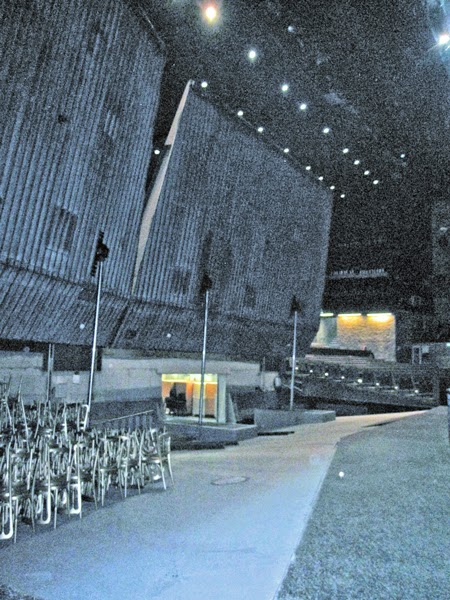
But  more surprising than the decision to hide this architectural marvel, was the revalation that the entire front section of seating had disappeared.  Or at least appeared to have.  The sloped floor and seats are on hydraulic arms that are cantilevered and can swing the seating units up out of the way to allow equipment to be brought in.  It also serves as a scenery dock and storage area.


The first nine rows of the centre sections of seats in the Felsenreitschule are on hydraulic arms.  This allows them to be lifted out of the way.  The day we visited the area served as storage space for the chairs that would be used at the gala dinner on Sunday evening in the Karl-Böhm-Saal.

The Karl-Böhm-Saal serves as the refreshment hall for both the Haus für Mozart and the Felsenreitschule.  Originally created to serve as the winter riding school by Prince-Archbishop Guidobald Graf von Thun it was the scene of tournaments and military training in the 17th century.  This year it was also the site of a gala dinner prepared by Elena Arzak, one of Europe's more noted chefs.  Needless to say that as it was being held in honour of Rossini the famous Tournedos of that name were on the menu.

The beautiful Karl-Böhm-Saal serves as the intermission foyer and crush bar for the Haus für Mozart
and the Felsenreitschule.  It was built in 1662 as the winter riding school and restored by Clemens
Holzmeister and again with the major renovations of 1960/70.

The balcony and staircases were added by Holzmeister in the style of the original period when further work was done in 1999.
The Karl-Böhm-Saal serves as the refreshment hall for both the Haus für Mozart and the Felsenreitschule.  Originally created to serve as the winter riding school by Prince-Archbishop Guidobald Graf von Thun it was the scene of tournaments and military training in the 17th century.  This year it was also the site of a gala dinner prepared by Elena Arzak, one of Europe's more noted chefs.  Needless to say that as it was being held in honour of Rossini the famous Tournedos of that name were on the menu.

The fire firescreen fronting the great fireplace built into the rock of the Mönchsberg was also created by Holzmeister to symbolize the history of the room - ecclesiastical, military and artistic.
The Festival venues are used primarily during the Easter, Whitsun and Summer Festivals and lay largely empty during the rest of the year.  He made a point of mentioning that it was the Festival that gave the city much of its status and, its very apparent, wealth.

A few facts the guide revealed concerning the Festival made us very aware of its importance to the city of Salzburg:

  • The Festival employees 226 people year round but that figure jumps to over 6000 during the summer months.  
  • The budget is around 60 million euros with ticket revenue covering about of third of that amount.  
  • Its been estimated that the Festival brings in tax revenues equal to three times what it receives in public subsidies.  
  • In 2011 it was estimated that the Festival generated some 276 million euros in business revenues for the district.  

The afternoon was capped off by finding a table on the loge of Café Tomaselli overlooking the Alter Markt and choosing from their extensive eis menu.

A view from the loge at Tomaselli and a choice between an eis-caffe and a mocha frappe - what more could a gnome of vacation ask for?

Music, drama, history, a great setting and good (and fattening) food - that's why they call it vacation.  Right?

June 14 - 1789: Whiskey distilled from maize is first produced by American clergyman the Rev Elijah Craig. It is named Bourbon because Rev Craig lived in Bourbon County, Kentucky.

Wednesday, July 15, 2009

Mercoledi Musicale

Photo by Neil Gillespie*My good friend Parsi, with whom if as there was is a goddess in heaven I'd I'll be having dinner and concert going this coming Saturday in Corinth but sadly it is not to be because as I don't now have a babysitter for the kids, had the good fortunate to be at one of those evenings that will go down in operatic history. I could forgive him for that but then a few nights ago he also caught Helen Mirren in Phaedra at the wonderful Theatre in Epidaurus. Parsi , if you weren't so "adorable"....

Appropriately on the 4th of July Yankee Diva Joyce DiDonato was singing Rosina as part of an all-star cast in Rossini's Barber of Seville at London's Royal Opera House. During one particularly hectic moment in the frantic staging she tripped and sprained her ankle - or so it appeared. She went on to sing the rest of the performance using a crutch. But it turns out it was more than a simple sprain. She has sang the rest of the performances from a wheelchair.

But it's probably better to let the lady herself tell you the complete story but only after you've heard her as Rosina standing on her own two feet. Here she is with her frequent partner the wonderful Juan Diego Florez, showing both her vocal and comedic skills.


So here's Joyce's taking on the evening of the 4th and the adventure that followed at the next performance. We are sure as hell talking Yankee pluck here!

Brava for the Diva!

The photograph of Ms DiDonato en fauteuil roulant is taken from her blog and is the work of the very talented Neil Gillespie.


*God help me I am starting to write like an Italian ballet critic!

15 luglio - San Bonaventura da Bagnoregio


Reblog this post [with Zemanta]

Wednesday, May 13, 2009

Mercoledi Musicale

On Friday night I joined a packed house at La Scala - the scene for the last minute seats at the box office was crazy, people cheering as they got their tickets and waving them jubilantly - to see the second last performance of Rossin's Il Viaggio a Reims. My dear friend Opera Chic has written in her trademark style about the opening night and I have little I can add to her already insightful writing. Luca Ronconi's much traveled production is still a major delight and it seems that each new generation is able to field a cast to do it and Rossini's joyous piece d'occasion justice. I was particularly delighted to see Daniella Barcelona once again - she is becoming one of my favorites, I'm hoping to see her in L'Italiana in Algeri in Trieste next month.

A while back my friend Parsi posted this legendary encore from the 1992 Pesaro Festival production.


In response to the ecstatic bravos of the audience at the end of that performance Claudio Abbado led his exceptional forces in an encore of one of the big ensemble pieces. The singers - some of the great Rossini singers of the time - just let go and had fun with the whole thing.
Friday night's cast taking their bows to a cheering, stomping audience. Then turning to applaud along with us for the artistry of Carlo Colla and his puppeteers.

Though we didn't get an encore Friday evening the cheering that greeted the walk around curtain calls went on for a good 10 minutes. An evening of great theatre, great fun and some exceptional singing.

13 maggio - Nostra Signora di Fatima

Wednesday, September 24, 2008

Mercoledi Musicale

I know I'm given to mini-themes here so it should come as no surprise that today's music ties in with Lunedi's lunacy. Rossini stopped writing operas when he was 37 and for the remaining 39 years of his life wrote mostly occasional pieces - secular, sacred, instrumental and vocal.

His Péchés de vieillesse (Sins of My Old Age) includes this lovely vocal piece I Gondolieri sung here by the 2005 TMEA All-State Mixed Choir conducted by Simon Carrington accompanied by Thomas Jaber. I've been assured by a few singers I know that the older Rossini had lost none of his ability to give singers - particularly the tenors - a work out.


A Dedication: This little piece is for Ryan - he loved Rossini.

It has been almost two years since Ryan decided to leave us. As I recounted in one of my first postings he and I met over a whistled snatch of Rossini's Di Tanti Palpiti and became the best of friends. At the time he left I was filled with both anger and loss at, what seemed to me, an unexplainable act. The anger has long ago disappeared but the sense of loss is as acute today as it was two years ago.

So much has happened in that time that I wish I were able to share with him. The move to Rome, our wedding, the loss of our Reese, travel, food and all the silly day-to-day things you share with friends. And of course, the music, especially the music.

Sure there are other people I can talk to about the dreadful Aida at Caracalla or the incredible Fidelio at Reggio Emilio but not in the same way. With them there would not be that deep, appreciative chuckle and raised knowing eyebrow. So often I have found myself leaving the opera or concert hall thinking: if only I could tell Ryan about ... I can only imagine the conversations!!!

Dearest R. your Darling Boy and the Lad still miss you very much and we hold you in our hearts. We can only hope that you found a peace that was otherwise denied you. Baci di Roma.

24 settembre - Beata Vergine Maria della Mercede

Thursday, August 28, 2008

Mercoledi Musicale +1*

Giaoachino Rossini's works had fallen on hard times over the 19th and early 20th centuries - of the 40 operas he wrote between 1810 and 1829 only one, the infernal Barber of Seville (sorry it is not one of my favorites,)appeared regularly in the world's opera houses. There would be the occasionally excursion into Italian Girl in Algiers or Cenerentola (Cinderella)when the right contralto/mezzo came along who could manage the vocal line, but his opera seria where deemed unworthy of revival.

However that began to change in the 1960s with the emergence of singers who could handle the challenging vocal demands. Many of those singers were Americans: Rockwell Blake, Frederica Von Stade (my beloved Flicka), Samuel Ramey, Chris Merritt and perhaps the greatest of them all: Marilyn Horne. She had great comic flair as Rosina and Isabella and was a sweeet, tender Cenerentola, but it was in the opera seria that she shone brightest. Many of the contralto roles Rossini wrote were for woman playing the part of a man: Calbo** in Maometto II, Malcolm in Donna del Largo, Arsace in Semiramide and the title role in Tancredi . Jackie may not have been the most convincing man but I remember that first Tancredi in Houston in 1977 - she strode out on stage, opened her arms and her mouth and dared any of us not to believe in her. And believe we did - then and right up until she retired in 1999, still at the peak of her art.


Tancredi was Rossini's 10th opera and his first great success. "Di Tanti Palpati" - Tancredi's first aria heard here - was so popular that there was a Papal ban on altar boys whistling it. After this performance in 1977 apparently it could be heard everywhere on the streets of Rome. And I'm sure they heard the cheering after this remarkable performance all the way out on Via Nazionale.

*So actually it should be Giovedi Musicale but...

** I was surprised that the critic for the Financial Times in her review of this year's production at Pesaro referred to it as being written for a castrato. She obviously didn't know Rossini's views on castrati nor had she read her programme notes.

28 agosto - San Augostino

Friday, August 22, 2008

Road to Rossini

We're heading off to Pesaro this morning for a few days of rest, relaxation and Rossini. We'll be driving across Italy and up the Adriatic coast - approximately a 364 km trip which according to the trusty TomTom should take us 3 hrs and 36 minutes. TomTom is ever the optimist!


View Larger Map

Though it's the capital of the region Pesaro is pretty much a sleepy little seaside town known for its beaches, proximity to Rimini and being the birth place of Rossini. Each year since 1980 the Swan of Pesaro has been celebrated with a Festival dedicated to his works.Rossini Festival Poster Scholars have researched his work, lost operas have been found and critical editions published. Famous singers have appeared on stage there and careers established. The two works we are seeing are relatively obscure - as indeed most of Rossini was until the 1960s: L’Equivoco Stravante and Maomatto Secondo. The first was written when he was 16 years old and was banned because of it licentious libretto - apparently a young woman disguises herself as a castrated man (!!!) to avoid an unwelcome marriage. The second uses Mohamed the Seconds conquests of the Eastern Mediterranean to tell of love, betrayal and death - your standard opera plot.

So it three days of sun, seaside and song.

22 agosto - Santa Maria Regina

Sunday, March 16, 2008

The Italian Girl in Athens!

In the past two months I've had the pleasure of meeting two blog buddies. Last month Aaron from Meanwhile was visiting Rome and we were able to meet for lunch and a bit of a wander. On Friday Laurent and I spent an enjoyable evening with one the premiere opera bloggers around: Parsi from Parsifal.

In an e-mail I had mentioned that I would be in Athens this week and asked if anything operatic was on the books. Not only was Rossini's L'Italiana in Algeri (The Italian Girl in Algiers) premiering Friday night but the great Greek Mezzo Agnes Baltsa would be singing the lead role of Isabella. And a friend of his had two extra tickets and if we would be interested..... Would we! Damn right!

Agnes Baltsa and me.I'll likely post a review later in the week - too much to see here to spend time in the hotel room blogging - but it was a great evening, spent with great people. And that would be Miss Baltsa taking a moment to pose with a fan at the opening night reception.

Thanks Parsi for including us in a wonderful evening. And remember Rome, Muti, Otello, December!

16 marzo - Delle Palme

Friday, February 29, 2008

Birthday Wishes ...

Rossini caricature... are going out to that bon vivant and all-round great guy Gioachino Rossini - 53 years old today. Yes, the Swan of Pesaro was born February 29, 1792. And in honour of the occasion we're sending out birthday greetings and best wishes from all of his friends and fans. And what better way to say Happy Birthday than with a few of the Maestro's own compositions.

First off Rolando Villazon asks the musical question: La Danza!


He may not be a Rossini Tenor but he sure knows how to wow a crowd. That gang in Berlin was with him all the way.

And Emanuele Luzzati and Guilio Gianni continue our theme with a piano rendition of La Danza until mascot Puncinello has a wild and funny dream to the overture to Il Turco in Italia.


Happy Birthday Maestro you don't sound a day older!

29 febbraio - San Giusto

Monday, February 11, 2008

Lunedi Lunacy

Lele's PuncinelliI first saw the work of Emanuele (Lele) Luzzati back in 1963 in a programme book for the Glyndebourne Festival. It would be another 6 years before I saw his magical designs on stage but in the meantime, through a few children’s and music books that were available in Canada, I became enamored of the child-like exuberance and musicality of his imagination. He was known throughout Europe as a stage designer, book illustrator, muralist, film director, animator (with partner Guilio Gianni) and designer of fantastic children’s parks and playgrounds. Still actively creating at the age of 84, his death in January 2007, left the world with one less source of joy, wonder and lunacy.


It's questionable if Rossini actually wrote the Cat Duet but god knows he heard enough caterwauling sopranos to give him inspiration.


Lele and Gianni were nominated several times for Oscars and amongst their noted animations where the titles for Brancaleone alle Crociate (Brancaleone at the Crusades) second in a series of Italian comedies featuring Vittorio Gassman as a hapless knight who becomes the leader of an army of rogues, cheats and liars. The first movie gave rise to the expression - often applied to Italian politicians: They're as bad as Brancaleone's Army!

11 febbraio - Nostre Signore di Lourdes

Monday, November 26, 2007

Do Tell

Orange crate label - Orange County Public LibraryAt the end of the first half of Saturday's evening's concert performance of Guillaume Tell, I would've been more than happy to board a Number 2 tram and head for a restaurant at Piazza di Popolo. An animated Antonio Pappano had conducted a peppy version of the (in)famous Overture and was driving the performance along at a good pace but the evening just wasn't catching fire - the french horns which have a lot to do in Tell were having a real off-evening, missed entries and some out of tune playing. The chorus, under 80 year old Norbert Balatsch, was proving one of the glories of the evening. But the soloists were largely uninvolved with the proceedings and big moments went by unnoticed.

Suddenly at the beginning of Act 3 the whole thing took off. Singers who had been, for the most part, glued to their music stands and scores became involved - the air practically crackled with tension during the the Apple Shooting scene and the action and music drove on to an exciting Act 4 and triumphant finale.

Within the next two hours Michelle Pertusi (Tell), who had been totally uninvolved for the first two acts, gave a heartbreaking performance of Sois immobile and American tenor John Osborn (Arnold) became a Rome favorite. Pertusi had been the worst offender in the first half - going through the motions, sprawled out in his chair and examining his nails when not required to sing. Maybe Pappano had given him a pep-talk during the intermission but it was suddenly apparent why he is one of the Rossini basses of choice these days. Osborn had been singing well all evening, his (and Pappano and his orchestral and choral forces) efforts to bring some drama into the Call to Arms and Gathering of the Cantons at the end of Act 2 had floundered on the laisse-faire singing of Pertusi and Alex Espisito (Walter Frust.) But the duets with a slightly underpowered but dramatically involved Norah Amsellem (Mathilde)had been fine and at the beginning of act 3 exciting. He opened Act 4 with a beautiful account of Asile heréditaire then set the place on fire with Amis, Amis secondez ma vengance. The bravos and applause went on for a good three or four minutes and the ovation that greeted his appearance at the end was thunderous.

And though Laurent and I agreed that maybe another rehearsal may have been in order and those music stands and scores had to go, we were on our feet with the rest of the house.

It will be interesting to hear the live broadcast of the last of the three performances this coming Wednesday on RAI3-Euroradio. If Pappano can get that first half to equal the second it will be one of those great nights of opera.

26 novembre - San Corrado

Wednesday, November 21, 2007

Rossini Roundup

The second LP I owned (this was back in 1959) was the 1953 Glyndebourne La Cenerentola in an Italian pressing from Cetra. It was three thick vinyl records, a two page leaflet in badly translated English and the old Riccordi pocket Italian libretto that they still sell today. It has since been replaced in my collection by the CD reissue and at least two other versions of Rossini's Cinderella opera. My taste in music has grown since then to include pretty much everything from Monteverdi to Berg but Rossini still remains one of my favorite composers. And next week I'll be going into Rossini overload: two of his more serious works Guillaume Tell and Mosè in Egitto are on the boards here and, of course, we have tickets for both.

Saturday coming the Accademia Santa Ceceila is presenting a concert version of Tell, his final stage work written for the Paris Opéra in 1829. This will be the first time that it has been performed in French in Rome. Antonio Pappano is scheduled to conduct which is pretty damned exciting and I can only hope that he's recovered from his recent problem- apparently baton waving can result in workplace injuries. It's going to be a long evening as this is French Grand Opéra at its grandest - the performance starts at 1700 so I think I'll pack us a picnic lunch and a decent bottle of something red and wet.

I'm familiar with Michele Pertusi who will be singing the Tell and Pharaoh in the Mosè, but the rest of the singers are, to me at least, only names. I've heard some good things about American tenor John Osborn who'll be singing the killer part of Arnold. Its a role associated with some of the great tenors of the past so there will be a few ghosts hanging around this Saturday including the remarkable French tenor Georges Thill. Here he is singing Arnold's big aria Asile héréditaire.


And next week the Teatro dell'Opera starts a series of the Mosè - the Italian version from 1819 - plagues, parting of the Red Sea and a love story to boot. Its not often produced outside Italy so this is an opportunity to see another relatively rare work. In 1829 Rossini rewrote it extensively for Paris under the name Moise et Pharaon. Though he cut some of the numbers that had been big in Naples he wisely kept the most famous number the Preghiera or prayer of the Hebrews as they stand on the banks of the Red Sea. Here it is in the French version from La Scala back in 2003. Muti takes it a little slow (sorry Opera Chic) for my taste but its still an beautiful piece of music.


For the 2008 season everybody seems to be doing Barber of Seville but there's always the Rossini Festival in Pesaro next August for my Rossini fix.


21 novembre - Presentazione di B. V.