As my friend Ron once suggested when we were strolling through the streets of Roma, you have to look up to see the unusual. And as I've often found that applies when walking through most cities in Europe. I hadn't been looking up as we walked along Leidsestraat in Amsterdam I would have seen the fascinating displays in the Gant store but missed these charming friezes on what was once a cigar makers shop.
Now I'm not advocating child labour, nor do I approve of children smoking cigars but this industrious little group, under the tutelage of a cherubic Mercury, seem pretty knowledgeable in the art of making a good cigar.
I noticed that though none of them seem to have taken to the addictive weed when they've finished their work they seem to know how to enjoy the fruits of the vine!
My friend MJ tells me that there was a time when it was cheaper - and in times of war politically more expedient - for plantation owners in the Southern United States to send their tobacco to Holland rather than England for processing.
14 June -1789: HMS Bounty mutiny survivors including Captain William Bligh and 18 others reach Timor after a nearly 7,400 km (4,600 mi) journey in an open boat.
- Posted using BlogPress from my iPad
Showing posts with label Historic Buildings. Show all posts
Thursday, June 14, 2012
Saturday, June 13, 2009
Wanton Distruction
For six of the seven years that I lived there I was involved with the Aylmer Heritage Association (AHA). It is a group dedicated to saving the architectural patrimony of Aylmer, a town with one of the richest stock of heritage buildings in the Ottawa Valley. Founded in 1810 by a small group of Scots Methodists from New England the town thrived as a lumbering community and staging post for trips up the Ottawa River. As it developed Irish immigrants and French Canadians came in as labourers and workers; prosperous merchants built large stylish homes and all the businesses that were necessary for a town to prosper and grow were opened.Given the background of the town founders it stands to reason that the first house of worship was a Methodist Chapel - a lovely building recently restored and the headquarters of the AHA. Churches of other faiths followed and in 1838 Charles Symmes, one of the city fathers and an ardent Methodist, gave land for the expressed purpose of building a Catholic church - he may not have agreed with the way his staff worshiped but he wanted them to worship! The first St Paul's was destroyed by fire in 1892 and a new church built in 1893. In the Gothic style so favoured at the time, the interior was richly adorned and painted and the steeple reached for the heavens.
In the 1800s St Paul's steeple was a landmark to travellers on both sides of the river whither arrival was by steamer or stage coach. And was still an indication that I was near home when I was coming back from trips up the Valley a full century later. I always knew I was almost there when I could see that steeple. That will no longer be the case.
Early on the morning of June 11th a fire broke out in the back of the church and within hours, no doubt fed by the old wood interior, St Paul's had become an empty stone shell. It appears, from evidence and witness accounts, that the fire was an act of arson. The purposeful destruction of historical buildings is not unknown in the town but normally that would be when it stood in the way of some developer's plans. This was a working and active parish church with a good size congregation and was in the process of being restored. Why anyone would want to destroyed it is a mystery.
An investigation is under way and it appears an arrest is imminent. But if found and then convicted what punishment do you give to someone who has destroyed a piece of history? What is a fitting sentence when the heritage of a place is wantonly destroyed? What do you get for taking the heart out of a community?
13 giugno - Sant'Antonio di Padova
Sunday, March 04, 2007
Mon Pays - Aylmer, Sunday March 4, 2007
Mon pays ce n'est pas un pays, c'est l'hiverMon jardin ce n'est pas un jardin, c'est la plaine
Mon chemin ce n'est pas un chemin, c'est la neige
Mon pays ce n'est pas un pays, c'est l'hiver

My country isn't a country, it's winterMy garden isn't a garden, it's the plain
My road isn't a road, it's the snow
My country isn't a country, it's winter

Mon pays ce n'est pas un pays, c'est l'hiverMon refrain ce n'est pas un refrain, c'est rafale
Ma maison ce n'est pas ma maison, c'est froidure
Mon pays ce n'est pas un pays, c'est l'hiver
My country isn't a country, it's winterMy refrain isn't a refrain, it's a gust of wind
My house isn't my house, it's the winter cold
My country isn't a country, it's winter
Mon Pays - Gilles Vigneault
Thursday, March 01, 2007
From the Office Window - Friday February 23 - 10:30 a.m.
Last Thursday I posted a few shots from our office windows taken on a cloudy day. The next day it was bright and clear with a wind that whipped the flags a caution. It was also -25c with that bloody wind but the views from the warmth of the 15th floor are great when the sun shines.
I'm ashamed to say I have yet to visit the Canadian War Museum - isn't that always the way. I'll have to wait for some visitors to come into town. I don't find it a particularly attractive building and frankly it looks like a building looking for a location with that expanse of land around it. However I have been told the exhibits are extremely well done and the current show on Afghanistan is worth the trip.

There has been talk about developing the entire Victoria Island complex including the Ottawa Carbide Mill (top photo) built by inventor Thomas Willson. Unfortunately the Aboriginal Experience village is complete covered with snow in the lower photo. This island has been a native meeting place for centuries.

When I look down at the Supreme Court Building I am always puzzled by the crazy - and let’s admit it unsuccessful - attempt to wed the Beaux Arts style with the Mansard roof line. Apparently that what Ernest Cormier, the architect, was instructed to built by the Government of the day. And it’s still more attractive than the War Museum.
The first bridge, the Alexandra Interprovincial Bridge, was the railway bridge into town when Ottawa had a train station at Confederation Square rather than in a distant suburb.
Sadly I will be losing my view of the Peace Tower in the next few days - the flag was always a good indicator as to how bad the wind was on a stormy day. The new job comes with a cost - relocation to an inside cell... sorry cubicle.
I'm ashamed to say I have yet to visit the Canadian War Museum - isn't that always the way. I'll have to wait for some visitors to come into town. I don't find it a particularly attractive building and frankly it looks like a building looking for a location with that expanse of land around it. However I have been told the exhibits are extremely well done and the current show on Afghanistan is worth the trip.
There has been talk about developing the entire Victoria Island complex including the Ottawa Carbide Mill (top photo) built by inventor Thomas Willson. Unfortunately the Aboriginal Experience village is complete covered with snow in the lower photo. This island has been a native meeting place for centuries.
When I look down at the Supreme Court Building I am always puzzled by the crazy - and let’s admit it unsuccessful - attempt to wed the Beaux Arts style with the Mansard roof line. Apparently that what Ernest Cormier, the architect, was instructed to built by the Government of the day. And it’s still more attractive than the War Museum.
The first bridge, the Alexandra Interprovincial Bridge, was the railway bridge into town when Ottawa had a train station at Confederation Square rather than in a distant suburb.
Sadly I will be losing my view of the Peace Tower in the next few days - the flag was always a good indicator as to how bad the wind was on a stormy day. The new job comes with a cost - relocation to an inside cell... sorry cubicle.
Labels:
Historic Buildings,
Office,
Ottawa,
Sights,
Sites,
Winter 2007
Thursday, February 22, 2007
From the Office Window - Thursday 3 P.M.


(Click on the pictures for an enlarged view.)
We have a great view from our corner on the 15th Floor - pretty much uninterrupted from the War Museum in the West to the Peace Tower in the East. Even though today was a bit gray and overcast its still a good view. On a sunny day when you can see the Gatineau Hills its a great one.
Labels:
Historic Buildings,
Office,
Ottawa,
Sights,
Sites,
Winter 2007
Tuesday, February 20, 2007
When All Aloud the Wind Doth Blow


When all aloud the wind doth blow,
And coughing drowns the parson’s saw,
And birds sit brooding in the snow,
And Marion’s nose looks red and raw,
When roasted crabs hiss in the bowl,
Then nightly sings the staring owl,
Tu-whit;Tu-who, a merry note,
While greasy Joan doth keel the pot.
And coughing drowns the parson’s saw,
And birds sit brooding in the snow,
And Marion’s nose looks red and raw,
When roasted crabs hiss in the bowl,
Then nightly sings the staring owl,
Tu-whit;Tu-who, a merry note,
While greasy Joan doth keel the pot.
Love's Labours Lost - William Shakespeare
When Icicles Hang by the Wall


When icicles hang by the wall,And Dick the shepherd blows his nail,
And Tom bears logs into the hall,
And milk comes frozen home in pail,
When blood is nipp’d and ways be foul,
Then nightly sings the staring owl,
Tu-whit;Tu-who, a merry note,
While greasy Joan doth keel the pot.
Love's Labours Lost - William Shakespeare
Sunday, November 26, 2006
Hallmark Moments
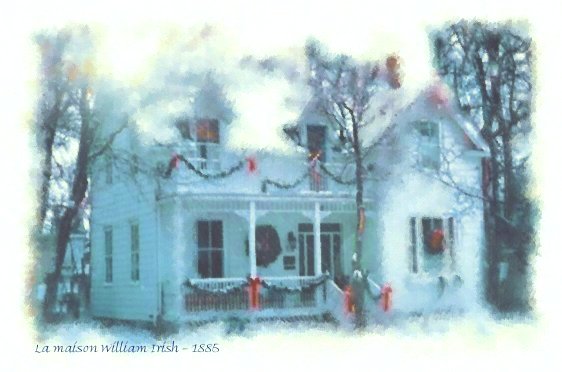
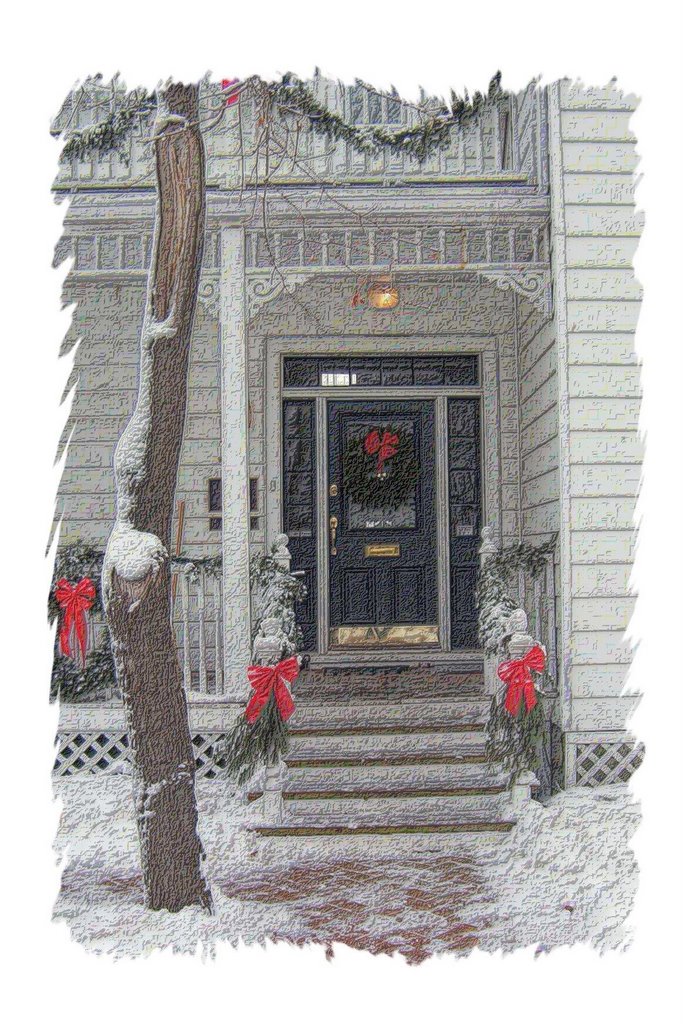
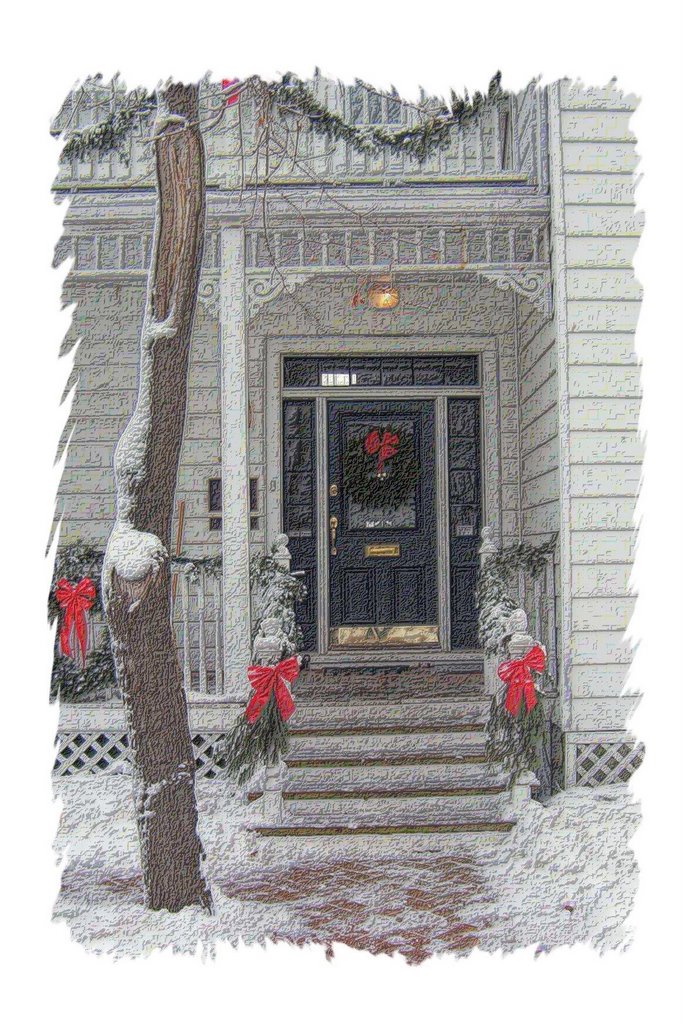
Built in 1885 and all Victorian-gingerbread (tasteful gingerbread of course) our house was made for decorating at Christmas. And decorated it has been - swags of white-lighted garlands have festooned railings, red-bowed wreaths have hung at windows, boughs of holly have decked halls - it's been a virtual Hallmark card. But this year the decorations are going minimalist: 1 big
wreath, 1 small one, red bows and lights - that's it! My supplier at the Parkdale Market was visibly shaken when I put in my order yesterday! She may have to cancel that winter vacation I normally pay for each November. The city will be disappointed too. For the second year running they didn't bother to put lights in the trees out front of the house.The decorations will go up today - a week earlier than normal - and the weather is perfect for it. Unlike the past three years when it was -25 or blowing snow or both today is partly cloudy and 8. Of course the irony is that this year decorating should take all of 20 minutes - put the lights, bow and pine cones in the big wreath, hang it up; put the
bow on the small one, hang it on the door. How complicated can it be? Hmm. I'll get back to you on that. (Bad estimate: try 2 hours - the hook for the wreath had been removed so I had to go out and get another one. And I couldn't find the only extension cord that fit. There is a reason I gave up my Project Management course! Posted by Willyam at 6:05 pm)In other years it has been at the least a 4 to 6 hour struggle with evening-up balcony swags, wrapping frozen strings of lights around garlands and positioning things just so. Last year it took the better part of two days because of the cold - securing a bow can take 10 minutes when your bemittend fingers are frozen. Multiply that by 6 and there goes another hour of sunlight.
For the past four years a picture of the be-garlanded house from the year before has been taken, Photo-Shopped to a fare-thee-well and used as our annual Christmas card - this year's is printing even as I work on this post. As you see from the pictures, the spirit has always been traditional, almost Dickensian. I guess for next year's card we will have to consider Zen with a Haiku greeting.
Thursday, November 16, 2006
It's all very romantic - until you find the dry rot!
My hands have only just stopped shaking - I wrote the final cheque today for this past summer's renovations. Let's just say that the figure on the in the amount line would have fed a family of four for two years.
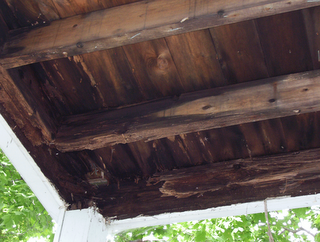
The original quote wasn't cheap but what drove it higher was the dry rot in the veranda ceiling. Can any one explain why dry rot is wet? Given that most of the supporting joists were more sponge than wood, it's a wonder I didn't fall through the floor last December while blithely decking the railings with boughs of holly! Of course, it may be that at -20 dry rot becomes rock solid ice rot. Memo to self: Put up this year's decorations a week earlier when you'll only get soaked through not frozen to the bone. Either way I'll probably get one of those colds that lingers through the entire winter.
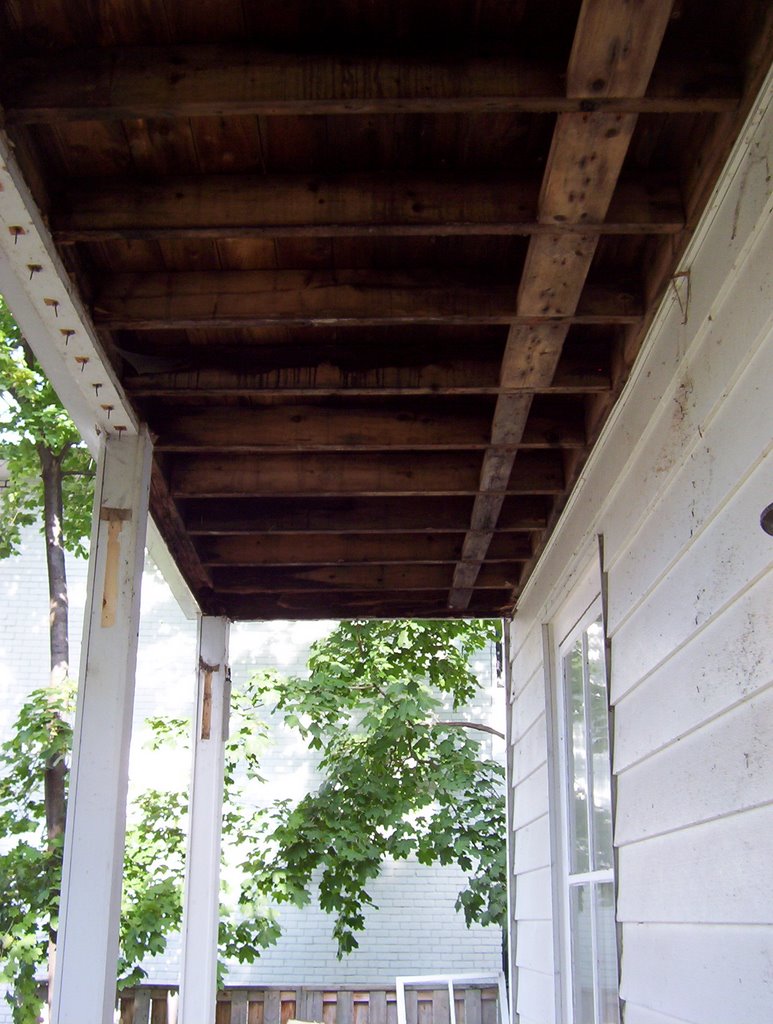
We were lucky to find a contractor who understood historical restoration and did an incredible job. Luc and his guys used as much of the existing material as they could - restoring gingerbread, adapting railings and recreating details. Unfortunately when they pulled off the veranda ceiling the above horror (a double click with give you an idea of the real extent of the disaster) was revealed. Luc gave me a choice between a completely new veranda at $4500.00 that would last for 30-
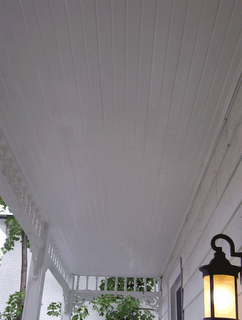
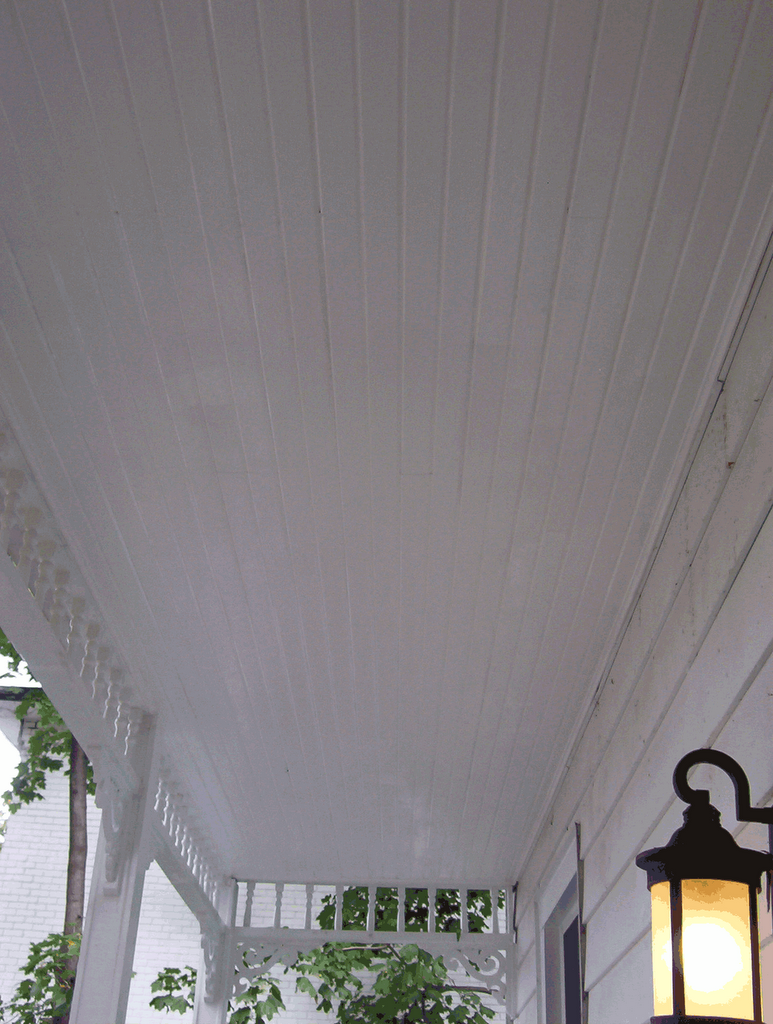
40 years or a solid repair job at $1600.00 that would last 20-25. The way I figured it 20-25 years from now I'll be in one room with a dresser, two chairs and a bed so the choice was an easy one. I must say the $1600.00 job looks like a million dollars. And the new windows and storm panels for the front dollar are perfect replicas of the original. Sadly that's the only problem when you restore a heritage home - all that work and money and the house looks just like it did before you started!
One word of advise to anyone thinking of buying a heritage home - and yes there are other fools out there who do that sort of thing: make sure you win a lottery and do it while you're young.
The original quote wasn't cheap but what drove it higher was the dry rot in the veranda ceiling. Can any one explain why dry rot is wet? Given that most of the supporting joists were more sponge than wood, it's a wonder I didn't fall through the floor last December while blithely decking the railings with boughs of holly! Of course, it may be that at -20 dry rot becomes rock solid ice rot. Memo to self: Put up this year's decorations a week earlier when you'll only get soaked through not frozen to the bone. Either way I'll probably get one of those colds that lingers through the entire winter.We were lucky to find a contractor who understood historical restoration and did an incredible job. Luc and his guys used as much of the existing material as they could - restoring gingerbread, adapting railings and recreating details. Unfortunately when they pulled off the veranda ceiling the above horror (a double click with give you an idea of the real extent of the disaster) was revealed. Luc gave me a choice between a completely new veranda at $4500.00 that would last for 30-
40 years or a solid repair job at $1600.00 that would last 20-25. The way I figured it 20-25 years from now I'll be in one room with a dresser, two chairs and a bed so the choice was an easy one. I must say the $1600.00 job looks like a million dollars. And the new windows and storm panels for the front dollar are perfect replicas of the original. Sadly that's the only problem when you restore a heritage home - all that work and money and the house looks just like it did before you started!One word of advise to anyone thinking of buying a heritage home - and yes there are other fools out there who do that sort of thing: make sure you win a lottery and do it while you're young.
Subscribe to:
Posts (Atom)