Sunday, June 03, 2012

Little Tricks of Nature

Last fall a plea went out from the Humane Society - I believe it was - for people to "foster" litters of squirrels that had been born late in the season. Apparently the early arrival of warm weather had encourage an unprecedented level of the sort of activity that guarantees an increase in the rodent population of our mighty metropolis. Though they aren't mentioned in Cole Porter's famous song apparently squirrels do do it - and last year they did it with a vengeance. And if proof were needed simply stepping out the back entrance to our building is all that's needed - and stepping out of the building with Nora guarantees that the presence of chattering, scampering black or gray rodents will be well noted - by half the neighborhood.

Offered with apologies to Quentin Tarantino.


Our Nora comes from a long line of hunters - as oft mentioned her mother, the lovely Lucy, is a champion boar hunter in Italy. And Nora has inherited all her mother's hunting instincts and the truly frightening hound howl that echoes many mornings across the Canal. Failing the presence of any great number of boars in the area our girl has decided that the pursuit of Sciurus carolinensis is a fair enough substitute. Many of our neighbours are in full support of her decision and would be more than thrilled should she succeed in "decreasing the surplice population".

However there is one gentleman who has made it his mission to show up every night at 1800 with bags of nuts which he distributes around the neighbourhood. Now whatever you say about squirrels - and believe me the people around here have much to say about squirrels, none of it printable in what is after all a family blog - they are bright little creatures. They know this gentleman will show up every evening and at 1800 precisely they appear lurking around the edges of the landscape like creatures in a Stephan King novel. Why spend all that time foraging when you know the nutty Good Humour man will be making his appointed rounds like clockwork.

And if further proof is needed of the intelligence of these ubiquitous pests this little scene caught my eye on Friday afternoon as I was walking home through Confederation Park.


Why do I honestly believe if the earth is flattened in one of those cataclysmic accidents beloved of Hollywood and young video game players that the only thing left will be ants, dandelions and... squirrels?

03 June - 1889 – The transcontinental Canadian Pacific Railway is completed.

Saturday, June 02, 2012

Time to Van Gogh


As I mentioned a few days ago the big "blockbuster" exhibition at the National Gallery for this summer is Van Gogh: Up Close - the first major showing of a collection of the Dutch post-impressionists paintings in Canada for 25 years.  The first time I saw a real Van Gogh would have been in the late 1950s - if my fading memory serves me right.   I vaguely remember lining up to shuffle - and in some case be shoved - passed some of his more famous works at the old AGO.  I do recall a flash of brilliant yellow and orange sunflowers until someone barked at me that "others wanna see the pictures too you know!" or at least that was the gist of the remark.  Ah the sophistication of Toronto in the 1950s.

The opening night of the current exhibition dragged that memory out of the fog of time as we joined the crowds gathering around the 40 paintings that have been culled from private and public collections from around the world.  It was difficult to appreciate the stated purpose of the exhibition to give us an "up close" view of his development - the volume of people meant you were either at a distance or really really close up.  I'll hold off on giving an opinion on it after a second - hopefully less crowded - visit in the next month or two.

Painted in Paris early in 1887 this is one of a series of canvases capturing the worn
footwear of a labourer.  The Cone Collection, Baltimore Museum of Fine Art  


But as so often happens I found that as lovely as the Iris and the Almond Blossom paintings are I was captivated by a still life Van Gogh completed in 1887 of a pair of old shoes.  Shoes were the subject of at least seven of his oils between 1886 and 1888.  Not the shoes of the ladies and gentleman of the salons but the worn, scuffed and oft mended shoes of labourers and workmen.  There have been lectures, dissertations and the odd thesis written about the meaning of these works.  Is Van Gogh using them as a metaphor for the wearing artistic road he has chosen?  Do the shoes symbolize the rough existence of the painter in an unappreciative world?  Or are they just a pair of shoes? Simply just another subject for a still-life?  What ever it is I found it one of the more interesting paintings in the exhibition.

Van Gogh purchased a number of woodcut prints in the dockyards at Antwerp and began to paint
copies of several of them including this one of The Plum Garden in Kameido.  I have to say that
I prefer the Hiroshige original(left) to the Van Gogh copy. I find he has turned something
that was light and has life into a dark, flat and ponderous vision.


100 Famous Views of Edo
Evening Shower at Atake
and the Great Bridge
Hiroshige - 1856-1856
Now I may just be being perverse but on first viewing I enjoyed two other related exhibits more than the major one.   With the opening of trade from Japan Ukiyo-e had begun to appear on the European scene at the time and Van Gogh had purchased a series of the stylized woodblock paintings that were to influence many of his works.  I had forgotten that the Royal Ontario Museum has an extensive collection of these pieces; thirty of them were on loan to the Gallery as illustrations of the style and their impact on the painter.  The majority of them were by the renowned and much revered 18th century artist Hiroshige - Van Gogh painted copies of several of the Japanese master's works.  My own feeling was that though it did accomplish its stated purpose - to illustrate their influence on Van Gogh  - this small exhibition was of such quality and interest that it could have stood very well on its own.


One of the thirty five small landscapes that Augustin Hirschvogel etched between 1545 and 1549.  This small jewel
is only 5.4 by 15.5 cms (2.126" by 6.102") but is filled with details that bring the scene to life.
Perhaps a little more obscure in purpose was a collection of graphics - etchings, pen and ink - from the National Gallery's own collection.  Many of the pieces on display are squirrelled  away in the archives of the Gallery - there just isn't enough space - and aren't often on display.  A lady beside mentioned that they can be viewed by arrangement with the gallery - which is perhaps a project for the future????  There were three in particular that immediately attracted me and that I must admit I spent more time in front of than anything else at the exhibition.   First and foremost was a small landscape by Augustin Hirschvogel - a tiny perfect view of a small town.  Hirschvogel was a member of the Danube School and is best known for a series of small landscapes he etched between 1545 and 1549.  I was fascinated by the detail that he achieved in a medium which he had only taken up in the last decade of his life.

Kolbe's The Cow in the Reeds is typical of his work - the vegetation takes on
gigantic proportions and dominates the scene almost overwhelming the resting cow.  Perhaps given all that
greenery the cow has decided she would be foolish to leave such abundant grazing.
Beside the Hirschvogel was a lovely study of St Jerome and the Lion amongst Ruins from the same period.  I haven't been able to track down anything about it either on the Gallery's website or through Google.  I will have to make another visit to find out more about it.  From a later period (1801) was an etching by Karl Wilhelm Kolbe, a German artist who seemed to have a bit of an obsession with cows.  A quick search revealed that his studies of various flora seemed to have cows as their fauna on more than one occasion.  I found The Cow in the Reeds which he did somewhere between 1800 and 1803 a delight.  It took a bit to find the cow but she is definitely there and seem quite quite contented.

During a bit of a hiatus in my work life at the beginning of July - more about that another time - I'll try and get back to the Gallery for a second more leisurely look.  But in the meantime I'm gearing up for the possibility of more Van Gogh's when I spend a few days in Amsterdam next week  - and more about that later.

02 June - 1846: Birth of the Italian Republic: In a referendum, Italians vote to turn Italy from a monarchy into a Republic.

Enhanced by Zemanta

Wednesday, May 30, 2012

Mercoledi Musicale

Back in 1972 the unlikely chart topper was a song based on the life and work of Van Gogh.  Don Mclean's Vincent, along with the eponymous song, was one of two hits from his album American Pie.

The album was dedicated to Buddy Holly and the title song has often been associated with that fatal plane crash that may well be thought of as "the day the music died".  Mclean himself has never been pinned down as to its meanings.  When asked once what it means he responded "It means I'll never have to work again."

Vincent was written as a tribute to the genius of both the painter and the man - someone who Mclean admired greatly.  The references to Van Gogh's works and life are many and have been catalogued in various places.


For some of us growing up in the early 70s those two songs had a resonance and a meaning that romanticized the loss of a defining artist and the belated recognition of a great one.   And I might ingenuously suggested that Starry Starry Night speaks more eloquently - and simply - of Van Gogh's work than many of the ponderous dissertations in catalogues and art magazines.

30 May - 1832: The Rideau Canal in eastern Ontario is opened.

Monday, May 28, 2012

Lunedi Lunacy

Last Thursday we went to the opening of Van Gogh: Up Close the exhibition that's intended to be this year's blockbuster at the National Gallery here in Ottawa. A retrospective it focuses on the flora that Van Gogh captured in his earlier years.  I'll be writing a bit about my own impressions of the first major show of Van Gogh's work in Canada in 25 years tomorrow but in the meant time here's a touch of lunacy.

On a trip to New York last week friend Cathy caught this take on one of the Dutch artist's more famous paintings:  The Starry Night.  Who knows maybe Van Gogh's inspiration was the result of a sugar rush brought on by one too many M&Ms????


And it reminded me of a wonderful exhibition in Chicago many years ago of the art of Chuck Jones, the brilliant American animator.  His company of mad-cap characters - Bugs, Elmer, Porky - sat for their portraits by the greats:  Whistler, Munch, Picasso, Chagall, Da Vinci, Lautrec and Van Gogh. And who better to be captured by the obsessive post-impressionist than that most obsessive of creatures Wile E. Coyote.


Obviously painted after the tragic events of December 1888 the look in Wile E.'s suggests that his obsession with his muse - much like Van Gogh's - had become even more "earie".

More about Chuck Jones and his work can be found at Chuck Redux - a fun blog with animations and art inspired by and influenced by the master animator.

28 May - 1934: Near Callander, Ontario, the Dionne quintuplets are born to Oliva and Elzire Dionne; they will be the first quintuplets to survive infancy.
Enhanced by Zemanta

Friday, May 25, 2012

Friday's Flowers

I grew up surrounded by lilacs; my father and brother had poured a concrete patio beside the house; it was under the shade of a huge weeping willow and protected on two sides by stands of lilacs. Well over 8 feet high even when weighed down with great clusters of purple flowers, on warm summer nights they filled the night air with an incredible scent - slightly reminiscent of the perfume my Grandmother favoured.


They also seemed to attract a great number of mosquitoes who felt that my person was the best dining venue in Alderwood. When I would come in - on those nights I was allowed to stay out with the family enjoying the night air - I would be covered in mosquito bites which then called for an application of a bit of lather from a bar of Lifeboy soap. In those days Lifeboy was a carbolic soap with a mild anti-bacterial power and, as far as I was concerned great healing powers - it did seem to take the sting out of those pesky bites. The fragrance of lilac mingled with the smell of carbolic soap is the Proustian Madeline of my childhood.


Fast forward to our first house in Hunt Club. It was a garden home with a patch of yard bounded by three townhouse walls and a cedar fence. It was basically hard clay, scrub grass and a small - almost Lilliputian - stone patio. But in the corner stood a lovely Persian lilac it was festooned with fragrant white blossoms. It was almost 12 feet high and by the time we moved out seven years later it was two stories high. But it almost wouldn't have had that chance to grow if one person - who shall remain nameless - had followed through on the plan to cut it down! Fortunately clearer minds - mine said he modestly - prevailed and it became a integral part of my small garden.  Hostas, lily of the valley and Solomon seals shared its shade with a cedar deck.  The rest of the garden was dotted with fox gloves, bergamot, daisies, campanella and a lovely hardy President Kekkonen rose bush surrounded a small waterfall illuminated by a stone Japanese lantern. The background was a cedar fence covered with Virginia creeper which glowed bright red in the waning days of fall. When I think back on those days in Hunt Club I hear the sounds of the waterfall, the glow of the lantern and the scent of lilac. Of all the gardens I have had I think it was that one that I created from clay and scrub that gave me the most pleasure and contentment.


All this to introduce today's flower - the lilac. Perhaps its just me being sentimental but I think Grandeville captured the very essence of that most gentle - but hardy - of flowers perfectly.


Someone was asking why I show multiple versions of the same print?  These were engravings that were coloured by hand and so from copy to copy there is a variation - sometimes in colouring, sometimes in shading, often in clarity because of differences in technique.  I find that often details missed in one can be found an another.  And also give the age of the books these were taken from  and the care given to them by the owners - some may be faded or discoloured which gives them, I think at least, an added dimension.


25 May - 1895: Playwright, poet, and novelist Oscar Wilde is convicted of "committing acts of gross indecency with other male persons" and sentenced to serve two years in prison.
Enhanced by Zemanta

Wednesday, May 23, 2012

Mercoledi Musicale

Last week I spoke about how classical artists have often "crossed-over" into the popular field and tenors seem to lead the field or at least in the 20th century. Enrico Caruso, John McCormack, Richard Tauber were famous tenors who in the first half of the last century acknowledged that popular tunes could be as profitable - if not more so - as operatic arias.  In fact McCormack pretty much deserted the operatic stage for the recording and radio studios.  And Tauber was a great favourite in Great Britain during the war and had his own radio broadcast as well as appearances in operetta and film.

One of my favourite - amongst so many - Jerome Kern songs is from his last show Very Warm for May.  The show flopped after a run of 59 performances and that despite one of the most engaging scores that Oscar Hammerstein and Kern had created over their 15 year collaboration.  For some reason Hammerstein would not allow the show to be revived but this song took on a life of its own and was sung by jazz singers, crooners, pop singers, cabaret performers and here by the wonderful Richard Tauber.


Tauber was an Austrian who had great success in both opera and operetta in Vienna and was famous for his Mozart roles at the Vienna State Opera.  However because of his Jewish ancestry he was forced to leave when Austria was annexed in 1938.  He left everything behind and with his wife sought refuge in Great Britain.  Despite tempting offers from the U.S. he was to become a British citizen and remained there until he death in 1947.

One of his greatest successes, both in Austria and the UK, was Lehar's The Land of Smiles but it also proved his financial downfall.  A New York production of the operetta in 1946 was a flop and he lost most of his money to the backers.  However after his death his widow as able to pay off the considerable debts with the royalties from his many British recordings.  One of his most popular recordings was the hit song from Lehar's story of the unhappy love between a Chinese Prince and a Viennese Countess.  Tauber was to record it both in German as Dein ist mein ganzes Hertz and many times in English as You Are My Heart's Desire.  He also included it in almost every concert he gave and this version is from a broadcast he did just before that unsuccessful American tour.


As bittersweet as tale told in Land of Smiles was Tauber's last appearance before his beloved English public.  In April 1947 he had returned from the disastrous trip to New York complaining of a persistent cough and was shortly thereafter diagnosed with lung cancer.  In September the Vienna State Opera visited London for a short season and invited him to sing Don Ottavio in a performance of Don Giovanni.  Reportedly on the evening of September 27 he sang with all the polish of yore and with an undiminished sweetness of tone that belie his failing health.  A week later he was to enter hospital but surgery was unsuccessful and he died in January of 1948. 

23 May - 1829: The patent for the Accordion is granted to Cyrill Demian in Vienna.

Enhanced by Zemanta

Tuesday, May 22, 2012

Lunedi Lunacy ... on Tuesday

Editorial cartoonist Matt Bors created this cartoon as a protest against the insipid cartoons that filled the pages of newspapers - both paper and virtual - after the death of Steve Jobs. Gives pause for thought doesn't it?


I found this over at  Bado's Blog - a great look at cartooning - political and more.


Matt Bors just won the 2012 Herblock Prize for Political Cartooning and more of his work can be seen at http://www.mattbors.com/

22 May - 334 BC – The Macedonian army of Alexander the Great defeats Darius III of Persia in the Battle of the Granicus.

Monday, May 21, 2012

Welcome to Canada

Queen Victoria (Charles Léandre,
Le Rire, June 12, 1897)
In the middle of the last century when I was a wee Willy - oh grow up the lot of you!!!! - today was known as Victoria Day and we celebrated the birthday of a Queen who had been dead for over 50 years. But as I wrote previously it was a time to assert our "Britishness" -  to fly our Union Jacks and show that we were loyal Monarchists through and through.  In 1953 - after the Coronation of Queen Elizabeth - it became the official day for observing the Queen's Birthday (though her birthday is actually April 21), up until then the Monarch's birthday had been a bit of a movable feast.   Now 50 years later it seems to be a day that has lost any Royal significance and has become better known as the "Let's Open the Cottage" weekend.

Back in 1951 as well as Victoria Day we had another occasion to show how true, blue and loyal we were and show it we did.  The young Princess Elizabeth and her husband came to Canada for a visit in October of that year.  For 33 days she toured Canada and included in that trip was a 48-km ride through the streets and boroughs of the Queen's City - Toronto.  As I recall we were given the day off school and little union jacks, red ensigns and buttons that proclaimed our welcome to the Princess and her Prince were distributed.

A few days ago while going through a drawer I came across two of those small buttons - long forgotten souvenirs of a childhood memory.   In all probability my mother had kept them and when I was cleaning out her apartment I found them and as now so then memories were revived and I put them away as a memento of an era that even in 1996 had been long past.  An era when like the young Princess we looked forward to the last half of the 20th century with optimisms and high expectations.

This image is much larger than the buttons we were given in 1951
- the actual button is about 1 1/2 inches across - the 25 year old Princess would have
had to have remarkable eyesight to see this Welcome on my lapel.
Ah well when you are 5 years old its the thought that counts.

Of course I don't remember the exact date or really the details but because it was October we must have dressed warmly for the trek up to the Queen Elizabeth Highway.  A 10 minute walk from our hose the QEW was the major highway (4 lanes! can you believe it?); it had been named after the Princess's  mother and dedicated on the Royal Visit in 1939.  I do remember that my mother and father took Teresa - our next door neighbour and my best friend - and I up to join the crowd that lined the road - our whole neighbourhood was there.  We were all waiting to greet the Princess - flags at the ready, buttons proudly displayed and hearts primed to show our future monarch how much we loved her and her Prince.  The motorcade moved passed us - we waved and cheered and behind the glass a small figure acknowledged us with a smile and a wave.   It was a fleeting moment but I knew then as I am as sure 51 years later that she waved and smiled right at me!

21 May - 1502: The island of Saint Helena is discovered by the Portuguese explorer João da Nova.

Friday, May 18, 2012

Friday's Flower


Being forced to learn Wordsworth's cloying little paean to that "jocund company" in grade school I should have reason enough to detest daffodils with a passion.  But you had to give old William his due,  he had it right - a bed of daffodils nodding and swaying in the breeze is a sight that does cause the heart to raise a few levels on the joyful scale.

What I hadn't realize until I did a bit of Googling that the daffodil is the same as  the narcissus is the same as the jonquil.  Nor did I know that it is highly toxic and though the most oft told derivation of its name comes from the Greek legend of a very lovely and vain young man it may also come from the Greek word narkao or "I grow numb", describing its narcotic properties.


The story that Delord tells and Grandville illustrates in Les fleurs animées recounts another tale of vanity but this time the vain one is a young Sicilian beauty spoken of as a warning to all young girls.


Sadly young Louis, a brave lad, a bold sailor and a kind comrade falls hopelessly in love with the vain beauty.  She leads him on and he soon sells all that he has to buy her the fine silks and gems that she demands - thinking only of how they will enhance her beauty not of the sacrifices her smitten lover has made to obtain them for her.  Eventually, having sold all he had, Louis becomes a brigand - robbing and "risking his soul's welfare in order to gratify the vain wishes of her heart."

The Governor sends a detachment of soldiers under the command of a handsome young corporal to deal with the robber and Louis is killed.  When the soldiers return Narcissa attempts to ensnare the young officer the way she had once ensnared poor Louis.  But the corporal is a man of the world and sees the emptiness beyond the beauty.


Rejected by her village Narcissa seeks refuge in a grotto by a holy stream high on the mountain of Monte-Negro.  But rather than weeping for her errors and repenting of her vanity she spends the day admiring her beauty in the waters of the stream.  One day a holy man climbed the mountain bent on exorcising the demons of vanity from the cold beauty.


A chilling warning - perhaps it is only in crowds that the lovely daffodil is "jocund company".

17 May -1152: Henry II of England marries Eleanor of Aquitaine.

Wednesday, May 16, 2012

Mercoledi Musicale

I am always amused when I read the horrified comments that greet "crossover" performances on the opera websites and blogs.   Now granted some of those performances do deserve a "What the hell was that suppose to be?" - a rather excruciating performance of I Could Have Danced All Night by a famous soprano springs to mind - but crossover is nothing new.  The great 19th century soprano Adelina Patti would often end not only her concerts but her operatic performances by performing Henry Bishop's Home Sweet Home even if it meant having a piano wheeled out on stage so she could play the accompaniment herself.   American soprano Eileen Farrell recorded four very successful albums of popular music in the 1950s and very few African-American singers omit a selection of spirituals either from their main programmes or as encores.

My darling Anna Caterina Antonacci appears to be carrying on the tradition and though she did not offer this as an encore at the concert in Rome, it appears it has become a fairly regular encore in her current programme. 


What I find as beautiful and touching  as Anna Caterina's quiet but intense delivery is the piano work of Donald Sulzen.   Nothing really elaborate, nothing show-offy in the accompaniment just a perfect match to the mood set by the soprano.  They really do have a remarkable partnership and again I am reminded of that most lauded of accompanist Gerald Moore.

16 May - 1943: Holocaust: The Warsaw Ghetto Uprising ends.
Enhanced by Zemanta

Monday, May 14, 2012

Lunedi Lunacy

Well this pretty much sums up the Canada I grew up it!!!!


I have to admit that I stole this from my friend Yellow Dog Granny but it was just too good not to steal!  That and the fact that it gives me the chance to tell all my Canadian readers - both of them - about a fun little project that several of us Canucks  (including D. over at She Who Seeks) have on the go.

Anyone who read YDG knows that West is the home of the infamous Skunk Egg but its also the home of the good residents of the West Rest Haven.  As well as her many other activities our YDG volunteers there running Jackie's Kitchen - a monthly taste treat that takes the gang on all sorts of culinary adventures. In June YDG decided to look no further than across the 49th parallel for a theme for the Kitchen and she's doing a Canadian themed day.  Now its difficult to pin down what actually is Canadian cuisine - poutine? tourtiere? fiddleheads? artic char?  We've had some problem with that one let me tell you.

If we can't identify a particularly Canadian food for the folks in West we decided at least we could share pictures of our home and native land with them.  So several of us have started a postcard campaign.  We're hoping for postcards from every Province and Territory.  So if you happen to someone that I haven't cornered written to about sending a card and would like to join us in saying "Hi  eh?" to our friends in West drop me a note at my e-mail and I'll send you the address.

Meanwhile I have to find my mother's old traditional recipe for poutine!!!!!

14 May - 1951: Trains run on the Talyllyn Railway in Wales for the first time since preservation, making it the first railway in the world to be operated by volunteers.

Enhanced by Zemanta

Sunday, May 13, 2012

Friday's Flower

I know that Friday was several days ago but it took time to gather a bouquet fine enough to present as a Mother's day offering to all my dear friends who deserve flowers that have been picked with care and thought.

I'm not sure if all the flowers dancing at Grandeville's Le Bal are May flowers but I think its a lovely illustration for Aubade*, Taxile Delorde's invocation to the first flowers of the spring as translated by Jeremiah Cleaveland.


This coterie of flowers has all the style and grace - and the tantalizingly exposed limbs -
of the coryphées from Le Ballet de l'Opéra de Paris who so enchanted
the wealthy gentlemen of the period.

We had several stalks of Campanule or Canterbury Bells in our first small garden
- they were always a favourite.  That dancer with the slightly manic look may have just
found out that her common English name is Lady's Ear Drop (Fuschia).


I love the French common name for Delphinium (Larkspur) - Pied d'alouette - which literally
translates as "the Lark's Foot".   The French has a very dance-like sound to it - perhaps it's
the term used in ballet for the dancing movement made by a stand of delphs.


Joining in the dance perhaps celebrating May and Mother's Day are the Muguet (Lily of the Valley),
the  Pyramidale (Bell Flower) and the Liseron (Morning Glory).  All those bell like flowers
dancing with such abandon must sound like a joyous carillon welcoming the warm weather and sun.

Overseeing the festivities is the regal Reine Marguerite- a little bit of serendipity
as my mother-in-law's favourite flower has always been the stately China Aster.
I only wish that she were able to once again enjoy their beauty.


So here's my Mother's Day bouquet and my wish that it may - like that first flower of the spring - indeed bring "good fortune for the rest of the year."

* This very old French word can mean a song or instrumental composition concerning, accompanying, or evoking daybreak or a poem or song about lovers separating at dawn.

13 May - 1995: 33-year-old British mother Alison Hargreaves became the first woman to conquer Everest without oxygen or the help of sherpas.

Saturday, May 12, 2012

The Bear That Went to War

Though it opened in May of 2005 somehow I had never made it to the new (well no longer new but as opposed to the former) Canadian War Museum.  I recall there was to-do about the original design but I do have to admit that Raymond Moriyama's building - rising as it does between the flat lands around LeBreton and the Ottawa River  - does make a rather spectacular statement.  I had not realized that the arrangement of the windows in the east facing fin spell out "Lest We Forget" and "N'oublions jamais"in Morris Code.

Originated in 1880 as a collection of artifacts from the wars fought on Canadian soil the CWM was eventually housed in the Cartier Square Drill Hall.  Officially established as a museum in 1942 it was moved to the Public Archives Building on Sussex Drive in 1967.  The growing collection finally found a new home in 2005 when Raymond Moriyama's building was dedicated on May 8, the 60th anniversary of the end of World War II.

The interior entrance space appears to be intended to give the impression of spaciousness but I found it mostly empty and cold.  By contracts the permanent exhibition areas seem cramped and confusing.  Laurent referred to it as being a bit like visiting an Ikea store - and he had a point.  Things seem overcrowded and several of the interactive exhibitions no longer appear to work.   Often items that could have been interesting if given more prominence were jammed into a corner or visually inaccessible.  A prim example was Hitler's parade car - rather than being able to walk around it or even having it on a turntable it was awkwardly position and lacked the dramatic impact that it could have had as a symbol of an oppressive dictatorship and the reason our boys were fighting in far-off Europe.  A very strange piece of curating!!!!!  Even the reconstruction of a World War I trench - though creating a claustrophobic and gloomy atmosphere - with a bit more imagination could have gone further in giving us a small taste of what the soldiers in that most doomed of wars faced.

That is not to say that the visit was not worthwhile - just that it could have been much more.  And as so often happens it was one tiny small exhibit that caught my eye and had me looking for the story behind the artifacts on display.

Lawrence Browning Rogers was born in Montreal in 1878 and after many attempts at a career turned to farming in the Cantons l'est.  He was to die in the second battle at Passchendaele in October of 1917.

In the spring of 1915 Lawrence Rogers, a farmer from East Farnham, enlisted with many other able-bodied men in the Canadian Mounted Calvary to serve for "King and Country" in the hostilities that had broken out in Europe.  After training in Valcartier his unit was shipped overseas and arrived in England in July of that year.  Lieut. Rogers was to serve as a medic in the trenches until his death on October 30, 1917.  Excerpts from letters he wrote home to his wife May reveal the hardships of training, the sea voyage, life in the trenches and the horrors of the wounded and dying.

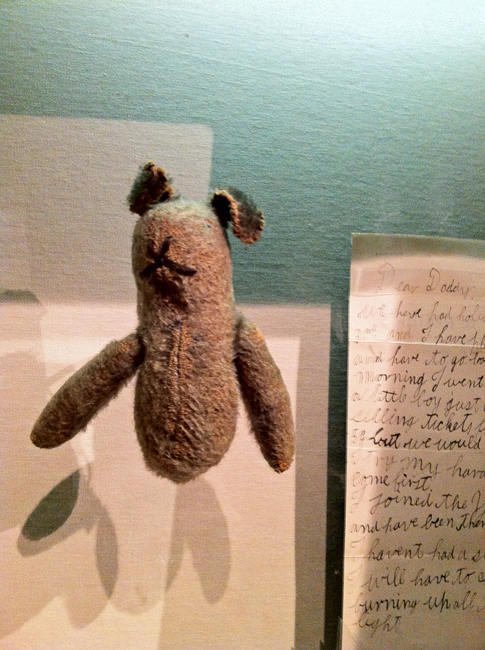
This tiny tattered and battered teddy bear accompanied Lieut. Rogers on his journey from boot camp to the front and was with him when he died.  He was returned to the family and now has a place of honour at the Canadian War Museum.

His story was much like so many others but what attracted me to it was the remnants of a tiny teddy bear that had gone through all those experiences with him.  As he was leaving for Europe his 10 year old daughter Aileen gave him the teddy to remind him of home, his family and her.  He carried it with him everywhere and it was found along with his wedding ring and letters amongst his personal effects when he died and as was the custom of the time they were sent back to his family.

The tattered teddy,  dirty and missing his back legs, could perhaps be thought to represent so many of the men and boys who returned from that "War to End All Wars" broken in body and often in spirit.  Men who likely had tiny reminders of home in their kit bags and letters such as the one from Rogers's seven year old son Howard that is on display along with the teddy bear.

The seven year old Howard recounts his holidays and other events in a world thousands of miles away from the mud and filthy of the trenches.  Perhaps his mother helped him write his letter but it still a rather fine piece of writing for a seven year old. 

I haven't been able to decipher the date on the letter but it sadly reached the front a few days after Roger's death at Passchendaele.  He didn't get to read young Howard's recounting of the day to day events in his little corner of the Empire that his father was defending.
Dear Daddy
We have been on holidays since the
3rd and I have played all the time
and have to go back to-morrow
morning. I went to the movies twice.
A little boy just came to the door
selling tickets for some movies at
5¢ but we would not take one.
I try my hardest at school to
come first.
I joined the Y.M.C.A.
and have been there twice at gym.
I haven't had a swim yet.
I will have to close as I am
burning up all the electric
light.
More than anything else on display these three small things - a picture, a teddy and a letter - spoke to me of  the First World War and Canada's part in it.  And it brought to mind the moving and remarkable final sequence* of Richard Attenborough's Oh What A Lovely War


A more detailed account of Lieut. Rogers, his family and teddy can be found at A Bear at War.  It gives a very human face to the Great War and the men who fought in it and their families back home in Canada.

*This was not trick photography but a sequence filmed from a helicopter - each of the 100,000 crosses had to be inserted in hand-dug holes in the chalky soil of the South Downs.

12 May - 1364: Jagiellonian University, the oldest university in Poland, is founded in Kraków.


Enhanced by Zemanta

Food For ..... Thought?????

It was once referred to by critic Haskel Frankel as “one of the funniest, most sensual scenes ever put on film without removing one stitch of clothing.”;  the famous - or infamous depending on your point of view - "eating scene" from Tom Jones is a classic of improvisation.  Featuring Albert Finney, a lobster, a joint of beef, several oysters and the ribald reactions of the Irish-Anglo actress Joyce Redman it still raises a laugh and the occasional eyebrow today.

In an interview in 2000 Finney recounted the filming: “Joyce and I had done theatre together.  And we just played it for fun. It was filmed early in the morning, and it took hours. They kept bringing more food — trying us out on different dishes. They’d say things like, ‘Bring more oysters. She’s very good on oysters.’ ” He added: “We weren’t sure the audience would get it at all. It seems they did.”


The diminutive actress died earlier today at her home in Kent - she was 93 and had last appeared on stage at the National Theatre in 1997 with Judi Dench in Amy's Way.  Her last film appearance was in 2001 as the elderly Queen Victoria in Victoria and Albert

She was primarily know for her stage work particularly at the National Theatre during its founding years under Laurence Olivier.   She was an actress of remarkable range - from Shakespeare (holding her own in the iconic Othello with Olivier and Maggie Smith  ) - to the Restoration and on to modern works - her Juno Boyle in Juno and the Paycock was acknowledge as one of the landmark performances in those early seasons at the National.

I saw her on stage during a heady week in Toronto when the National Theatre brought us a season of three plays and a company that included Olivier, Geraldine McEwan, Edward Hardwicke, Robert Lang, Anthony Nicholls, Madge Ryan, Graham Crowden and John Stride.  The three plays highlighted the versatility of Olivier's company at the time.  McEwan, Lang and Olivier in a savage Dance of Death - Strinburg's discetion of a marriage; the whole company in fine farcical form in Faydeau's A Flea in Her Ear (to this day one of the greatest examples of French farce I have ever seen); and finally in Congreve's Love for Love.

It was in the later that Miss Redman shone the brightest as a money-grubbing high born lady of limited means.  It was also the occasion for one of the finest "dry-ups" I have every seen on stage.  She and Olivier (as the screamingly foppish Mr Tattle) were exchanging barbs when things came to a stand-still.  There was an audible prompt from stage left - nothing - a slightly louder prompt - still nothing.  Finally in that husky voice - and not quite out of character - she flicked her fan and barked "I can't hear you!".  The line came, she tapped her chin with the fan and flicking it open rasped "Ah yes!" and unflustered continued the scene.  We all knew what had happened but somehow it didn't break of the mood - in fact if anything it played off it.  In that moment there was not doubt that we were watching consummate artists plying their craft.

 May 12 - 1551: National University of San Marcos, the oldest university in the Americas, is founded in Lima, Peru.


Enhanced by Zemanta