November 10 - 1975: The 729-foot-long freighter SS Edmund Fitzgerald sinks during a storm on Lake Superior, killing all 29 crew on board.
Showing posts with label First World War. Show all posts
Showing posts with label First World War. Show all posts
Monday, November 10, 2014
Lunedi Lunacy
In Oh What a Lovely War director Richard Attenborough captured the lunacy that was the 1914-1918 War. The bumbling ineptitude of men like Douglas Haig, John French and William Robertson in sending men to certain death using outdated methods of engagement for minimal gains is brought home in subtle and sometimes not so subtle ways. The Aussie allies in this little clip are not impressed with their Allied Commanders.
November 10 - 1975: The 729-foot-long freighter SS Edmund Fitzgerald sinks during a storm on Lake Superior, killing all 29 crew on board.
November 10 - 1975: The 729-foot-long freighter SS Edmund Fitzgerald sinks during a storm on Lake Superior, killing all 29 crew on board.


Monday, August 04, 2014
The Animals of War
Though the first shots were fired on July 28, 1914 the declarations of a war that was to bring about the downfall of four Imperial powers, change the map of Europe and destroy the lives of millions were not issued until August 3 and 4th. Until that point the tensions that had arisen from the entirely serendipitous assassination of Archduke Franz Ferdinand and his wife Sophie had been more like a family squabble than the prologue to a devastating war that would resound into our current century. It was only going to last a few weeks but by November of the same year the editor of the Canadian magazine Maclean's wrote, "Some wars name themselves. This is the Great War."
As a nation Canada's first overseas war had been the Second South African War (the Boer War) in 1899; Canada sent troops but the country was bitterly divided along political and provincial lines about joining the conflict. At the outset Sir Wilfred Laurier, the Prime Minister at the time, sent 1000 soldiers to support the Mother Land; ultimately over 7000 Canadians were to serve in that far away war and 267 were to die.
The dead and lost of that war are remembered in monuments throughout the country - the one in Confederation Park in Ottawa was erected within months of the end of the conflict. But it took almost a century (2012) before another troop of heroes from the Boer War and their successors in the First and Second World Wars were to be remembered: the animals in war.
Fittingly the Animals in War Dedication was installed next to the South African War memorial in Confederation Park. Canada supplied over 50,000 horses for the mounted troops of the combined Commonwealth cavalry in our first international conflict as a nation. When Britain declared war on Germany one hundred years ago today Canada was automatically brought into the conflict. The Canadian Expeditionary Force was as volunteer army - conscription was not introduced until 1917 - and first wave of men left Val Cartier in October of 1914 eager to fight "the hun". Along with them went dogs, horses and mules to once again give support.
The footprints of dogs, mules and horses heading into the battlefield are imprinted in the concrete slabs that from the base of the memorial. Mules carried panniers and artillery; Horses carried mounted troops and hauled field guns; Carrier pigeons delivered messages to specific destinations; and Dogs were used as messengers, medical assistants, bomb detectors, and search and rescue workers. Even the lowly glowworm served as a source of light for reading maps in the trenches. They all left their mark on the battlefield and often in the hearts of their human comrades.


This life-sized statue of a medical service dog stands guard over the Dedication. She is wearing an authentic rendering of a medical backpack that dogs carried in the First World War.


A few years ago I posted an item on the Animals in War Monument in London which Lloyd Swick credits with planting the seed of a like monument here in Ottawa. Though perhaps not as impressive as its London counterpart I find it a fitting tribute to the animals who - as we are reminded on the London memorial - had no choice.
A click on the image below will take you to the website of the Animals in War Dedication which has a wealth of information and stories of the "Beasts of War".

August 4 - 70: The destruction of the Second Temple in Jerusalem by the Romans.
As a nation Canada's first overseas war had been the Second South African War (the Boer War) in 1899; Canada sent troops but the country was bitterly divided along political and provincial lines about joining the conflict. At the outset Sir Wilfred Laurier, the Prime Minister at the time, sent 1000 soldiers to support the Mother Land; ultimately over 7000 Canadians were to serve in that far away war and 267 were to die.
 |
| In 1902 the school children of Ottawa contributed their pennies to pay for a Memorial to citizens of Ottawa who lost their lives in the Second South African War (1899-1902). It was the first time that the Canadian military were involved in a foreign conflict and it caused deep divisions within the country. Of the 7000 Canadians (including many nursing sisters) who fought 267 died; amongst them the 16 volunteers from Ottawa whose names are on the memorial. |
 |
| Dedicated in November 2012 this wonderful memorial to Animals in War in Confederation Park was created by David Clendining, a local sculptor. The three rocks, each bearing a bronze plaque rest on a concrete bases imprinted with paw and hoof prints. A medical assistance dog stands guard over the memorial - quiet but vigilant: devoted to his task. |
 |
For centuries, animals have demonstrated an enduring partnership with humans during times of war.They have served as means of transportation, beasts of burden, messengers, protectors and mascots.Still today, dogs use their unique, sharply tuned instincts to detect mine clusters, and conduct search and rescue operations. We remember the contribution and sacrifice of all animals.
 |
 |
Relentless shelling in the First World War (1914-1918) left huge craters of mud and sewage. Horses and mules could best navigate these difficult conditions to supply the front and evacuate the wounded.
 |
At the high school I attended in Winnipeg, there was a large World War I depiction, a painting that hung on the walls. One image was etched indelibly into my mind: teams of horses and mules, eyes inflamed with fear, straining on their harness as they and their human comrades, with their shoulder to the wheel, struggled to free supply wagons stuck in shell holes full of mud.Lloyd Swick
Animals in War Dedication Project
Horses carried soldiers, and pulled gun carriages, supply wagons and ambulances. Many paid the ultimate price and their loss was mourned by those they served.
 |
| This detail is modeled after a painting by Fortunino Matania: Goodbye Old Man |
There was another painting that hung on that high school wall which was stunning in the emotion it evoked – it remained in my mind throughout all these years. It has served as an inspiration for the design of the War Animals Dedication Project.
An artist, Fortunio Matania, had been sent to Menin, Belgium to capture the meaning of war. This portrayal was the result. Aptly entitled “Goodbye Old Friend,” it showed a gunner knelt down, holding the head of his horse in his lap, bidding his comrade farewell. The horse is mortally wounded and awaits death. Imagine the anguish felt by the gunner, being forced to shoot his companion with whom he shared the hardships of war; a companion with whom he had developed a close bond of friendship, trust, loyalty and admiration. I had read one account of war, where an entire battery, about 150 strong, filed by and kissed their dying horse. Obviously the horse must have been loved and served the battery faithfully over the years.
Lloyd SwickAnimals in War Dedication Project
 |
 |
A click on the image below will take you to the website of the Animals in War Dedication which has a wealth of information and stories of the "Beasts of War".
August 4 - 70: The destruction of the Second Temple in Jerusalem by the Romans.
Saturday, May 12, 2012
The Bear That Went to War
Though it opened in May of 2005 somehow I had never made it to the new (well no longer new but as opposed to the former) Canadian War Museum. I recall there was to-do about the original design but I do have to admit that Raymond Moriyama's building - rising as it does between the flat lands around LeBreton and the Ottawa River - does make a rather spectacular statement. I had not realized that the arrangement of the windows in the east facing fin spell out "Lest We Forget" and "N'oublions jamais"in Morris Code.
The interior entrance space appears to be intended to give the impression of spaciousness but I found it mostly empty and cold. By contracts the permanent exhibition areas seem cramped and confusing. Laurent referred to it as being a bit like visiting an Ikea store - and he had a point. Things seem overcrowded and several of the interactive exhibitions no longer appear to work. Often items that could have been interesting if given more prominence were jammed into a corner or visually inaccessible. A prim example was Hitler's parade car - rather than being able to walk around it or even having it on a turntable it was awkwardly position and lacked the dramatic impact that it could have had as a symbol of an oppressive dictatorship and the reason our boys were fighting in far-off Europe. A very strange piece of curating!!!!! Even the reconstruction of a World War I trench - though creating a claustrophobic and gloomy atmosphere - with a bit more imagination could have gone further in giving us a small taste of what the soldiers in that most doomed of wars faced.
That is not to say that the visit was not worthwhile - just that it could have been much more. And as so often happens it was one tiny small exhibit that caught my eye and had me looking for the story behind the artifacts on display.
In the spring of 1915 Lawrence Rogers, a farmer from East Farnham, enlisted with many other able-bodied men in the Canadian Mounted Calvary to serve for "King and Country" in the hostilities that had broken out in Europe. After training in Valcartier his unit was shipped overseas and arrived in England in July of that year. Lieut. Rogers was to serve as a medic in the trenches until his death on October 30, 1917. Excerpts from letters he wrote home to his wife May reveal the hardships of training, the sea voyage, life in the trenches and the horrors of the wounded and dying.
His story was much like so many others but what attracted me to it was the remnants of a tiny teddy bear that had gone through all those experiences with him. As he was leaving for Europe his 10 year old daughter Aileen gave him the teddy to remind him of home, his family and her. He carried it with him everywhere and it was found along with his wedding ring and letters amongst his personal effects when he died and as was the custom of the time they were sent back to his family.
The tattered teddy, dirty and missing his back legs, could perhaps be thought to represent so many of the men and boys who returned from that "War to End All Wars" broken in body and often in spirit. Men who likely had tiny reminders of home in their kit bags and letters such as the one from Rogers's seven year old son Howard that is on display along with the teddy bear.
I haven't been able to decipher the date on the letter but it sadly reached the front a few days after Roger's death at Passchendaele. He didn't get to read young Howard's recounting of the day to day events in his little corner of the Empire that his father was defending.
A more detailed account of Lieut. Rogers, his family and teddy can be found at A Bear at War. It gives a very human face to the Great War and the men who fought in it and their families back home in Canada.
*This was not trick photography but a sequence filmed from a helicopter - each of the 100,000 crosses had to be inserted in hand-dug holes in the chalky soil of the South Downs.
12 May - 1364: Jagiellonian University, the oldest university in Poland, is founded in Kraków.

 |
| Originated in 1880 as a collection of artifacts from the wars fought on Canadian soil the CWM was eventually housed in the Cartier Square Drill Hall. Officially established as a museum in 1942 it was moved to the Public Archives Building on Sussex Drive in 1967. The growing collection finally found a new home in 2005 when Raymond Moriyama's building was dedicated on May 8, the 60th anniversary of the end of World War II. |
The interior entrance space appears to be intended to give the impression of spaciousness but I found it mostly empty and cold. By contracts the permanent exhibition areas seem cramped and confusing. Laurent referred to it as being a bit like visiting an Ikea store - and he had a point. Things seem overcrowded and several of the interactive exhibitions no longer appear to work. Often items that could have been interesting if given more prominence were jammed into a corner or visually inaccessible. A prim example was Hitler's parade car - rather than being able to walk around it or even having it on a turntable it was awkwardly position and lacked the dramatic impact that it could have had as a symbol of an oppressive dictatorship and the reason our boys were fighting in far-off Europe. A very strange piece of curating!!!!! Even the reconstruction of a World War I trench - though creating a claustrophobic and gloomy atmosphere - with a bit more imagination could have gone further in giving us a small taste of what the soldiers in that most doomed of wars faced.
That is not to say that the visit was not worthwhile - just that it could have been much more. And as so often happens it was one tiny small exhibit that caught my eye and had me looking for the story behind the artifacts on display.
 |
| Lawrence Browning Rogers was born in Montreal in 1878 and after many attempts at a career turned to farming in the Cantons l'est. He was to die in the second battle at Passchendaele in October of 1917. |
In the spring of 1915 Lawrence Rogers, a farmer from East Farnham, enlisted with many other able-bodied men in the Canadian Mounted Calvary to serve for "King and Country" in the hostilities that had broken out in Europe. After training in Valcartier his unit was shipped overseas and arrived in England in July of that year. Lieut. Rogers was to serve as a medic in the trenches until his death on October 30, 1917. Excerpts from letters he wrote home to his wife May reveal the hardships of training, the sea voyage, life in the trenches and the horrors of the wounded and dying.
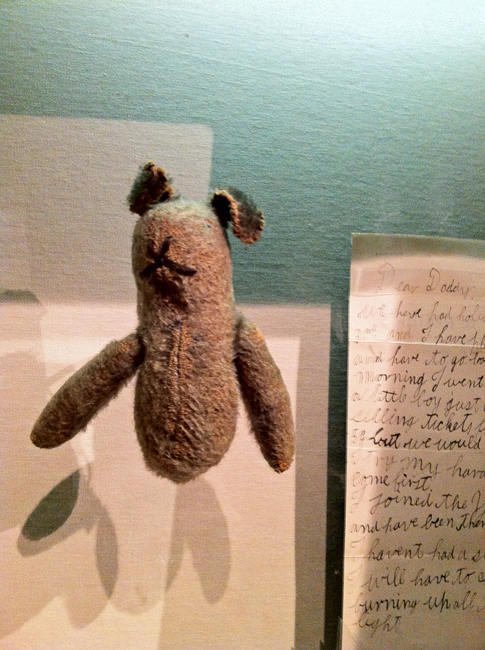 |
| This tiny tattered and battered teddy bear accompanied Lieut. Rogers on his journey from boot camp to the front and was with him when he died. He was returned to the family and now has a place of honour at the Canadian War Museum. |
His story was much like so many others but what attracted me to it was the remnants of a tiny teddy bear that had gone through all those experiences with him. As he was leaving for Europe his 10 year old daughter Aileen gave him the teddy to remind him of home, his family and her. He carried it with him everywhere and it was found along with his wedding ring and letters amongst his personal effects when he died and as was the custom of the time they were sent back to his family.
The tattered teddy, dirty and missing his back legs, could perhaps be thought to represent so many of the men and boys who returned from that "War to End All Wars" broken in body and often in spirit. Men who likely had tiny reminders of home in their kit bags and letters such as the one from Rogers's seven year old son Howard that is on display along with the teddy bear.
 |
| The seven year old Howard recounts his holidays and other events in a world thousands of miles away from the mud and filthy of the trenches. Perhaps his mother helped him write his letter but it still a rather fine piece of writing for a seven year old. |
I haven't been able to decipher the date on the letter but it sadly reached the front a few days after Roger's death at Passchendaele. He didn't get to read young Howard's recounting of the day to day events in his little corner of the Empire that his father was defending.
More than anything else on display these three small things - a picture, a teddy and a letter - spoke to me of the First World War and Canada's part in it. And it brought to mind the moving and remarkable final sequence* of Richard Attenborough's Oh What A Lovely War.Dear Daddy
We have been on holidays since the
3rd and I have played all the time
and have to go back to-morrow
morning. I went to the movies twice.
A little boy just came to the door
selling tickets for some movies at
5¢ but we would not take one.
I try my hardest at school to
come first.
I joined the Y.M.C.A.
and have been there twice at gym.
I haven't had a swim yet.
I will have to close as I am
burning up all the electric
light.
A more detailed account of Lieut. Rogers, his family and teddy can be found at A Bear at War. It gives a very human face to the Great War and the men who fought in it and their families back home in Canada.
*This was not trick photography but a sequence filmed from a helicopter - each of the 100,000 crosses had to be inserted in hand-dug holes in the chalky soil of the South Downs.
12 May - 1364: Jagiellonian University, the oldest university in Poland, is founded in Kraków.
Subscribe to:
Posts (Atom)