I've been going through a whole pile of unpublished posts, some dating back to 2008, realizing that a goodly number should just be deleted, others are dated, others kept as examples of good ideas badly executed and then maybe a few that I could complete and post. This entry was originally intended to be published this past January as I was heading over to London but packing and, as I recall, a technical glitch waylaid it. What called it to mind is a remarkable slide show on the BBC website of paintings by Clarkson Stanfield.
January 13, 2012 - 1910: The first public radio broadcast takes place; a live performance of the opera Cavalleria rusticana is sent out over the airwaves from the Metropolitan Opera House in New York, New York.
I'm heading off to London tonight - it will be tomorrow I guess by the time this is posted - to take part in an English tradition that goes back 300 years - the Christmas pantomime. Anyone who has followed this blog will know that I don't mean the "walking against the wind" "trapped in an glass cage" stuff that you see in the summer from buskers who think they are Marcel Marceau. Pantomime or better yet Panto is that particular form of British entertainment that began when
John Rich introduced the characters of Harlequin and company to the London theatre public in 1717.
What started off as "low opera" or intermezzi became a very specific form of full length entertainment that has evolved over the past three centuries, changed with the times and tastes, gone through bad periods and now seems to be on a new high. For many years here in Ottawa we were visited each Christmastide by pantos produced in England by Tudor Davies and brought lock, stock and Dame from England. Then Ross Petty took over and gave us amongst others a very memorable
Aladdin. But now it seems the only Christmas entertainment we get is another version of
The Nutcracker. So off I go to London to get my dose of panto for this year - and to see Dame Edna Everage in her debut as The Fairy of London in
Dick Whittington. She is one of many "stars" appearing throughout the British Isles in some 120 odd pantos being produced this year.
 |
| The London audiences of the 1828-29 Panto season were treated to an entertainment in the old "Grimaldi" tradition with not one but three Harlequins, a clown, Pierrot, Mr Stanfield's Grand Moving Picture and "the Surprising Foreign Dwarf". All that preceded by a drama and a satirical piece. A very full evening indeed. |
Though there have always been "stars" in panto - John Rich, Joey Grimaldi, Dan Leno, Vesta Tilley, Herbert Campbell, Norman Wisdom, Julie Andrews, Cliff Richard (Cliff Richard???) - there was a period when audiences came not just for their favourites but for the processions, patriotic tableaux, transformation scenes and stage spectacle. During the glories days at Drury Lane it was not unknown for a stage designer to take a bow on opening night after his latest creation had been unveiled particularly if that designer was
Clarkson Stanfield and he had just produced one of his remarkable dioramas or moving panoramas.
 |
| We are assured that "Stanfield's Grand Moving Picture" was "the whole painted by Mr Stanfield from sketches made by himself". It was a grand tour that took his audience from Spithead to Constantinople. |
According to a playbill - one of the four (I've posted items about the other three
here) that have been in my various homes for the past 40 odd years - for
The Queen Bee or Harlequin and the Fairy Hive, the Drury Lane Christmas panto in 1828-29, Stanfield created a moving picture that took the viewers on a sea voyage from "Spithead at Sunrise" through the Straits of Gibraltar and ending with a "Grand View of Constantinople".
 |
| Gibraltar - seen from two perspectives in the top and middle paintings - was a favourite subject for Clarkson Stanfield's brush as were stormy seas such as this one buffeting the Dogana and Santa Maria della Salute in Venice. Perhaps this is not so unusual given that his early life was spent at sea as a "press ganged" member of the Royal Navy. Stanfield abandoned scenery painting after the Drury Lane panto in 1834 and devoted his time to easel painting. |
En-route the, no-doubt astounded, audience witnessed the Cowes Regatta and according to the playbill saw the entire "Turkish Squadron". It is difficult to see how this fit in with the preceding or succeeding locations but logic wasn't necessary in a panto so why not go from Constantinople to "A Village near London". And keep in mind that this was only Scene 13 of 17 of the third piece on the bill for the evening of January 20, 1829. The audience had already seen a drama entitled
Charles the Tenth and Sheridan's satire
The Critic. It was a full evening's entertainment.
 |
| The principle behind the diorama or moving panorama was a one - a grand painted canvas tracing one continuous scene unrolled across the width of the that unrolled across the width of the stage and allowed characters to made |
Of his scenic display that year the Times of London wrote:
When our memory glances back a few years and we compare in "the mind's eye", the dingy, filthy scenery which was exhibited here - trees, like inverted mops, of a brick-dust hue - buildings generally at war with perspective - water as opaque as the surrounding rocks, and clouds not a bit more transparent - when we compare these things with what we now see, the alteration strikes us as nearly miraculous. This is mainly owing to Mr. Stanfield. To the effective execution of the duties belonging to the scenic department, he brought every necessary qualification - a knowledge of light and shade which enabled him to give to his scenes great transparency and a ready and judicious taste for composition, whether landscape, architecture or coast, but more especially for the last . . . His present scene is fully equal - in some parts superior - to any thing he has heretofore done ... The view of Lord Nelson's ship the Victory, is the most gorgeous specimen of naval architectural painting that we ever saw ... The view of Gibraltar, bristling with fortifications is uncommonly fine. It exhibits an extent of space ... and a grandeur of elevation which seem to say "I am invulnerable".
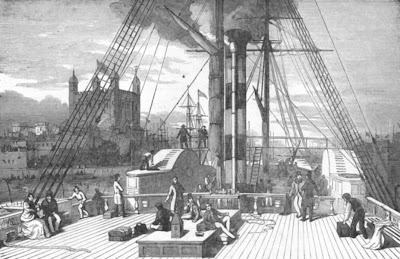 |
| The voyage of the John Bull was followed in this diorama as it set out from London, past the Tower and onward to Europe. The various locales rolled behind the set piece of the ship as the passengers, and no doubt the audience, expressed pleasure and surprise at the vistas opening up to them. |
First introduced into panto in 1820 at Covent Garden the moving panoramas consisted of a large canvas - Stanfield's design for Zoraster at Drury Lane was 482 feet long - rolled horizontally between two cylinders across the upstage area. A diorama - like the one Stanfield produced in 1828 - was similar but produced a three dimensional effect with two painted, cut-out and sometimes transparent canvases place one in front of the other. This allowed for further elements like the yachts in the Regatta to be moved between the two. It was a triumph of the scene painters' illusionary art wedded with modern gas lighting and stage machinery.
To show how little some things have changed the panto I saw in Wimbledon, Dick Whittington
, included a moving panorama that took us with the eponymous hero under the sea. It wasn't painted canvas but projected and in line with modern trends and technology we donned Dame Edna glasses to witness the wonders of the deep in 3D. Who says panto isn't modern and up to date????
07 September - 1911: Guillaume Apollinaire is arrested and put in jail on suspicion of stealing the Mona Lisa from the Louvre museum.


